The Australian peptide community comprises university research groups, contract synthesis labs, accredited testing facilities, and professional networks that produce and verify research-grade peptides for scientific use. For U.S. researchers, it represents a credible source of high-purity compounds and collaborative expertise, provided you clear two non-negotiable checkpoints before ordering:
- Verification minimum: Request a batch-specific Certificate of Analysis (COA) with HPLC chromatogram and MS identity confirmation. Accept nothing less than ≥95% purity for standard research-grade material; aim for ≥98% or ≥99% for impurity-sensitive or clinical/therapeutic assays.
- Compliance checkpoint: Confirm the compound's TGA scheduling status and secure U.S. institutional approvals (IACUC/IRB, IBC) plus a Material Transfer Agreement (MTA) before any shipment crosses the border.
If you need a verified starting point, Peptasticlabs offers independently tested compounds with COAs on request, or verify equivalent documentation from any accredited domestic supplier before committing to an order.
Table of Contents
- What the Australian peptide community is and why it matters
- Regulatory and compliance checks every U.S. researcher must run
- How to verify peptide quality before accepting a batch
- Practical steps for sourcing, ordering, and shipping from Australian partners
- How U.S. researchers can engage with the Australian peptide community
- Peptasticlabs: trust signals for U.S. researchers evaluating a supplier
- Key Australian peptide research institutions and experts
- Australian peptide conferences relevant to U.S. researchers
- Intellectual property considerations when collaborating with Australian entities
- Communication and cultural practices that improve collaboration
- Key Takeaways
- Peptasticlabs: verified research-grade peptides, ready to order
- Useful sources and references
What the Australian peptide community is and why it matters
The ecosystem spans four distinct actor types. University research groups at institutions such as the University of Queensland and the Australian National University publish peptide synthesis and characterization work, making them natural collaboration targets. Contract synthesis labs operate under Good Manufacturing Practice (GMP)-adjacent standards and produce solid-phase peptide synthesis (SPPS) batches for external clients. Accredited testing laboratories, certified to ISO/IEC 17025 or the National Association of Testing Authorities (NATA) equivalent, provide independent HPLC and MS verification. Conference organizers and professional forums complete the picture, connecting suppliers, analysts, and academic researchers.
Typical outputs from this community include research-grade peptides with full COA packages, standard operating procedures (SOPs) for storage and reconstitution, MTA templates, and peer-reviewed publications. The critical distinction for procurement is between regulated research suppliers, who publish batch documentation and comply with TGA classifications, and commercial or personal-use websites that operate in grey-area markets without equivalent accountability.
Regulatory and compliance checks every U.S. researcher must run
Act on scheduling status first. The TGA has actively scheduled peptides into Schedule 4 (prescription-only) and, in some cases, Schedule 9 (prohibited), and enforcement is ongoing. BPC-157 is one documented example of a compound that moved from unscheduled to scheduled, triggering import referrals and seizures.
Before placing any order, confirm each item on this checklist:
- TGA scheduling status: Check the Australian Register of Therapeutic Goods (ARTG) and current scheduling decisions for the specific compound.
- U.S. institutional approvals: IACUC or IRB approval for animal or human-subject work; IBC sign-off if the compound triggers biosafety review.
- MTA: Required whenever biological materials or IP-bearing samples are exchanged between institutions.
- Supplier compliance: Confirm the supplier labels product as Research Use Only (RUO) and does not market it for therapeutic human use.
- Special Access Scheme (SAS): Determine whether a clinical or compassionate-use pathway applies to the compound in question.
- Documentation package: COA, Safety Data Sheet (SDS), batch/lot traceability, third-party MS and HPLC reports, and declared storage and transport conditions.
Regulatory bodies and industry experts advise verifying documentation through NATA-equivalent or third-party accredited sources rather than relying on vendor claims alone. Online testimonials and unverified lab reports do not substitute for accredited documentation.
Pro Tip: TGA scheduling trends toward greater restriction. A compound unscheduled today may be reclassified within your study timeline. Build a reclassification check into your annual procurement review, not just the initial order.
Enforcement consequences are real. Australian Border Force actively intercepts scheduled peptide shipments, and regulatory penalties for advertising and distributing unapproved products have included significant fines. Treat supplier advertising claims with caution and verify documentation independently.
How to verify peptide quality before accepting a batch
Require a batch-specific COA with HPLC purity and MS identity as the baseline. Quality guidance sets ≥95% as the floor for research-grade material; therapeutic or impurity-sensitive work typically requires ≥98% or ≥99%. Peptasticlabs independently tests its catalog compounds to ≥99% HPLC purity, with COAs available on request.
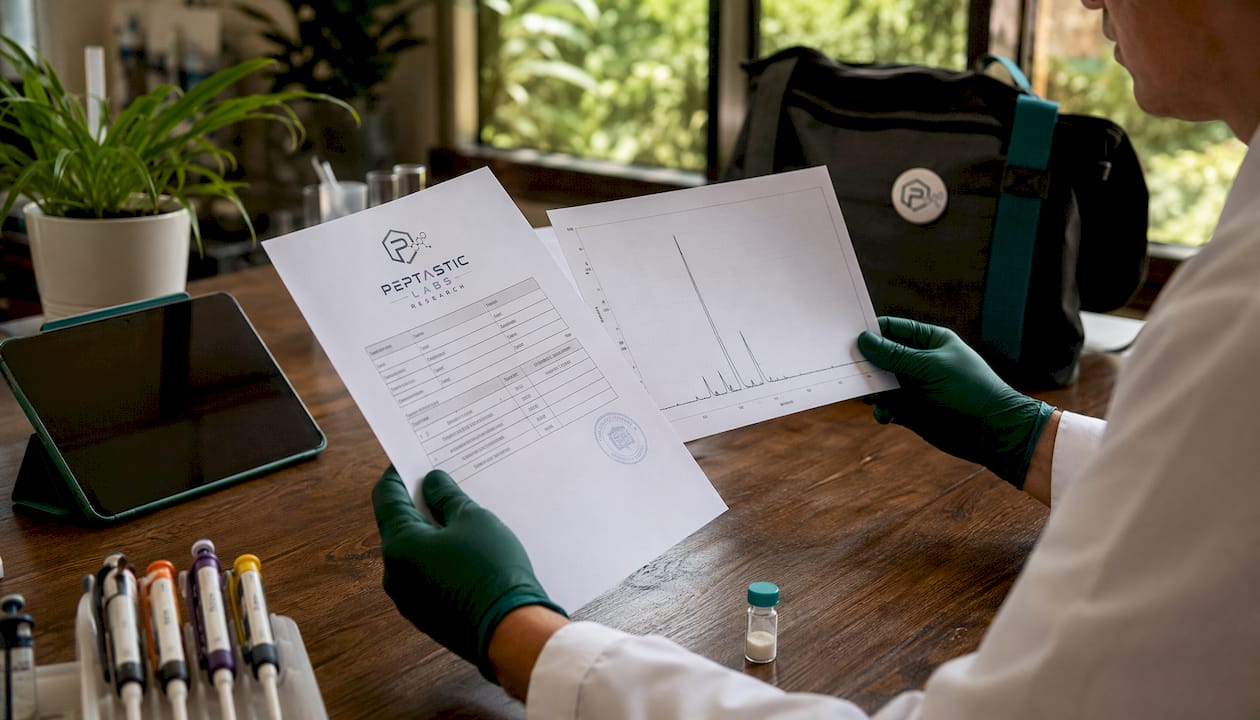
Minimum COA elements to require:
| COA Element | Why It Matters |
|---|---|
| Batch/lot number | Enables traceability and recall if needed |
| Synthesis date | Confirms freshness relative to storage conditions |
| HPLC chromatogram with retention time | Quantifies purity and detects co-eluting impurities |
| MS (exact mass) spectra | Confirms molecular identity and flags truncated sequences |
| Purity specification and method | Documents column, solvent system, and detection parameters |
| Storage recommendations | Specifies temperature, light, and humidity requirements |
Third-party verification is non-negotiable for new vendors, critical experiments, or regulatory submissions. Ask for the independent lab's name and accreditation status, not just a PDF. Analytical caveats to watch: oxidation artifacts, sequence isomers, and truncated sequences can appear in MS and HPLC data. Request method details, including column type, solvent system, and MS tuning parameters, so your team can assess whether the method would resolve the impurities most relevant to your assay. For a detailed breakdown of what a compliant COA should contain, the COA verification guide at Peptasticlabs covers each element.
Pro Tip: Use a peptide reconstitution calculator to cross-check declared purity against your working concentration before the first use. Discrepancies between expected and observed activity often trace back to reconstitution errors, not compound failure.
Practical steps for sourcing, ordering, and shipping from Australian partners
Follow this sequence to reduce delivery risk and protect cold-chain integrity:
- Pre-verify COA and confirm scheduling status for the specific compound and lot.
- Secure IACUC/IRB, IBC, and MTA approvals before placing the order.
- Place the order with explicit cold-chain instructions: temperature range, packaging type, and data logger requirement.
- Confirm carrier selection and temperature monitoring protocol with the supplier.
- Prepare U.S. customs documentation: commercial invoice with a clear scientific description, COA, SDS, and any required import permits.
- At receiving, execute immediate cold-chain transfer, quarantine the batch, and run a QC spot check (HPLC or MS) before use.
| Logistics Factor | Domestic (Australia) | International to U.S. |
|---|---|---|
| Transit time | several business days | multiple weeks |
| Cold-chain risk | Lower; seasonal packaging adjustments used | Higher; data loggers required |
| Customs documentation | Minimal | Commercial invoice, COA, SDS, import permits |
| Scheduling risk | Managed domestically | Active ABF interception risk |
Failure to include an explicit scientific description on the commercial invoice is a common trigger for customs holds. State the compound name, CAS number, intended research use, and RUO status on every shipment document.
How U.S. researchers can engage with the Australian peptide community
Start with audited institutional collaborations or conference contacts, not consumer forums. Direct outreach to Australian university peptide labs, with a clear statement of intended use and institutional affiliation, establishes credibility and reduces regulatory friction from the first exchange. Request seminars or sample exchanges under a signed MTA before committing to a full procurement relationship.
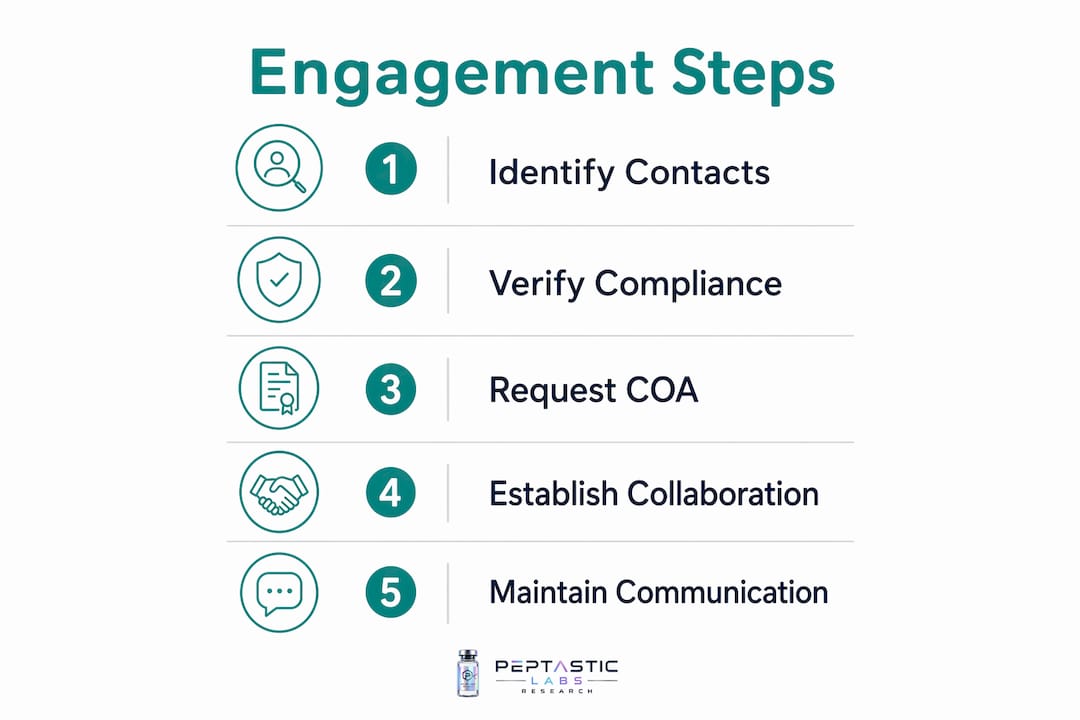
For online resources, monitor accredited testing lab directories, university research portals, and professional networks tied to institutions rather than commercial marketplaces. When drafting initial contact emails, lead with your institutional approvals, COA requirements, and intended research application. Attaching a template MTA in the first exchange signals that your institution operates at the compliance level Australian research partners expect. The Australian peptide research examples resource at Peptasticlabs provides provenance context useful for framing collaboration proposals.
Peptasticlabs: trust signals for U.S. researchers evaluating a supplier
Peptasticlabs positions itself as a research-grade peptide supplier with documented, independently tested purity claims across a broad catalog of compounds. Before procurement, verify the following:
- Third-party HPLC/MS results: Request raw chromatograms, not summary tables. Confirm the testing lab's accreditation status.
- Batch traceability records: Each lot should carry a unique batch number traceable through synthesis, QC, and dispatch.
- COA availability: COAs are available on request; confirm the document includes all minimum elements listed in the verification table above.
- Storage and shipping SOPs: Request written confirmation of temperature controls used during dispatch.
- RUO declaration: All materials are for research use only; institutional approvals are required for regulated compounds.
For purity standards context relevant to your experimental design, the peptide purity standards guide at Peptasticlabs addresses threshold selection and reproducibility implications.
Key Australian peptide research institutions and experts
The University of Queensland's Institute for Molecular Bioscience (IMB) is one of the most active sites for peptide discovery research in the Southern Hemisphere, with published work spanning venom-derived peptides, antimicrobial sequences, and drug-lead optimization. Monash University's Medicinal Chemistry group and the Walter and Eliza Hall Institute of Medical Research (WEHI) in Melbourne also maintain active peptide programs relevant to immunology and oncology applications.
For networking, the Australian Peptide Association (APA) connects academic and industry researchers and is the primary professional body for the field. U.S. researchers seeking collaboration contacts should search APA membership directories and recent publication author lists from IMB and WEHI as starting points.
Australian peptide conferences relevant to U.S. researchers
The Australian Peptide Conference, organized by the APA, is a primary recurring meeting and draws international attendees. The conference covers synthesis methodology, therapeutic applications, and regulatory developments, making it directly relevant to procurement and collaboration planning. The Lorne Conference on Protein Structure and Function, held annually in Victoria, includes peptide-focused sessions and attracts both academic and industry participants.
U.S. researchers unable to attend in person should monitor published proceedings and abstract books, which often contain contact information for Australian labs open to international collaboration.
Intellectual property considerations when collaborating with Australian entities
Australian universities operate under IP frameworks governed by their own commercialization policies and, in some cases, the Australian Research Council's funding conditions. Before exchanging materials, sequences, or unpublished data, confirm whether the Australian partner's institution claims ownership of jointly developed IP and whether that claim is compatible with your U.S. institution's policies.
An MTA should specify IP ownership for any modifications or derivatives arising from the collaboration. For compounds with potential therapeutic application, engage your institution's technology transfer office before the first material exchange. Australia is a signatory to the Patent Cooperation Treaty (PCT), so provisional patent filings in either jurisdiction can establish priority dates that protect both parties.
Communication and cultural practices that improve collaboration
Australian research culture is direct and informal relative to many U.S. institutional norms, but professional correspondence with university labs should remain formal in the first exchange. State your institutional affiliation, IRB/IACUC status, and intended use clearly in the opening email. Australians generally respond well to concise, specific requests over lengthy background narratives.
Time zone differences of 14–17 hours (depending on U.S. location and Australian daylight saving) mean that asynchronous communication is the default. Set clear response-time expectations early and use shared document platforms for COA review and MTA negotiation to avoid version-control delays. When scheduling calls, morning slots in Australia align with late afternoon or evening in the U.S. Eastern time zone.
Key Takeaways
Engaging Australian peptide sources requires scheduling verification, institutional approvals, and batch-specific COA documentation before any shipment enters the U.S.
| Point | Details |
|---|---|
| Verify scheduling status first | Confirm TGA Schedule 4/9 classification for each compound before ordering to avoid ABF interception. |
| Require batch-specific COA | Minimum: HPLC chromatogram, MS identity, batch number, and ≥95% purity specification (≥98% or ≥99% for sensitive or clinical/therapeutic assays). |
| Secure institutional approvals | IACUC/IRB, IBC, and a signed MTA must be in place before any cross-border material exchange. |
| Plan cold-chain logistics | International transit runs 2–4 weeks; require data loggers and seasonal packaging adjustments from the supplier. |
| Peptasticlabs as a verified option | Peptasticlabs offers over 22 independently tested compounds at ≥99% HPLC purity, with COAs and batch traceability on request. |
The real calculus of cross-border peptide sourcing
The Australian peptide community offers genuine value: rigorous academic synthesis programs, ISO/IEC 17025-accredited testing infrastructure, and compounds that can be difficult to source domestically at equivalent purity. The caveat is that the regulatory environment is active and tightening. TGA scheduling decisions have moved faster than many procurement teams anticipated, and a single unverified shipment can trigger a customs hold that delays a study by months. The practical recommendation is to start with one test batch under full documentation, validate it with an independent QC run on arrival, and scale only after that batch clears every checkpoint. That sequence protects study integrity and gives your institution's compliance team a documented precedent to work from.
Peptasticlabs: verified research-grade peptides, ready to order
Researchers who need independently tested compounds without the cross-border compliance burden have a direct option. Peptasticlabs supplies over 22 HPLC-verified peptides at ≥99% purity, with batch-specific COAs, third-party MS confirmation, and full traceability documentation available on request. Every product is labeled Research Use Only, and the procurement workflow is designed for institutional buyers who require documentation at each step.
Institutional approvals are your responsibility before ordering regulated compounds. Once those are in place, the next step is straightforward: visit the Peptasticlabs research catalog, request the COA and third-party lab report for your target compound, and initiate the procurement workflow outlined in this guide.
Useful sources and references
- TGA Scheduling Decisions and ARTG Search — verify current scheduling status for specific compounds before ordering.
- Australian Border Force Import Guidelines — customs documentation requirements for biological and chemical imports.
- NATA Accredited Laboratories Directory — locate ISO/IEC 17025-accredited testing labs for independent COA verification.
- NHGRI Peptide Genetics Glossary — authoritative definition of peptide chain length and classification.
- StatPearls: Biochemistry, Peptide (NCBI) — SPPS methodology and synthesis provenance reference.
- UQ News: Injectable Peptides and Evidence Review — independent verification standards and enforcement context.
- Peptide Hub Australia: Education Centre — Australian regulatory framework overview and TGA guidance links.
Note: Do not rely on consumer marketplaces or unaccredited vendor reports as primary documentation. Always validate COAs with an independent, accredited laboratory before batch acceptance.