For most antibody antigen projects, choose a peptide around 15 amino acids; the practical window runs 10 to 20 aa. Optimal length depends on the application, sequence composition, and vendor synthesis capabilities. Yield, purity, and cost typically worsen as the peptide exceeds a length around 30 residues, so longer designs generally require specific justification.
TL;DR:
- Peptides for antibody antigens are best kept between 10 and 20 amino acids, with 15 aa being the most common choice for balanced synthesis and immune response.
- Longer peptides exceeding 30 residues often suffer from decreased yield and purity, and tend to require special synthesis methods or switch to recombinant production.
- Peptide solubility issues mainly arise from high hydrophobic content or charge clusters, which can be mitigated by adding solubility tags or modification strategies.
- Analytical characterization of peptides, especially those longer than 15 aa, should include detailed HPLC chromatograms and mass spectrometry confirmation to verify purity and identity.
- When ordering complex or longer sequences, specify quality control documentation and solubility expectations in advance to prevent batches that are difficult to purify or unreliable for experiments.
Table of Contents
- How Do You Choose Peptide Length for Different Applications?
- Why Does Peptide Length Limit Synthesis Yield and Purity?
- What Sequence Features Affect Peptide Solubility?
- How Does Peptide Length Affect HPLC and Mass Spec Results?
- A Practical Checklist for Selecting Peptide Length
- What Quality Documentation Should You Request for Any Peptide Length?
- An Editorial Take on Peptide Length Decisions
- Sourcing Research-Grade Peptides for Difficult Sequences
- Sources
- FAQ
How Do You Choose Peptide Length for Different Applications?
Peptide length selection starts with what the peptide needs to do, not with a single universal number. Antibody antigen design, epitope mapping, structural work, and hormone-related research each carry their own reasoning.
Antibody antigen peptides work best at 10 to 20 amino acids, with 15 aa a common target because it balances two competing needs. Shorter sequences risk too few epitope options for the immune system to respond well; longer ones start folding into secondary structure that can bury the very epitope you want exposed. A 15 aa peptide usually contains several overlapping 5 to 7 aa epitope possibilities while still synthesizing cleanly.
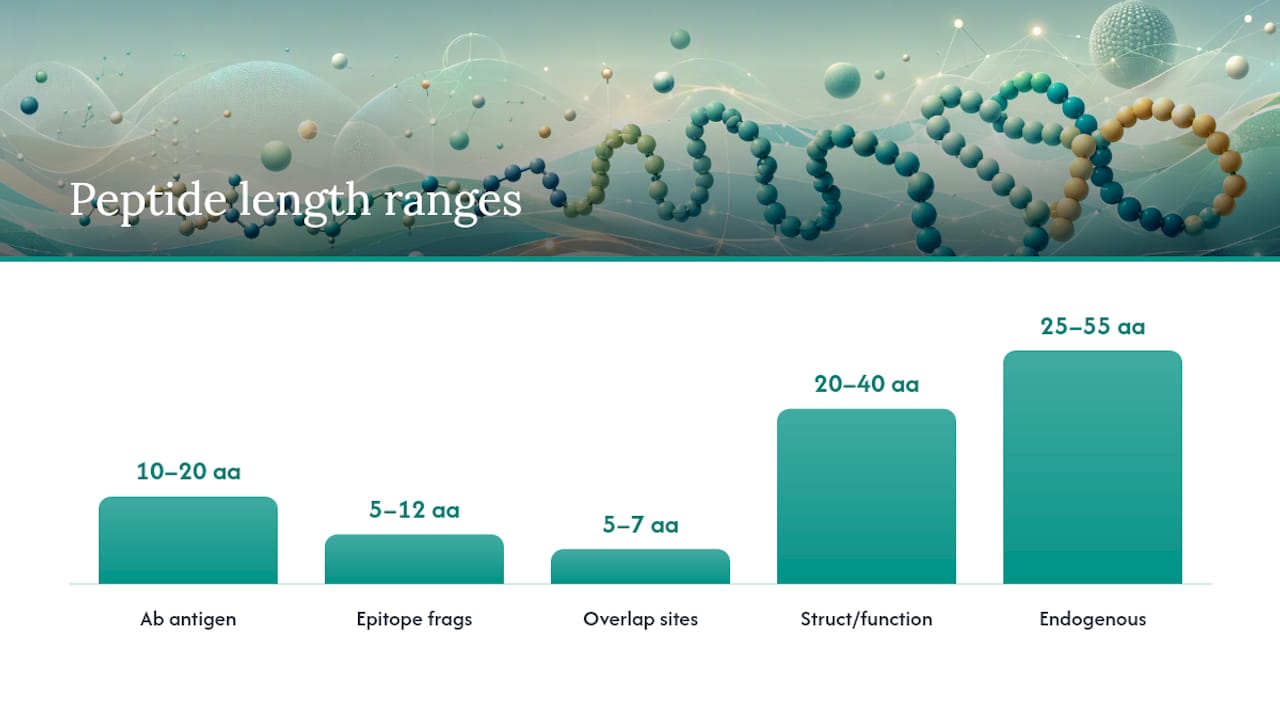
Epitope mapping flips the logic. Here you often want a panel of short overlapping fragments, typically 5 to 12 aa, tiled across a longer protein region to pinpoint exactly which residues an antibody recognizes. Some mapping protocols instead use longer overlapping windows (20 aa or more) when the goal is coarse localization rather than residue-level resolution.
Structure/function and proteomics work frequently demands longer peptides, sometimes 20 to 40 aa, because the biological activity depends on a fold or a multi-residue binding surface that a short fragment cannot reproduce.
Endogenous peptides make the case for flexibility. Insulin runs 51 amino acids, and natriuretic peptides like ANP (28 aa) and BNP (32 aa) sit well outside the antigen sweet spot. Working with sequences like these means accepting more synthesis complexity and adjusting your handling and purification expectations from the start, a topic covered in more depth in our breakdown of peptide types and uses.
- Antibody antigens: 10 to 20 aa, ~15 aa typical
- Epitope mapping fragments: 5 to 12 aa
- Coarse mapping windows: 20+ aa
- Structure/function peptides: 20 to 40 aa
- Endogenous hormone peptides: often 25 to 55+ aa
Why Does Peptide Length Limit Synthesis Yield and Purity?
Solid-phase peptide synthesis builds a chain one residue at a time, and each coupling and deprotection step carries its own efficiency. A single step running at 99% efficiency sounds close to perfect, but efficiencies compound multiplicatively across the whole sequence.
The 30 aa threshold: Purity and yield reliably decline as chain length grows, and sequences longer than roughly 30 amino acids need special synthesis attention. Past 50 residues, you are functionally in polypeptide and small-protein territory, where solid-phase synthesis alone often stops being practical.
The consequences show up directly in the lab, not just on a spec sheet:
- Truncated and deletion species accumulate alongside your target sequence, compromising the sequence integrity your assay depends on.
- Effective concentration drops because a portion of every milligram is off-target byproduct, not your peptide.
- Purification demands more preparative HPLC time and more resin, driving up both cost and turnaround.
Once a target sequence exceeds roughly 50 residues, recombinant expression or enzymatic ligation strategies usually outperform stepwise chemical synthesis on both cost and final purity. If your project sits near that line, it is worth asking your vendor directly whether solid-phase synthesis is even the right approach before you commit to a sequence.
What Sequence Features Affect Peptide Solubility?
Length interacts with composition, and a poorly designed 12 aa peptide can be harder to work with than a well-designed 25 aa one. Two features drive most solubility problems: hydrophobic content and charge distribution.
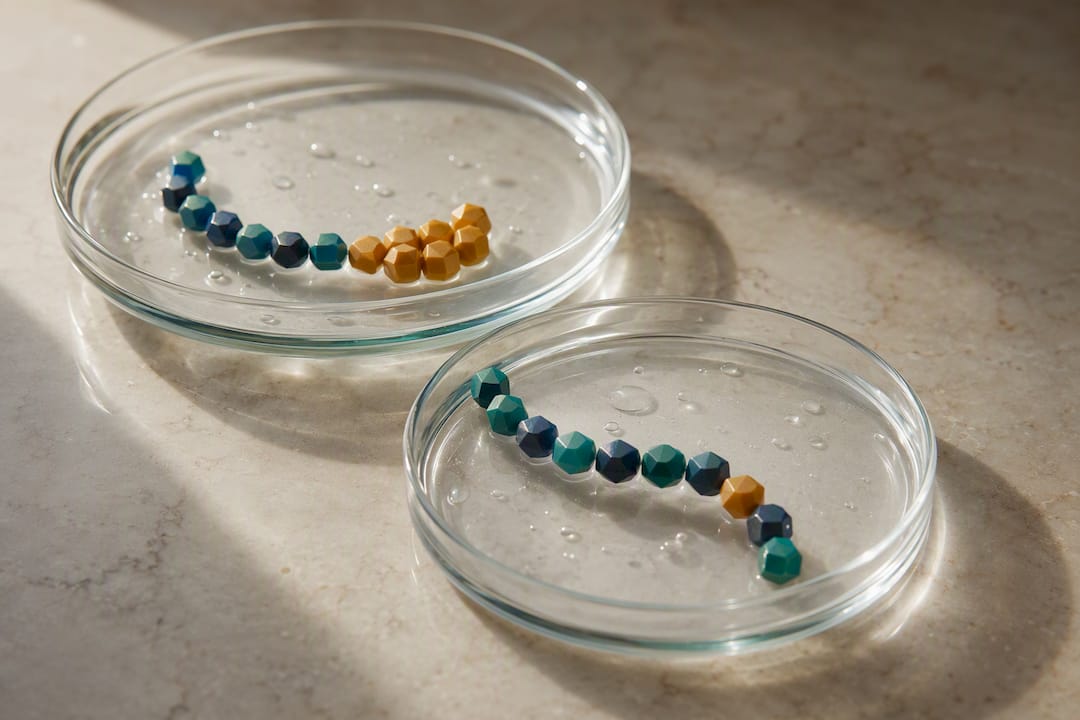
Design guidelines generally recommend keeping hydrophobic residues under roughly 50% of the sequence and including at least one charged residue for every five residues. A stretch of four or more consecutive hydrophobic residues tends to aggregate regardless of overall peptide length, and a dense block of same-charge residues can cause solubility issues of its own, particularly near physiological pH.
Common fixes include:
- Adding a solubility tag such as a short charged linker (multiple lysines or glutamates) at one terminus
- Inserting a flexible spacer (glycine-serine repeats) between a hydrophobic core and the rest of the sequence
- Acetylating the N-terminus or amidating the C-terminus to reduce charge-related aggregation at the ends
Very short peptides, in the 3 to 5 aa range, present the opposite problem. Sequences this short can be difficult to purify and recover cleanly unless they include at least one hydrophobic residue, since a fully polar tripeptide often has too little retention on a reverse-phase column to separate from salts and byproducts.
Pro Tip: Run your candidate sequence through a peptide property calculator before finalizing length. Free tools that estimate mass, isoelectric point, and hydropathy will flag a solubility problem while you can still add a residue or tag, rather than after synthesis has already started.
How Does Peptide Length Affect HPLC and Mass Spec Results?
Residue count maps fairly predictably to molecular weight. As a rough rule, each amino acid adds roughly 110 daltons on average, so a 15 aa peptide typically lands near 1.5 to 2 kDa, while a 40 aa peptide can approach 4.5 to 5 kDa. That number matters because it determines how well your analytical setup can actually characterize the peptide.
CSH C18 130Å peptide columns deliver their best resolution in the 1 kDa to 15 kDa range, which comfortably covers nearly every antibody antigen peptide and most functional peptides. Above 15 kDa, you are edging into small-protein territory where column chemistry and gradient method both need reconsidering.
Before accepting any peptide batch, request:
- A raw HPLC chromatogram, not just a summary purity number
- Mass spectrometry confirmation matching the calculated molecular weight
- A stated purity percentage tied to the chromatogram's integration
- A Certificate of Analysis documenting the batch
Reading these traces yourself, rather than trusting a single percentage on a label, is covered in our guide on requesting raw chromatograms in HPLC peptide testing. Research-grade purity targets of 95% or higher are standard for antigens under 20 aa; sequences pushing past 30 aa sometimes ship at 90 to 95% because achieving higher purity becomes disproportionately expensive relative to the added benefit.
A Practical Checklist for Selecting Peptide Length
Choosing peptide length works better as a sequence of decisions than a single guess. Run through these steps before you finalize a design:
- Define the assay first. An ELISA antigen, a Western blot antigen, and a structural binding study each favor different starting lengths.
- Pick an initial length from the application ranges above, defaulting to 15 aa for antibody work unless you have a specific reason to deviate.
- Evaluate composition. Check hydrophobic percentage and charged residue spacing before locking in the sequence.
- Decide on modifications and conjugation. Carrier protein conjugation (KLH, BSA) for short antigens, terminal capping for stability, or a cysteine handle for site-specific labeling all affect the final design.
- Specify QC and solubility expectations in writing when you place the order, not after the peptide arrives.
If a target region runs long and important epitopes are unclear, splitting it into two or three overlapping shorter peptides usually beats ordering one long, harder-to-purify sequence. Conversely, if a short candidate keeps failing purification, extending it by a few residues to add a charged anchor point often solves more problems than reformulating the buffer.
Pro Tip: Put purity target, requested HPLC trace, mass spec confirmation, solubility notes, and recommended reconstitution buffer directly on your order form. Vendors respond to written specifications far more reliably than to a verbal or implied expectation.
What Quality Documentation Should You Request for Any Peptide Length?
The right documentation depends partly on length. A 12 aa antigen peptide is relatively forgiving to synthesize, so a purity percentage and a chromatogram usually suffice. A 35 aa sequence is a different story: deletion products and truncations are far more likely, so mass spec confirmation of exact molecular weight becomes essential, not optional.
Peptastic Labs maintains a catalog of more than 22 independently tested compounds, each verified to 99% or higher purity via HPLC, with batch documentation and Certificates of Analysis available on request. For difficult sequences near the 30 aa attention threshold, that documentation lets you confirm identity and purity before committing bench time to a compromised batch.
- HPLC chromatograms confirm purity and flag truncated species
- Mass spec identity confirms exact mass, catching deletions a purity percentage alone can miss
- Certificates of Analysis document the specific batch you received, not just a product-line average
For background on how amino acid composition shapes folding and function across different peptide classes, see our guide on peptide amino acid chain structure and function.
An Editorial Take on Peptide Length Decisions
Most researchers overthink peptide length by treating it as a single optimization problem, when it is really two separate questions: what the biology requires, and what your synthesis vendor can deliver cleanly. For routine antibody work, 15 aa remains a sound default because it rarely fails on either count. The mistake worth avoiding is chasing a longer sequence for perceived specificity when a shorter, well-composed peptide with a smarter epitope choice would work just as well and synthesize far more reliably.
The bigger error is waiting until a sequence is already ordered to discover it sits past the 30 aa caution line. Talk to your supplier about composition and expected purity before finalizing any sequence near that threshold. That single conversation prevents most of the wasted batches researchers attribute, incorrectly, to bad luck.
— Tintastic
Sourcing Research-Grade Peptides for Difficult Sequences
Researchers can access independently tested, HPLC-verified peptides with transparent quality control documentation. Every batch across the catalog ships with documentation you can check against your own analytical expectations, whether you are ordering a straightforward 15 aa antigen or a compositionally tricky 30 aa target.
For sequences that push past standard antigen ranges, or that carry a hydrophobic stretch you're worried about, request the HPLC chromatogram, mass spec identity, and Certificate of Analysis before you finalize your order. Details on the quality processes behind each batch are outlined on the research page. Browse the catalog, specify your purity and documentation requirements up front, and place your order directly through the site.
Sources
- Peptides: classification and terminology (PMC article)
- Selecting a Peptide Sequence — Pacific Immunology
- Designing peptides — Sigma-Aldrich (Merck)
FAQ
How Do You Decide What Peptide Length to Choose?
Start with the application: 10 to 20 aa (commonly 15 aa) for antibody antigens, shorter fragments for epitope mapping, and longer sequences only when the biology requires a fold or multi-residue binding surface. Check hydrophobic content and synthesis feasibility before finalizing.
What Is the Typical Length of a Peptide?
Peptides are generally defined as chains shorter than 50 amino acids, with oligopeptides commonly classified as fewer than 20 residues under IUPAC-referenced terminology. Antibody antigen peptides typically fall in the 10 to 20 aa range.
What's the Difference Between an Oligopeptide and a Polypeptide?
Oligopeptides are short chains, generally under 20 amino acids, while polypeptides are longer chains that can extend into the hundreds of residues and eventually fold into functional protein structures.
How Long Should a Research Peptide Sequence Be Before I Order It?
There's no universal number. Confirm the sequence against your assay's needs, check hydrophobic and charged residue balance, and request an HPLC chromatogram and mass spec confirmation from your supplier, especially for anything approaching 30 amino acids.
Does Peptastic Labs Provide Documentation for Longer or Difficult Peptides?
Yes. HPLC verification, batch documentation, and Certificates of Analysis are provided on request across the catalog, helping confirm identity and purity for compositionally challenging or longer sequences.