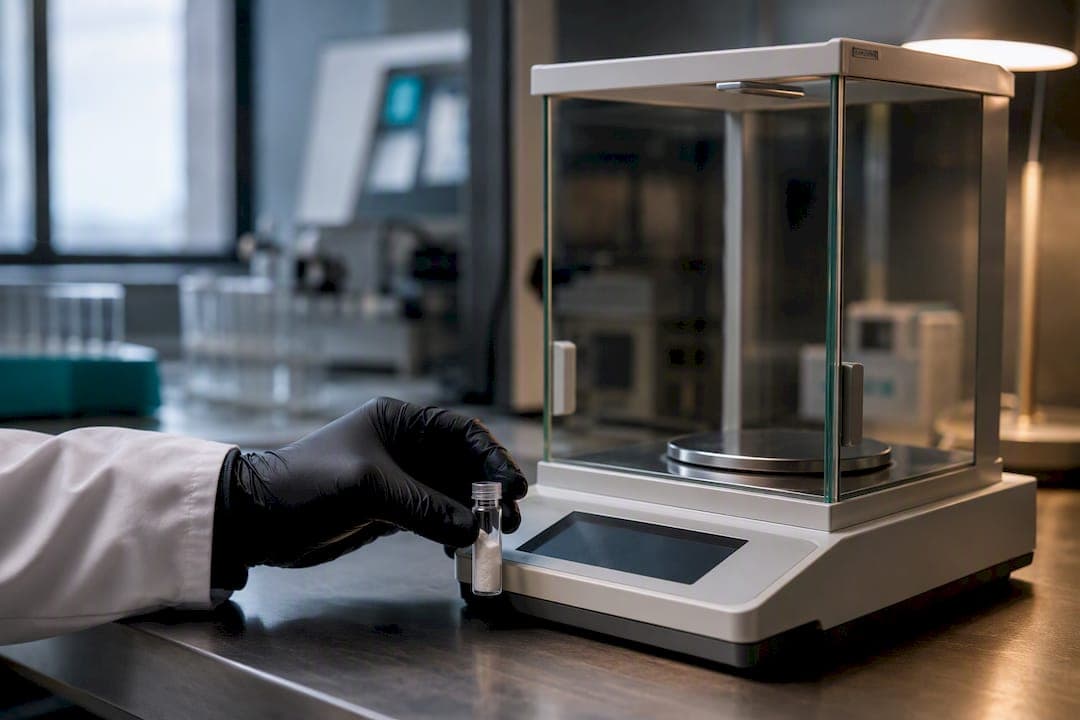
This guide covers research-use-only peptides for GLP-1 receptor biology and preclinical peptide studies, not clinical therapeutics. For any in vivo protocol, confirm endotoxin and sterility data before the first injection.
TL;DR:
- Accurate peptide identification requires MS confirmation, especially for chemically modified GLP-1 analogs, not just HPLC purity.
- Use lot-specific Certificates of Analysis with raw spectral data to verify peptide purity, identity, and impurity profiles before purchasing.
- Lyophilized peptides stored at -20°C or colder maintain stability, but reconstituted solutions should be used quickly to avoid degradation.
- Vendors are categorized into three tiers based on documentation quality, with Tier 1 offering full transparency and Tier 3 providing minimal information.
- Independent third-party testing is recommended when vendor data lacks raw spectra or when high-assay accuracy and reproducibility are critical.
Table of Contents
- Quality Standards and Reference Materials for GLP-1 Peptide Research
- Analytical Methods for Identity, Purity, and Impurity Profiling
- Vendor Validation and Procurement Checklist for GLP-1 Peptides
- Stability, Storage, and Reconstitution Best Practices
- How Peptastic Labs Approaches These Standards
- Order Research-Grade GLP-1 Peptides with Full Documentation
- Sources
- FAQ
Quality Standards and Reference Materials for GLP-1 Peptide Research
Every defensible purity claim traces back to a reference standard, and the pharmacopeial model for building one is worth understanding even if your lab never manufactures its own. The United States Pharmacopeia uses a two-step value-assignment process for peptide reference materials: first, bulk purity is established through mass balance, accounting for water, counter-ions, residual solvents, and related substances; second, that characterized bulk is used to assay the final lyophilized vial content via HPLC. This approach, detailed in a peer-reviewed characterization of peptide reference standards, explains why lyophilized standards are preferred over solution-based ones. Moisture and counter-ion corrections are harder to control in solution, and they introduce variability every time a vial is opened.
For a working lab, this translates into a short list of fields to check on every Certificate of Analysis before it goes in the freezer log.
- Lot number matching the physical vial label, not just the outer box
- HPLC purity chromatogram with visible baseline and integrated peak areas
- MS identity confirmation (observed mass versus theoretical mass, with tolerance stated)
- Water content and residual solvent data
- Related impurities listed individually, not just as a summed "other" percentage
- Endotoxin and sterility results, when the peptide is destined for in vivo work
Pro Tip: Request the raw chromatogram file, not just a summary purity number. A single stated percentage can hide a shoulder peak or a co-eluting impurity that only shows up when you look at the trace itself.
Biological potency assays appear on some pharmacopeial monographs, but they matter mainly when higher-order structure or receptor engagement is central to your experiment. For most binding and signaling assays, HPLC purity plus MS identity is sufficient. For structure-sensitive work, ask the vendor whether a functional assay was run on that specific lot.
Acceptance thresholds should scale with assay sensitivity. A purity floor of 98% is a reasonable baseline for general in vitro work, drawn from procurement guidance built around academic sourcing standards.
Analytical Methods for Identity, Purity, and Impurity Profiling
RP-HPLC remains the workhorse for quantitative purity and content assignment in GLP-1 peptide characterization, and for good reason: it is reproducible, well-understood, and directly comparable across labs when method parameters are shared. But HPLC alone cannot confirm identity. A peak at the expected retention time could still be the wrong peptide, a truncated fragment, or a deamidated variant with nearly identical chromatographic behavior. That is where LC–MS/MS and high-resolution mass spectrometry (HRMS) become essential, particularly for GLP-1 analogs carrying chemical modifications such as lipidation or PEGylation, where mass shifts need precise confirmation.
Orthogonal methods round out a defensible characterization panel:
- Size-exclusion chromatography (SEC) to flag aggregation, which matters more for longer or lipidated GLP-1 constructs
- CE-SDS or ion-exchange chromatography (IEC) to resolve charge and size variants that co-elute on standard reverse-phase columns
- Circular dichroism (CD) or hydrogen-deuterium exchange mass spectrometry (HDX-MS) when higher-order structure is relevant to the assay outcome
Method-development work published by chromatography vendors shows that peptide-optimized column chemistries and systematic gradient screening measurably improve peak shape and impurity separation for GLP-1 synthetic peptides, an approach demonstrated in application notes on GLP-1 separation methods. A generic C18 method built for small molecules will often under-resolve closely related peptide impurities.
On validation, ICH M10 and ICH Q2/Q14 guidance frame the parameters that matter: selectivity, sensitivity down to a defined lower limit of quantitation (LLOQ), accuracy, precision, and demonstrated stability-indicating capability under forced-degradation conditions like heat, light, oxidation, and pH extremes, a framework laid out in a review of quality and stability considerations for peptide therapeutics.
Pro Tip: When a vendor cannot produce raw MS spectra, not just a summary "confirmed" statement, treat that as a data gap, not a formality. Peptide identity confirmation without visible spectral data is not verifiable.
Vendor Validation and Procurement Checklist for GLP-1 Peptides
Reproducibility problems in peptide research trace back to procurement decisions more often than to bench technique. A structured intake process catches most of them before a single assay is run.
- Confirm the peptide is labeled research-use-only (RUO) and that your institution's material-acquisition policies permit the order.
- Request a lot-specific Certificate of Analysis showing the HPLC chromatogram and raw MS spectra, not summary values alone.
- Set your purity acceptance threshold before ordering, based on assay sensitivity, and reject lots that fall short rather than adjusting the protocol around a weaker peptide.
- Ask about endotoxin and sterility testing status if the material will touch cell culture or animal work.
- Where vendor documentation is thin, arrange independent third-party testing, ideally through an ISO 17025 accredited laboratory, before committing to a large purchase.
Vendors tend to fall into three tiers. Tier 1 suppliers provide full batch documentation unprompted and support third-party verification requests without friction. Tier 2 suppliers provide COAs but may resist sharing raw spectral files. Tier 3 suppliers offer little beyond a purity percentage on a product page, a pattern noted in procurement frameworks for academic peptide sourcing. Treat Tier 3 documentation as a starting point for your own verification, not a substitute for it.
On logistics, confirm whether the peptide ships lyophilized (preferred for most research applications) and what cold-chain conditions apply in transit. Keep customs and import documentation on file for research materials crossing borders, and retain batch records for the life of the study.
A simple acceptance framework:
- Accept when the COA shows purity at or above your threshold, MS identity matches within tolerance, and impurities are individually itemized.
- Reject when identity cannot be confirmed or purity falls below your stated minimum for the assay.
- Request additional testing when documentation is incomplete but the vendor otherwise meets your tier expectations.
Stability, Storage, and Reconstitution Best Practices
Lyophilized storage is the default for a reason: moisture accelerates hydrolysis and deamidation in peptides, and it complicates the mass-balance corrections used during value assignment. Vendors performing rigorous reference standard characterization run moisture analysis as a standard step precisely because uncontrolled water content skews every downstream concentration calculation. Instruments used for this kind of moisture analysis in pharmaceutical settings apply the same logic labs should use before trusting a stated concentration.
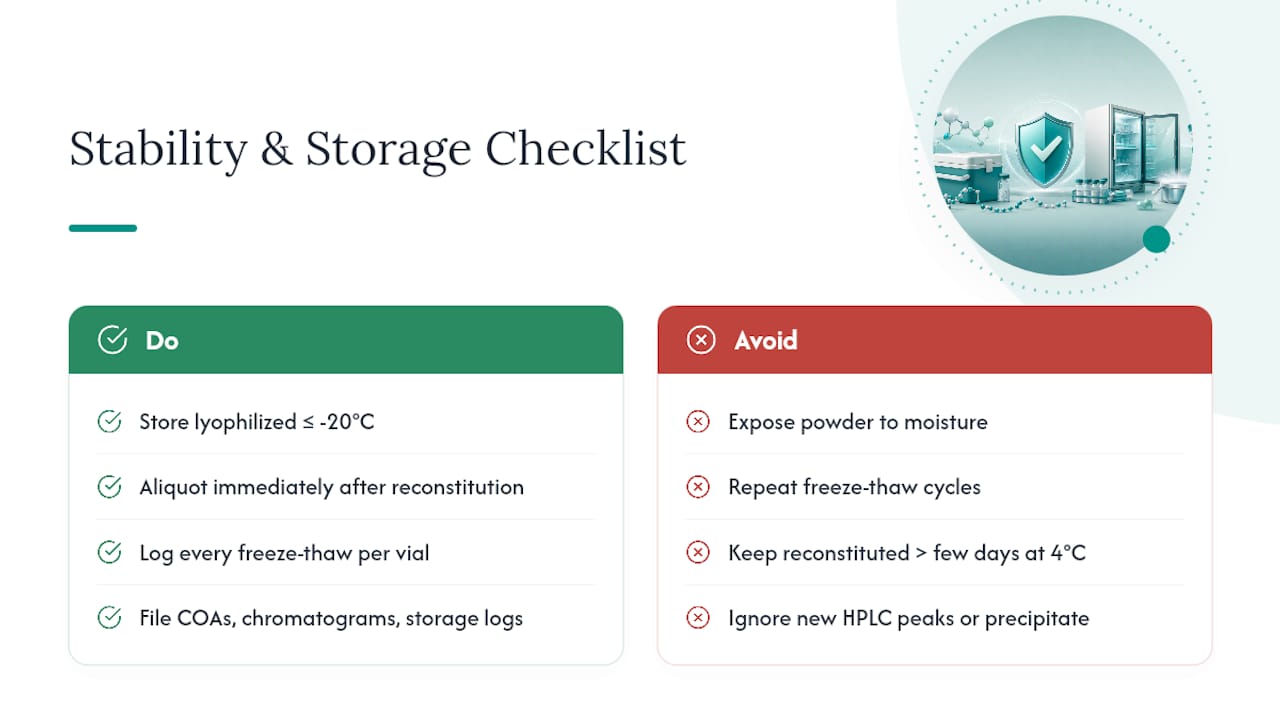
For reconstitution, most GLP-1 research peptides dissolve cleanly in sterile water or dilute acetic acid, depending on the sequence's isoelectric point. Target concentrations for in vitro assays typically fall in the micromolar range for stock solutions, then get diluted further at the bench. Aliquot immediately after reconstitution and avoid repeated freeze-thaw cycles, which degrade peptide integrity faster than a single freeze-thaw cycle would suggest.
Store lyophilized powder at negative 20 degrees Celsius or colder for long-term stability; reconstituted solutions generally hold for days at 4 degrees Celsius but should be used quickly. Watch for new HPLC peaks, precipitate formation, or discoloration as early warning signs of degradation during storage.
Pro Tip: Log every freeze-thaw cycle per aliquot on the vial itself. A chromatogram that looked clean at receipt can shift after three unrecorded thaw cycles, and you will not catch the cause without a written history.
Keep COAs, chromatograms, and storage logs filed together per batch. Reviewers and collaborators increasingly ask for this chain-of-custody documentation before accepting peptide-based results for publication.
How Peptastic Labs Approaches These Standards
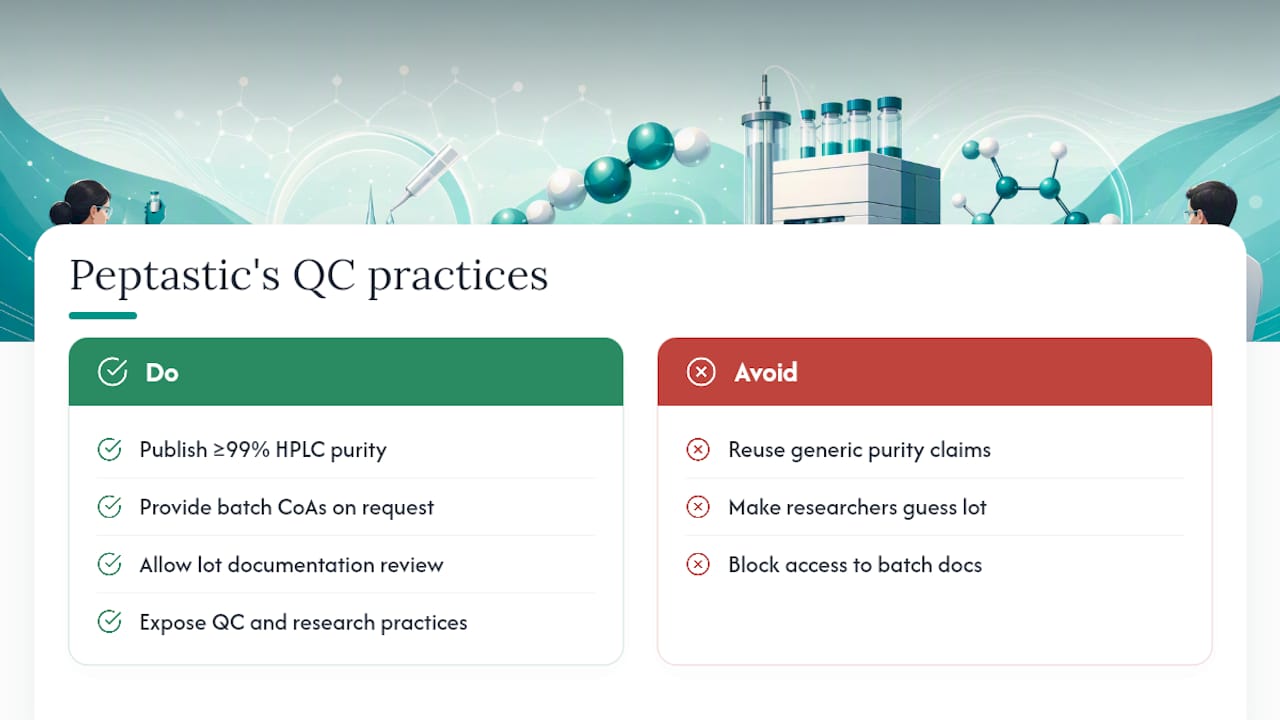
Most of the friction in peptide procurement comes from documentation gaps, not chemistry. Peptastic Labs addresses this by maintaining ≥99% HPLC-verified purity across its catalog and providing batch-specific documentation and Certificates of Analysis on request, rather than a single generic purity claim reused across lots.
That structure matters because a researcher evaluating a new vendor should never have to guess which lot a purity number applies to. Labs weighing whether to run additional third-party testing can review Peptastic Labs' research and quality control practices directly and request lot documentation before committing budget to a study.
— Tintastic
Order Research-Grade GLP-1 Peptides with Full Documentation
Research-grade GLP-1 peptides with batch-specific Certificates of Analysis and HPLC-verified purity documentation are supplied, so your lab isn't reconstructing a vendor's QC history from a single product page number.
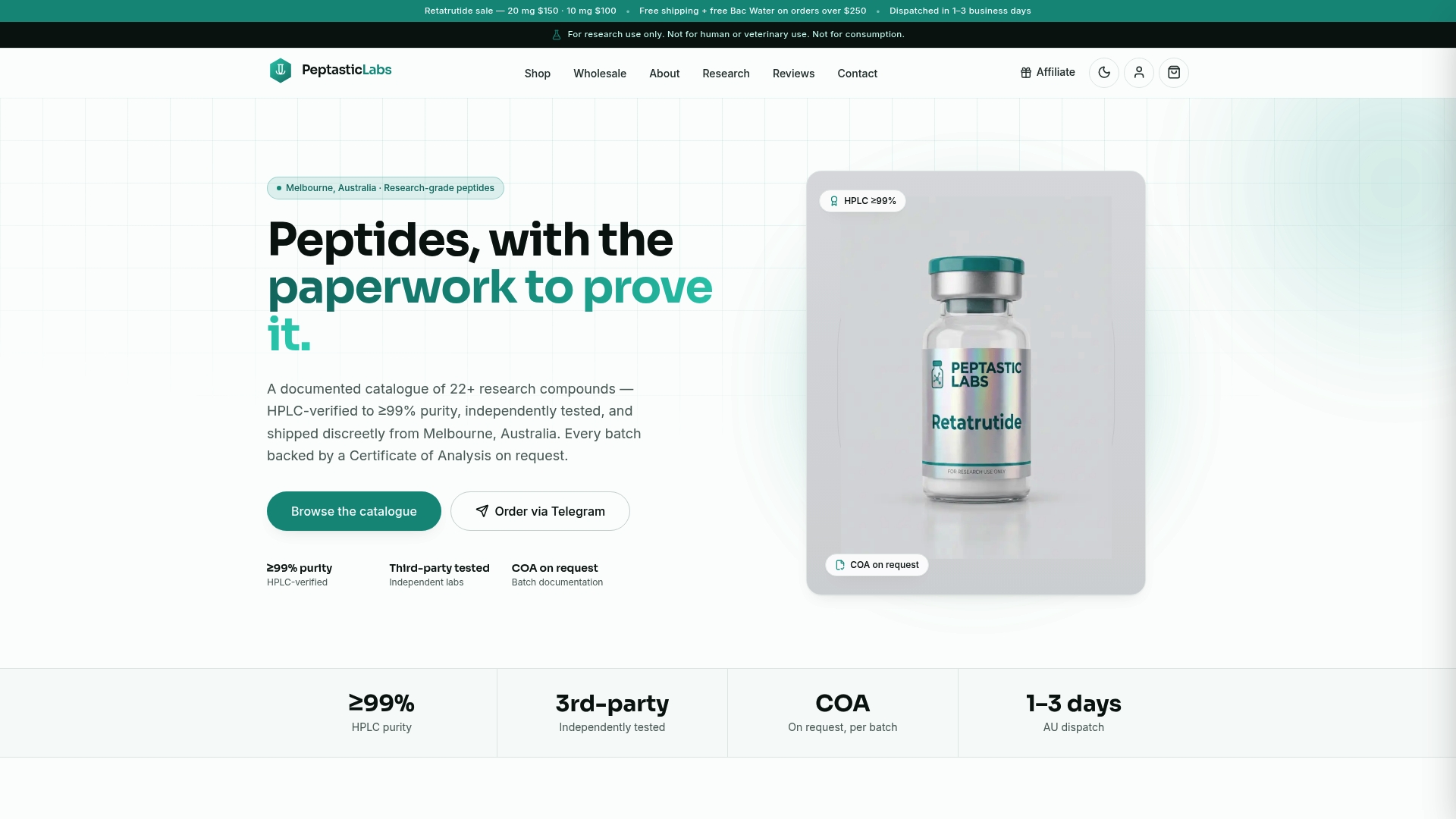
Every catalog entry ships with lot-specific COA data available on request, and third-party verification can be arranged for labs that want independent confirmation before a large order. All materials are labeled research-use-only and intended strictly for preclinical or basic laboratory research, not for human or veterinary use. If your protocol calls for a specific purity threshold or documentation package, review the current GLP-1 research peptide catalog and request the lot documentation your institutional review process requires before checkout.
Sources
- Development and characterization of peptide reference standards (PMC)
- Sourcing peptides for academic research: a 2026 data-driven framework
FAQ
What Should a GLP-1 Peptide Certificate of Analysis Include?
A defensible COA includes the lot number, an HPLC purity chromatogram, MS identity confirmation, water and residual solvent content, itemized impurities, and endotoxin or sterility data when the peptide is intended for in vivo use.
Do I Need Third-Party Testing If the Vendor Already Provides a COA?
Third-party testing through an ISO 17025 accredited lab is worth arranging when vendor documentation lacks raw MS spectra or when the purchase volume justifies independent confirmation, even if a vendor COA is already on file.
How Should Lyophilized GLP-1 Peptides Be Stored Before Use?
Lyophilized peptide should be stored at negative 20 degrees Celsius or colder, kept away from moisture, and reconstituted only shortly before use to limit freeze-thaw cycles and degradation.