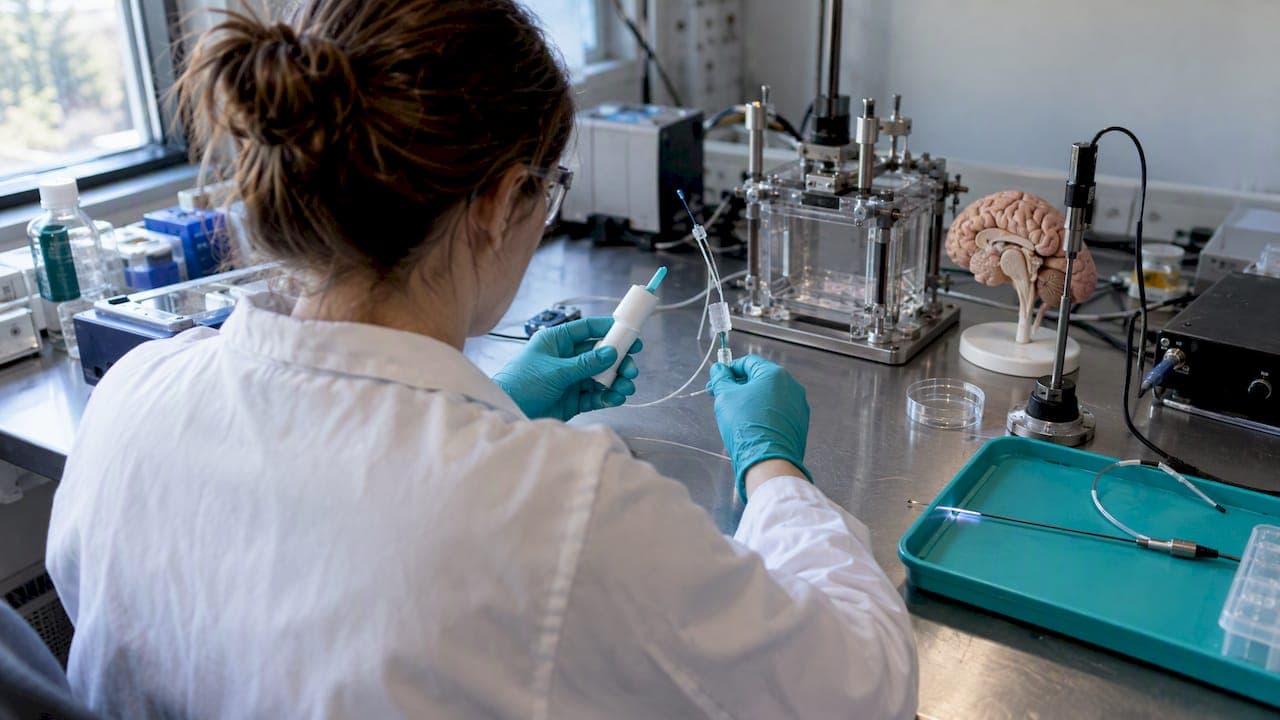
Five route classes dominate current neuropeptide delivery research: intranasal administration, receptor-mediated transcytosis shuttles, nanocarrier-enhanced systemic delivery (with or without ultrasound activation), invasive local routes (ICV, CED, intrathecal), and photoactivatable release for spatiotemporal precision. Intranasal and shuttle methods suit noninvasive, broad distribution studies; focused ultrasound adds regional targeting; invasive routes remain the last resort for high local concentration. Across nearly all noninvasive approaches, peptide protection through encapsulation, PEGylation, or mucoadhesion is a practical requirement, not an option.
TL;DR:
- Intranasal delivery combined with posterior olfactory targeting and ultrasound can significantly increase regional brain peptide levels compared to standard sprays.
- Receptor-mediated transcytosis shuttles require careful affinity and species-specific validation to avoid trapping at the BBB and ensure effective brain uptake.
- Nanocarrier strategies, especially ultrasound-triggered phase-change nanoemulsions, show promise for protecting peptides and achieving site-specific release.
- Invasive routes like ICV, CED, and intrathecal injections provide high local concentrations but involve risks such as infection and require neurosurgical procedures.
- Confirming peptide purity, stability, and deposition accuracy is essential for reliable interpretation of delivery success in both preclinical and translational studies.
Table of Contents
- Classifying Neuropeptide Delivery Routes and Transport Mechanisms
- Intranasal Delivery: Mechanisms, Devices, and Enhancement Strategies
- Receptor-Mediated Transcytosis and Shuttle Strategies for Systemic Delivery
- Nanocarriers and Formulation Strategies for Protection, Targeting, and Release
- Local Invasive Delivery: ICV, Intraparenchymal CED, Intrathecal, and Implantable Systems
- Photoactivatable and Spatiotemporal Release Methods for Experimental Precision
- Peptide Stability, Protection Strategies, and Formulation Best Practices
- Translational Study Design: Animal Models, Imaging, and Endpoints
- Safety, Risks, and Regulatory Considerations
- Peptastic Labs: Peptide Provenance and Analytical Standards for Delivery Studies
- Priorities and Pitfalls in Neuropeptide Delivery Research
- Bringing Verified Peptide Quality to Delivery Research
- FAQ
- Sources
Classifying Neuropeptide Delivery Routes and Transport Mechanisms
Delivery strategies split first by destination: systemic routes that rely on the peptide crossing the blood-brain barrier (BBB) after entering circulation, and direct CNS routes that place the peptide in neural tissue or cerebrospinal fluid without requiring BBB penetration. Each category uses distinct transport mechanisms, and understanding which one applies to a given method determines how researchers should design dosing, imaging, and controls.
Intranasal administration bypasses the blood-brain barrier through olfactory and trigeminal nerve pathways rather than through systemic circulation, and this route can produce higher brain bioavailability than oral delivery for peptides that would otherwise be degraded or excluded by the gut and BBB. Transport along these pathways occurs through extracellular routes (paracellular diffusion between cells, transcellular passage through them) and through intracellular axonal transport, which is slower but can reach deeper brain structures.
Systemic routes that aim for BBB crossing depend on receptor-mediated transcytosis (RMT) or adsorptive-mediated transcytosis (AMT), both of which exploit transport machinery the brain's endothelial cells already use for nutrients or charged molecules. Peptide size, polarity, and susceptibility to enzymatic cleavage govern how much of an administered dose survives long enough to use any of these routes.
A short taxonomy of formulation and trigger strategies clarifies the options available once a route is chosen:
- Protective formulations: mucoadhesives, cyclodextrins, PEGylation, and lyophilized preparations that extend peptide half-life before and during administration.
- Carrier-based systems: liposomes, polymeric nanoparticles, and nanoemulsions that encapsulate peptides for protection and targeted release.
- Receptor-targeted shuttles: peptide or antibody fragments conjugated to the payload to engage transferrin, insulin, or other BBB receptors.
- Physical enhancement triggers: focused ultrasound, photoactivation, or convection-enhanced delivery that add spatial or temporal control on top of a chosen formulation.
These categories are not mutually exclusive. Many of the strongest translational results pair a formulation strategy with a physical trigger, a pattern that recurs throughout the method-specific sections below.
Intranasal Delivery: Mechanisms, Devices, and Enhancement Strategies
The nose-to-brain route has become the most studied noninvasive strategy for neuropeptide delivery because it avoids first-pass hepatic metabolism and offers direct anatomical access to the CNS through the olfactory and trigeminal nerves. The olfactory pathway, concentrated in the posterior-superior nasal cavity, offers the shortest anatomical distance to the olfactory bulb and forebrain structures, while the trigeminal pathway distributes more broadly to the brainstem and spinal cord via branches that traverse the nasal mucosa.
Within either pathway, peptides move through extracellular routes (paracellular and transcellular transport across the epithelium) or intracellular axonal transport along olfactory and trigeminal neurons. Axonal transport reaches deeper structures but takes hours to days, while extracellular transport is faster but limited mostly to superficial brain regions near the cribriform plate.
Several enhancement strategies improve the fraction of an intranasal dose that reaches the brain rather than being cleared or degraded:
- Mucoadhesive polymers extend nasal mucosa residence time, reducing loss from mucociliary clearance.
- Cyclodextrins improve peptide solubility and can transiently loosen epithelial tight junctions to favor paracellular transport.
- Cell-penetrating peptide conjugates assist transcellular uptake for payloads that otherwise cross poorly.
- PEGylation slows enzymatic degradation in the nasal cavity, though it can also reduce epithelial permeability if the PEG chain is too large.
- Viscosity modifiers control droplet spread and reduce posterior drainage into the pharynx, which otherwise wastes dose.
Device and deposition strategy matters as much as formulation. Catheter-based instillation that targets the posterior olfactory region achieves more consistent CNS deposition than standard aerosol sprays, which tend to deposit anteriorly where clearance is fastest. This distinction became central to a large-animal study combining intranasal delivery with focused ultrasound (FUSIN), in which catheter-guided posterior instillation followed by ultrasound-mediated targeting produced a measurable increase in regional brain accumulation compared with the contralateral hemisphere in a porcine model. The FUSIN workflow administers the peptide intranasally first, then applies focused ultrasound over the target region to locally enhance vascular permeability and promote regional uptake, a sequence that adds spatial precision without requiring systemic injection or surgery, as demonstrated by significant local enhancement in targeted brain regions.
Pro Tip: When designing an intranasal protocol, verify posterior olfactory deposition with a fluorescent tracer before running the full pharmacokinetic study: anterior drainage can silently erase an otherwise sound formulation.
Practical limitations persist regardless of enhancement strategy. Mucociliary clearance removes much of an administered dose within minutes, enzymatic cleavage in the nasal mucosa degrades unprotected peptides before absorption, and intersubject anatomical variability (nasal cavity volume, turbinate structure, mucus production) makes absolute bioavailability difficult to predict from one study to the next. Combining a protective formulation with posterior-targeted deposition, and validating that combination in a large-animal model before assuming rodent findings will translate, remains the most reliable mitigation strategy available.
Receptor-Mediated Transcytosis and Shuttle Strategies for Systemic Delivery
Receptor-mediated transcytosis exploits transport systems that brain endothelial cells use to move nutrients and signaling proteins across the BBB. Conjugating a neuropeptide to a ligand or antibody fragment that binds one of these transporters, commonly the transferrin receptor or the insulin receptor, allows the construct to piggyback across the barrier instead of relying on passive diffusion, which most peptides cannot achieve given their size and polarity.
Shuttle construction involves real trade-offs that determine whether a candidate is worth pursuing:
- Peptide-based shuttles are cheaper to synthesize, easier to conjugate, and more modular than antibody-based alternatives, which favors their use in exploratory screening and early formulation work.
- Antibody-based shuttles (including brain-penetrating fusion proteins) often achieve higher receptor affinity but carry greater production complexity and a higher risk of immunogenicity on repeated dosing.
- Affinity versus release is a central design tension: a shuttle that binds its receptor too tightly can become trapped at the endothelial membrane rather than releasing its payload into brain parenchyma.
- Species specificity limits direct translation of shuttle data between rodents and humans, since receptor sequence and expression density differ across species and can change binding kinetics substantially.
Modular peptide-shuttle systems exploiting receptor-mediated transcytosis are increasingly favored over larger antibody constructs specifically because of their synthesis simplicity and conjugation versatility, even when raw binding affinity is lower. For any claim that a shuttle construct crosses the BBB, the evidence bar should include direct brain tissue quantification (not just reduced plasma clearance), ideally corroborated by imaging or histology rather than indirect pharmacodynamic readouts alone. Generative AI-assisted peptide design is beginning to accelerate the search for shuttle candidates with improved permeability and lower immunogenicity, though these computational predictions still require empirical validation before they inform dosing decisions.
Nanocarriers and Formulation Strategies for Protection, Targeting, and Release
Nanocarrier systems address a problem that applies to nearly every noninvasive delivery route: unprotected neuropeptides rarely survive long enough in circulation or at a mucosal surface to reach their target intact. Liposomes, polymeric nanoparticles, nanoemulsions, and exosomes each encapsulate the peptide payload, shielding it from protease activity while the carrier itself is engineered for a specific release profile.
Carrier selection depends on several interacting factors:
- Payload properties: hydrophilic peptides generally favor liposomal encapsulation, while more hydrophobic sequences pair better with polymeric nanoparticles.
- Release kinetics: some applications need rapid burst release at the target site, while others benefit from sustained matrix-controlled release over days.
- Immunogenicity: exosome-based carriers, being cell-derived, tend to provoke less immune response than fully synthetic polymers, though batch consistency is harder to control.
- Peripheral organ accumulation: nanoparticles cleared by the liver or spleen before reaching the brain reduce effective dose and raise off-target exposure concerns.
Targeting ligands conjugated to the carrier surface substantially improve cell-type selectivity. Rabies virus glycoprotein (RVG) peptide, neurotensin, Tet-1 peptide, and aptamer sequences have each been used to direct nanovesicles toward specific neural cell populations, and targeting ligands measurably improve brain accumulation in preclinical models, though peripheral organ uptake remains an unresolved limitation across most constructs tested so far.
Encapsulation itself provides two distinct benefits beyond targeting: protease protection extends the functional half-life of an otherwise fragile peptide, and sustained-release matrices (including implantable gels and wafers) maintain local exposure over a timeframe that a bolus injection cannot match.
Emerging platforms illustrate where the field is heading. Ultrasound-actuated phase-change peptide nanoemulsions represent one of the newer approaches: the carrier remains stable as a liquid-core nanoemulsion until focused ultrasound triggers acoustic vaporization, releasing the encapsulated peptide at the targeted site. Early preclinical work on phase-change peptide nanoemulsions shows that ultrasound-induced vaporization can facilitate trans-endothelial transport of the encapsulated payload, though the reports remain early and the experimental caveats around reproducible vaporization thresholds and off-target heating have not been fully resolved.
A separate line of evidence underscores why protection matters at all. Rapid enzymatic degradation is consistently identified as the dominant barrier to effective nose-to-brain delivery, and noninvasive formulations that omit a protective strategy such as mucoadhesion or encapsulation tend to underperform regardless of how well the targeting ligand is chosen. Carrier design and peptide protection are not separate problems: they are the same problem addressed at different points in the delivery chain.
Local Invasive Delivery: ICV, Intraparenchymal CED, Intrathecal, and Implantable Systems
Invasive local delivery routes bypass the BBB entirely by placing the peptide directly into cerebrospinal fluid or brain parenchyma, and they remain the preferred option when a study requires high regional concentration that noninvasive routes cannot reliably achieve, or when rapid systemic clearance would otherwise eliminate most of the dose before it reached the target.
Three invasive routes dominate current practice, each with distinct operational demands:
- Intracerebroventricular (ICV) injection delivers peptide directly into the ventricular CSF, from which it distributes via bulk CSF flow; dosing frequency depends on CSF turnover rate, which clears most small molecules within hours.
- Convection-enhanced delivery (CED) uses a pressure gradient through an implanted catheter to drive peptide distribution through brain parenchyma over a larger volume than diffusion alone would achieve, and requires careful monitoring of infusion rate and catheter placement to avoid reflux along the catheter track.
- Intrathecal (IT) injection delivers peptide into spinal CSF, useful when the target is spinal cord or when ventricular access is impractical.
Local CNS administration routes avoid the blood-brain barrier and can minimize systemic exposure, but they carry neurosurgical requirements and device-related risks that noninvasive methods do not. Implantable matrices, wafers, and hydrogels extend the utility of these routes by providing sustained local release over days to weeks rather than the brief exposure window of a single bolus injection, a strategy with clinical analogs in existing intracranial drug-eluting implants.
The main risks to monitor include infection at the catheter or implant site, cerebrospinal fluid leakage, and neurological side effects from either the procedure itself or from peptide concentrations that are higher locally than any systemic route would produce. Clinicians generally treat invasive local routes as a last resort specifically because of infection and device complication rates, reserving them for cases where hybrid approaches pairing systemic administration with a targeted physical trigger such as focused ultrasound cannot achieve adequate local concentration.
Photoactivatable and Spatiotemporal Release Methods for Experimental Precision
Photoactivatable, or "caged," neuropeptides offer a level of spatial and temporal control that no formulation or systemic route can match. The peptide is synthesized with a photolabile protecting group attached to a residue essential for receptor binding, rendering it biologically inactive until illuminated. A brief pulse of light at the appropriate wavelength cleaves the caging group and releases the active peptide within milliseconds, at a spatial resolution limited only by the focused light spot, often on the scale of micrometers.

Photoactivatable neuropeptides have been demonstrated experimentally for opioid peptide delivery in neural tissue, where researchers used caged opioid constructs to trigger receptor activation at a chosen location and moment within living tissue, something no diffusion-based delivery method could replicate with comparable precision. These experiments typically pair the caged compound with two-photon or confocal illumination setups that allow activation restricted to a defined cellular or subcellular region.
The clinical applicability of photoactivation is limited by physics rather than chemistry. Light penetration through tissue falls off sharply with depth, restricting practical use to superficial structures or to settings where an optical fiber can be implanted near the target. Heating from repeated or intense illumination is a secondary concern that constrains activation frequency in sensitive tissue. For mechanistic neurobiology, where the question is which circuit or receptor population mediates a specific effect, photoactivation remains unmatched for precision. For therapeutic delivery to deep or distributed brain targets, it is not currently a practical alternative to the systemic or local routes discussed above.
Peptide Stability, Protection Strategies, and Formulation Best Practices
Every delivery method discussed so far depends on the peptide surviving intact long enough to reach its target, and degradation is rarely a minor variable. Principal degradation pathways include proteolytic cleavage by endogenous peptidases, oxidation of susceptible residues, and aggregation during storage or repeated freeze-thaw cycles. HPLC and mass spectrometry remain the standard methods for confirming that a peptide preparation matches its expected sequence and purity before and after a delivery experiment.
Practical formulation steps that protect payload integrity include:
- Encapsulation in a liposome or nanoparticle shell to physically block protease access.
- PEGylation to slow enzymatic recognition and extend circulating half-life.
- Mucoadhesive excipients for intranasal formulations, extending contact time at the absorptive surface.
- Lyophilization for long-term storage, reconstituted immediately before use to minimize solution-phase degradation.
- Controlled freeze-thaw handling, since repeated cycles can measurably degrade peptide integrity; our freeze-thaw SOP outlines a single-freeze, single-thaw protocol that limits this source of variability.
Pro Tip: Report storage temperature, reconstitution buffer, and time-since-reconstitution for every delivery experiment: a potency drop from degraded stock is easy to mistake for a delivery failure.
Reproducibility across delivery studies depends on documenting peptide provenance as carefully as the delivery method itself: the batch's Certificate of Analysis, HPLC purity value, storage conditions prior to use, and any freeze-thaw history belong in the methods section, not left as an assumption. Our guide to avoiding peptide degradation during storage covers the handling details most relevant to delivery-focused protocols.
Translational Study Design: Animal Models, Imaging, and Endpoints
Choosing the right animal model early prevents wasted effort later. Rodent studies remain appropriate for mechanistic screening and initial dose-response characterization, but nasal anatomy, skull thickness, and BBB receptor density differ enough from humans that large-animal validation (porcine or nonhuman primate) is generally necessary before a delivery method can support translational claims, a point underscored by the porcine FUSIN study discussed earlier.
A reliable translational design generally includes:
- Species selection matched to the question: rodents for mechanism, large animals for anatomy-dependent validation such as intranasal deposition or FUS targeting.
- Quantification method chosen for the claim being made: radiolabeling or fluorescent tracers for biodistribution, MRI or PET for noninvasive longitudinal tracking, and histology for ground-truth confirmation of regional deposition.
- Dose scaling informed by PK/PD data from the chosen species rather than simple body-weight extrapolation, since receptor density and clearance rates do not scale linearly across species.
- Controls that isolate the delivery variable: contralateral hemisphere comparisons, sham-device arms, and vehicle-only groups are standard for separating formulation effects from delivery-method effects.
- Timelines that match the biological question: acute uptake studies need imaging within minutes to hours, while sustained-release implants require follow-up over days to weeks.
Histology and imaging endpoints should be decided before the study begins, since retrofitting a biodistribution question onto a pharmacodynamic study design rarely produces usable quantitative data.
Safety, Risks, and Regulatory Considerations
Each delivery route carries a distinct risk profile that should guide monitoring choices. Focused ultrasound procedures require balancing cavitation-driven enhancement against the risk of microhemorrhage, and susceptibility-weighted imaging (SWI) is a standard tool for post-procedure safety surveillance in these studies. Invasive local routes carry infection and device-related risks that warrant monitoring for inflammation markers alongside standard neurological assessment.
Documentation practices matter as much as the experimental result. Adverse findings, whether a microhemorrhage on imaging or an unexpected inflammatory marker, should be recorded and reported with the same rigor as the primary efficacy endpoint, following GLP-like documentation standards even in academic settings. For any method intended to inform human translation, large-animal proof of concept, full biodistribution characterization, and a deliberate strategy to minimize systemic exposure where possible are the baseline expectations regulators and reviewers will look for before a method is considered ready for early clinical work.
Peptastic Labs: Peptide Provenance and Analytical Standards for Delivery Studies
Delivery outcomes are only as interpretable as the material being delivered. A batch with unconfirmed purity introduces a confound that no amount of careful dosing or imaging can resolve after the fact. Essential provenance to report in any delivery study includes the supplier, batch number, HPLC purity value, mass spectrometry confirmation of identity, storage conditions prior to use, and the reconstitution protocol followed.
Every peptide batch is independently HPLC and mass spec tested to confirm identity and purity before it reaches a researcher's bench, with Certificates of Analysis available on request for full batch documentation. High-purity, traceable material reduces one major source of variability in delivery and pharmacokinetic experiments, since researchers can rule out degraded or misidentified peptide as an explanation for an unexpected result. Our research page and method-focused blog posts outline additional QC and BBB-testing guidance relevant to writing reproducible delivery methods sections.
Priorities and Pitfalls in Neuropeptide Delivery Research
The strongest return on experimental effort right now comes from three priorities: optimizing posterior olfactory deposition before assuming an intranasal formulation has failed, pairing intranasal administration with focused ultrasound when regional targeting matters, and treating peptide QC as a prerequisite rather than an afterthought. Many published delivery failures are formulation or deposition failures in disguise, not evidence that a route itself is ineffective.
The most common pitfall is skipping a deposition-verification step. A study that assumes anterior nasal spray behaves like posterior catheter instillation, without confirming deposition with a tracer, risks attributing a device problem to the peptide or the biology. A second common error is insufficient control arms, particularly omitting contralateral or sham-device comparisons in FUS studies, which makes it difficult to separate the ultrasound effect from the baseline intranasal contribution.
Near-term experiments that would meaningfully strengthen translational claims include head-to-head large-animal comparisons of catheter-based versus aerosol intranasal deposition under matched FUS parameters, and direct brain-tissue quantification (not just plasma pharmacokinetics) for any new shuttle-peptide candidate.
— Tintastic
Bringing Verified Peptide Quality to Delivery Research
Delivery method choice determines how much of a dose reaches its target, but the purity and identity of the starting material determines whether that result means anything. We supply research-grade peptides across metabolic, cognitive and neuro, tissue and repair, longevity, cosmetic science, blends, hormone and reproductive, and ancillary and reagent product lines, each batch independently HPLC and mass spec tested with a Certificate of Analysis available on request.
For researchers running intranasal, shuttle-based, or nanocarrier delivery studies, that batch-level documentation removes one variable from an already complex experimental design: you can trust the peptide identity and purity going into the formulation step, which lets any delivery-related result be attributed to the method rather than to the material. Teams exploring translational or rare-disease-adjacent delivery questions may also find background context in resources like the RareLabs knowledge library on therapy development.
Browse our full peptide catalogue to find verified, research-grade material for your next delivery study, with bulk and wholesale options available for larger protocols.
This article is general information, not a substitute for advice from a qualified doctor. Consult a qualified healthcare professional about your own circumstances before acting on anything here.
FAQ
Can you give me some examples of neuropeptides?
Common research neuropeptides include oxytocin, vasopressin, substance P, neuropeptide Y, and opioid peptides such as enkephalins and endorphins. Each has distinct receptor targets and delivery challenges, which is why the route selected (intranasal, shuttle-mediated, or local) depends heavily on the specific peptide's size and stability profile.
Is oxytocin a neuropeptide?
Yes, oxytocin is classified as a neuropeptide, synthesized in the hypothalamus and acting both as a hormone in peripheral circulation and as a signaling molecule within the CNS. Its relatively small size and established intranasal formulations make it a frequently used model compound in nose-to-brain delivery research.
How to increase neuropeptide Y?
Neuropeptide Y levels are regulated by complex physiological factors including stress response and energy balance, and no single verified delivery method is established for selectively increasing endogenous NPY. Researchers studying NPY delivery typically rely on exogenous administration through intranasal or nanocarrier-based systemic routes rather than attempting to stimulate endogenous production.
What peptides increase dopamine the most?
No neuropeptide delivery study in this field has established a definitive ranking of peptides by dopamine-increasing effect, and claims of this kind should be treated cautiously given the complexity of dopaminergic signaling. Research into peptide effects on dopamine pathways typically focuses on specific receptor interactions rather than broad claims about magnitude of increase.
Sources
- Photoactivatable neuropeptides for spatiotemporally precise delivery of opioids in neural tissue (Banghart et al.)
- Focused ultrasound-mediated intranasal delivery (FUSIN) large-animal study (Theranostics / Thno)
- Brain-targeted drug delivery - nanovesicles directed to specific brain cells by brain-targeting ligands (Springer Link)
- Ultrasound actuated neuropeptide delivery across cerebrovascular interfaces using phase-change peptide nanoemulsions (Journal of Colloid and Interface Science preview)