Check BICON for your specific peptide before booking any shipment. Most research-grade peptides fall into a case-by-case evaluation, and many trigger either a DAWE import permit or Australian Industrial Chemicals Introduction Scheme (AICIS) registration. If the compound sits under a Chemical Weapons Convention (CWC) schedule, Australian Safeguards and Non-Proliferation Office (ASNO) lead times apply, and missing them can delay a shipment by weeks.
TL;DR:
- Most peptides require a specific biosecurity import search on BICON, AICIS registration, and possibly CWC permits, complicating clearance if overlooked.
- A detailed Certificate of Analysis with batch number, test method, and manufacturer declaration is essential for permit approval and to avoid border delays.
- The timing for permits can range from several weeks for first applications to two years validity for multiple shipments, making early planning crucial.
- Cross-checking site accreditation with permit class and coordinating documentation with suppliers beforehand can prevent rejections and delays.
- Using a reputable supplier like Peptastic Labs, which provides comprehensive batch documentation and verified purity data, streamlines compliance and expedites import processes.
Table of Contents
- Which Permits Apply to Peptide Imports in Australia?
- What's the Import Checklist Before Booking Shipment?
- What Documentation and Site Requirements Do Labs Need?
- How Long Do Permits Take and What Do They Cost?
- What Peptastic Labs Does to Support Compliant Imports
- Where to Check the Rules and Find Templates
- Sourcing Peptides That Match Your Permit Documentation
- The Real Bottleneck Isn't the Regulation, It's the Paperwork
- Sources
Which Permits Apply to Peptide Imports in Australia?
Three separate regulatory regimes can touch a single peptide shipment, and they do not always overlap the way you'd expect. Getting this wrong is the single biggest cause of delayed clearance for Australian labs.
BICON is the Department of Agriculture, Water and the Environment's database, and it's the authoritative starting point for every import. It houses biosecurity import conditions for more than 20,000 biological products and will tell you directly whether a permit, a treatment, or a specific condition attaches to your product. Border officers reference the same database you're searching, so a saved BICON result carries real weight if a shipment is questioned later.
AICIS registration is a separate obligation entirely. Under the Industrial Chemicals Act 2019, anyone who introduces or imports industrial chemicals into Australia must register with AICIS before importing, and there is no minimum quantity exemption; even very small research quantities require registration just as bulk shipments do. Institutional purchasing teams often assume "small-scale research" sits outside this scheme; it doesn't, and checking the AICIS Inventory and Categorisation Guide early prevents a scramble later.
ASNO/CWC scheduling applies to a smaller subset of peptides and precursor-related chemicals. If your compound falls under a CWC schedule, ASNO's permit timelines are strict: Schedule 1 applications need 37 days' notice, Schedule 2 or 3 need at least 7.
How these map in practice:
- Synthetic, non-scheduled research peptides typically require a BICON check and often AICIS registration, with no CWC involvement.
- Animal-derived peptide reagents usually trigger BICON biosecurity conditions tied to the source species.
- Scheduled precursor-related compounds add the ASNO/CWC permit pathway on top of whichever biosecurity or chemical registration already applies.
What's the Import Checklist Before Booking Shipment?
Treat this as a sequence, not a menu. Skipping steps out of order is exactly how shipments end up held at the border.
- Search BICON using the exact product name and CAS number, and save a screenshot or PDF of the result as evidence for your permit file.
- If BICON flags a permit requirement, assemble the application: product specifications, Certificate of Analysis, manufacturer declaration, intended research use, and Approved Arrangement (AA) site details if the permit requires containment.
- Confirm your organization's AICIS registration status before the first shipment lands, not after. Registration through AICIS is a separate lodgment from any DAWE permit application.
- If ASNO/CWC scheduling applies, lodge early. A Schedule 1 shipment needs its permit in hand 37 days before the goods move; build that into your procurement calendar, not your shipping date.
- Coordinate with your supplier on pre-shipment paperwork, confirming the freight documentation matches whatever conditions the permit specifies word for word.
Pro Tip: Don't wait for a documentation request from customs to produce your Certificate of Analysis. Institutional safety officers consistently report that missing or after-the-fact documentation is the most common reason peptide shipments get held at the border, not the peptide itself.
Lodging a BICON search and a permit application in the same week you plan to ship is the fastest way to lose a month. Build the checklist into your procurement calendar at the point you select a supplier, not after the invoice is paid.
What Documentation and Site Requirements Do Labs Need?
A Certificate of Analysis (COA) needs to show more than "purity confirmed." For permit evaluation purposes, it should include the HPLC purity result, the batch or lot number, the testing method, and the date of analysis. A COA without a stated method or batch reference is functionally useless to a customs officer trying to match paperwork to a physical shipment.
Alongside the COA, your Safety Data Sheet (SDS) and product labeling need to match exactly what's declared on the permit application, down to the compound name. Use your exporter's Shippers' Declaration for Chemicals template, completed and verified before the goods ship, rather than assembled after a hold notice arrives.
Site readiness matters just as much as paperwork. If a DAWE permit specifies an Approved Arrangement class (Class 5 covers most laboratory settings), your facility's accreditation has to match that class exactly. A mismatch between the permit's AA class and your site's actual accreditation is one of the most frequent causes of border rejection for lab imports, and it's entirely preventable with a five-minute cross-check before you apply.
Key documents to have ready before lodging any application:
- HPLC-based Certificate of Analysis with batch number and test date
- Safety Data Sheet matching the exact product name on the permit
- Manufacturer declaration of intended research use
- Completed Shippers' Declaration for Chemicals
- Confirmed AA site class matching permit conditions
Non-compliant goods aren't just delayed. DAWE guidance is direct: failing to meet stated biosecurity conditions can mean re-export or destruction of the goods at the importer's own expense.
How Long Do Permits Take and What Do They Cost?
DAWE import permits are commonly valid for two years and can cover multiple shipments within that window, so a single well-prepared application can save you from repeating the process every order. That's worth building into your budgeting: the upfront effort pays off across a two-year procurement cycle, not just one shipment.
Plan around these minimums:
- AICIS registration: complete before your first import; no volume threshold applies, so start this regardless of order size.
- DAWE biosecurity permit: timeline varies by product, but expect several weeks for first-time applications.
- ASNO/CWC Schedule 1: 37 days' minimum lead time before shipment.
- ASNO/CWC Schedule 2/3: 7 days' minimum lead time before shipment.
For anything involving multiple compounds, an AA site mismatch, or a first-time import, a customs broker or freight forwarder earns their fee. They know which DAWE forms pair with which BICON conditions, and that experience routinely shaves weeks off a first application.
What Peptastic Labs Does to Support Compliant Imports
Peptastic Labs supplies HPLC-verified Certificates of Analysis and full batch documentation on request, built to the specificity DAWE and AICIS applications actually need: test method, batch number, purity result, and manufacturer declaration in one package. That level of detail is exactly what a permit reviewer wants to see, and exactly what's missing when a shipment gets held.
Our documentation process is designed to hand your procurement team what a permit application requires, without the back and forth that eats weeks off a shipping timeline. If you're preparing an application, start by reviewing our research documentation and requesting a COA for the specific compound and batch you intend to order.
Where to Check the Rules and Find Templates
Bookmark these before your next order, not during a customs hold:
- BICON for biosecurity import conditions on your specific product
- DAWE biological imports guidance for permit validity and process
- AICIS registration requirements for industrial chemical introducers
- DFAT/ASNO CWC permit provisions for scheduled compounds
- Peptastic Labs' batch documentation checklist and COA guide for templates you can adapt directly
Sourcing Peptides That Match Your Permit Documentation
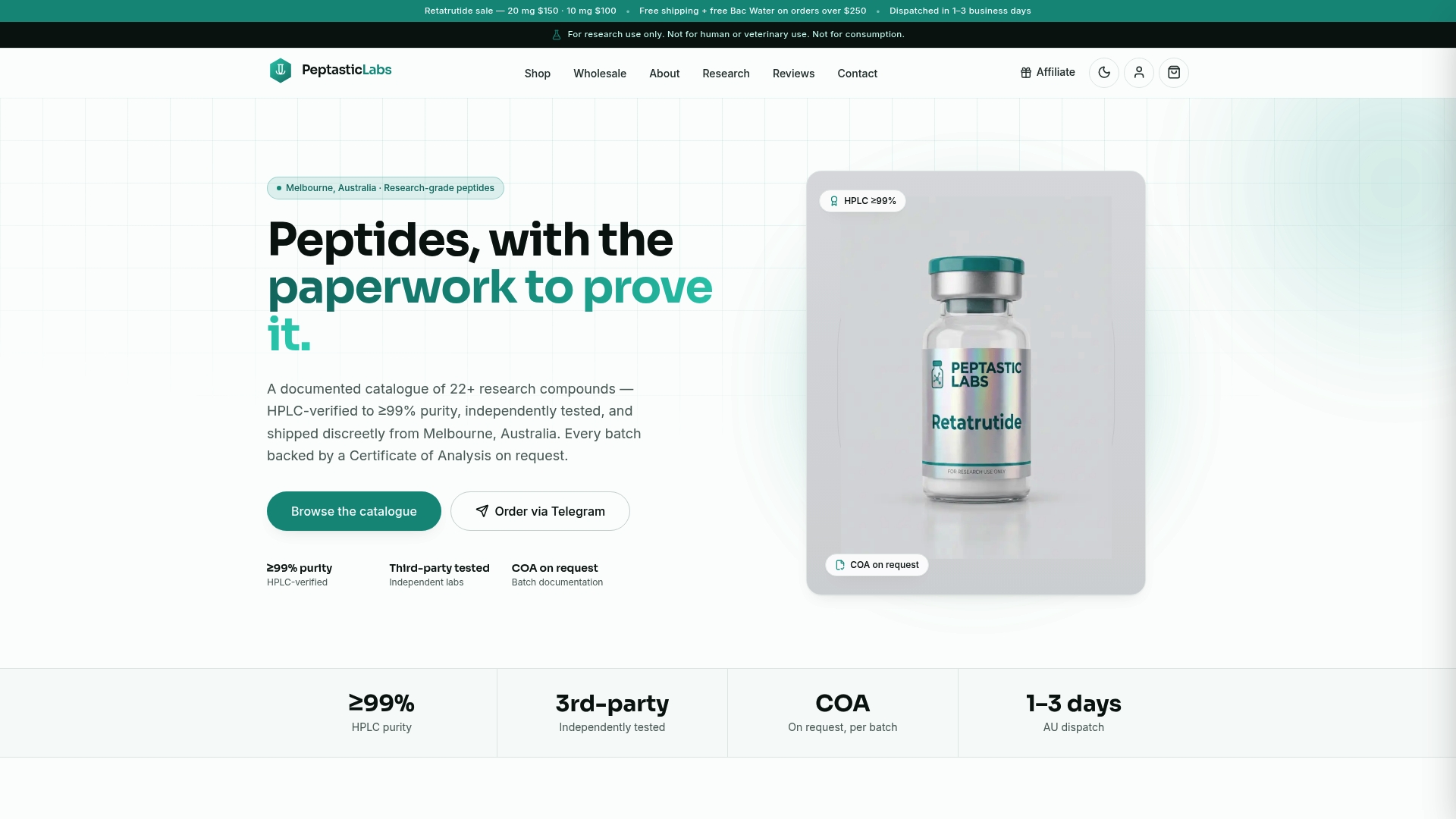
Peptasticlabs is built for exactly the problem this checklist solves: mismatched or incomplete documentation stalling an otherwise straightforward import. Every compound in the Peptastic Labs catalog ships with independently verified ≥99% HPLC purity data, and Certificates of Analysis are available on request with the batch number, test method, and manufacturer declaration your permit application needs already formatted for review.
That matters most when you're the one filling out a DAWE application at 4pm on a Friday and realize your current supplier can't produce a usable COA. Institutional purchasers ordering compounds like MOTS-c or other catalog peptides can request documentation ahead of the order, so it's ready before you lodge anything with BICON or AICIS, not after a hold notice arrives. If your lab has a shipment coming up, start at Peptastic Labs and request the COA for your compound now.
The Real Bottleneck Isn't the Regulation, It's the Paperwork
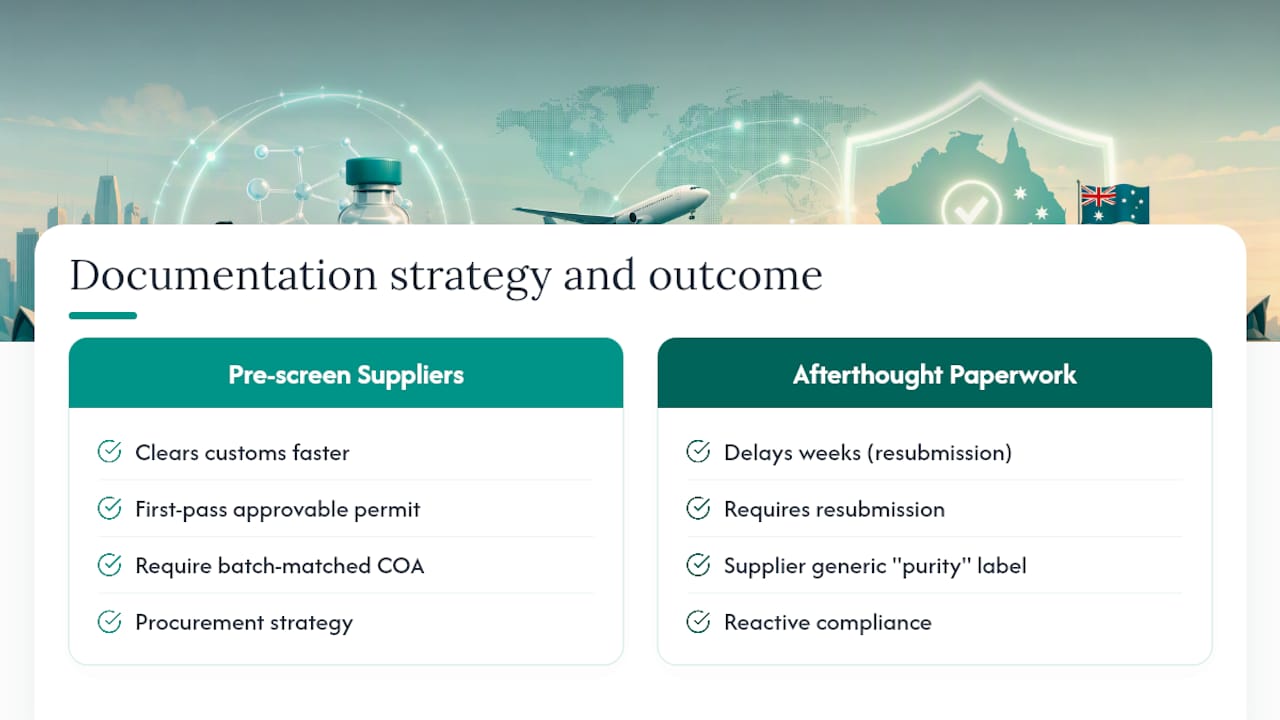
Most Australian labs treat peptide importing as a legal problem when it's actually a documentation problem wearing a legal costume. BICON, AICIS, and ASNO exist to answer three different questions: is this biologically risky, is this an industrial chemical, and is this a weapons-control concern. None of them are designed to trip up a legitimate researcher. What trips up researchers is arriving at the border with a supplier's generic "purity guaranteed" label instead of a batch-matched COA.
The conventional advice to "just check if you need a permit" undersells the real work. You need a permit and the documentation that makes the permit application approvable on the first pass, because a resubmission costs you the same weeks as starting over. Labs that build documentation requests into their supplier selection, before the first order goes in, consistently clear customs faster than labs that treat paperwork as an afterthought triggered by a hold notice. That's not a compliance tip. It's a procurement strategy that happens to also keep you compliant.
— Tintastic
Sources
- Biosecurity Import Conditions (BICON) — DAWE
- Industrial chemicals law in Australia — AICIS
- Summary of import permit provisions — DFAT / ASNO
- Importing biological products — DAWE