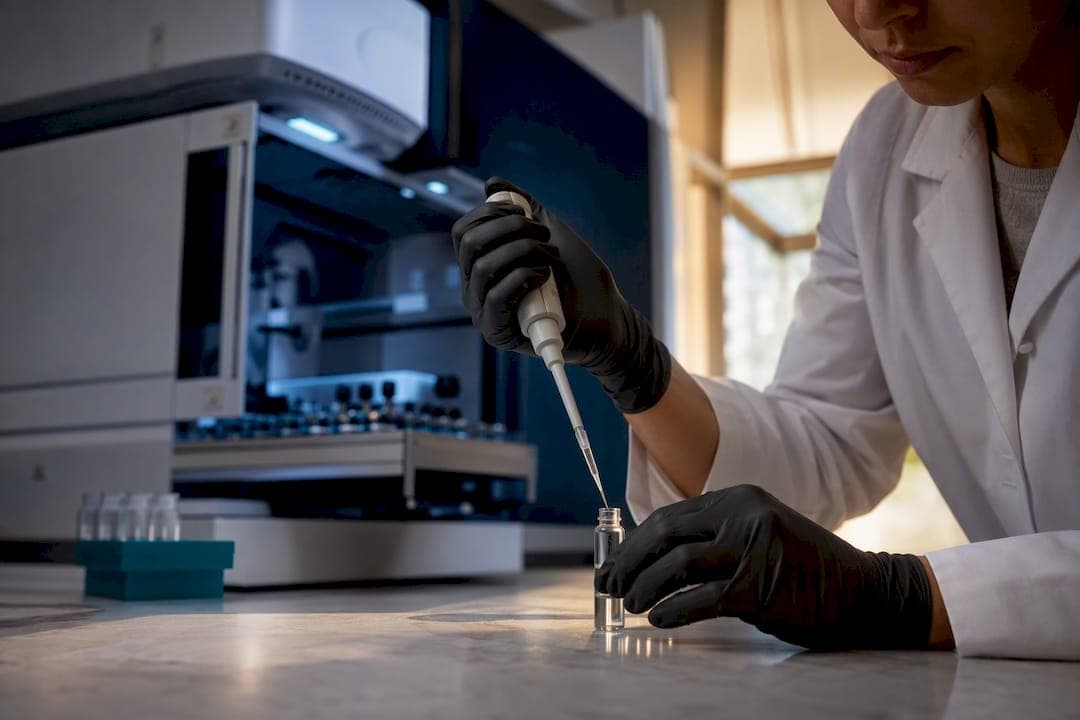
Mass spectrometry, specifically LC-MS/MS and MALDI-TOF, handles the vast majority of peptide sequencing work today, while Edman degradation survives as a narrow confirmatory check on short, unblocked peptides. De novo algorithms fill in where no reference database exists, database search wins when one does, and nanopore or fluorosequencing methods are edging toward practical use for single-molecule reads. Your sample prep and fragmentation strategy usually decide the outcome more than the instrument you pick.
TL;DR:
- Mass spectrometry, especially LC-MS/MS, remains the dominant method for peptide sequencing due to its high sensitivity, throughput, and PTM coverage, outperforming Edman degradation in most applications.
- De novo algorithms are increasingly powerful, especially when paired with multi-protease digestion strategies, enabling high-confidence sequencing of novel peptides without a reference database.
- Choosing the appropriate method largely depends on the research goal, sample purity, and PTM mapping needs, with MS-based techniques preferred for high-throughput or complex proteomics work.
- Sample preparation, including digestion strategy and enrichment, is critical for reliable sequencing, with mirror-protease approaches significantly improving coverage and PTM detection.
- Manual verification of spectral data remains essential, as automated software can misassign ions, especially around isobaric residues and in noisy spectra, emphasizing the importance of expert review.
Table of Contents
- Peptide Sequencing Methods: A Grouped Overview
- Mass Spectrometry Sequencing: The Operational Walkthrough
- Edman Degradation: Where the Classic Method Still Earns Its Place
- De Novo Sequencing vs. Database Search: Choosing the Right Algorithm
- Sample Preparation and Protease Strategy
- Fragmentation and Activation Methods: CID, HCD, ETD, and ECD
- Advanced and Emerging Sequencing Approaches
- How to Choose a Peptide Sequencing Method for Your Project
- How Peptastic Labs Supports Rigorous Sequencing Work
- What Researchers Get Wrong About Sequencing Confidence
- Sources
- FAQ
Peptide Sequencing Methods: A Grouped Overview
Every peptide sequencing method falls into one of three families: chemical degradation, mass spectrometry, or emerging single-molecule techniques. Each family solves a different problem, and picking the wrong one wastes sample and instrument time.
Edman degradation removes and identifies one N-terminal residue at a time through a repeating chemical cycle. It requires a free, unblocked amino terminus and works best on peptides under roughly 30 to 50 residues. It's slow, sample-hungry compared to modern MS, and blind to internal post-translational modifications, but it still gives an unambiguous, instrument-independent read when you need to confirm a synthetic peptide's N-terminal sequence.
Mass spectrometry sequencing dominates modern proteomics for good reason. MS/MS peptide sequencing works by fragmenting peptide ions and reading the mass differences between fragment peaks to reconstruct the amino acid order. LC-MS/MS pairs liquid chromatography separation with tandem MS detection, giving you high sensitivity, PTM coverage, and throughput that Edman chemistry can't touch. MALDI-TOF, run without the LC front end, gives faster but lower-resolution mass fingerprints, useful for quick peptide mapping rather than full de novo reads.
Database search versus de novo sequencing splits MS-based work into two philosophies. Database search matches observed spectra against a predicted digest of a known proteome, which is fast and reliable when your organism or construct is already annotated. De novo peptide sequencing builds the sequence directly from fragment ion mass differences with no reference required, essential for novel peptides, antibody sequencing, or organisms without a curated database.
Single-molecule methods (nanopore sequencing, fluorosequencing, single-molecule MS) read one peptide molecule at a time rather than averaging across a population. They're not yet routine lab tools, but they're the methods to watch for ultra-low-abundance samples.
Matching method to research goal typically breaks down like this:
- Confirming a synthetic peptide's identity: Edman degradation or MALDI-TOF, often paired with HPLC purity data.
- Mapping PTMs on a known protein: LC-MS/MS with ETD or HCD fragmentation.
- Sequencing a novel peptide with no reference: De novo sequencing, ideally with multi-protease digestion.
- High-throughput proteome-wide identification: LC-MS/MS with database search and strict false discovery rate control.
- Detecting a single rare peptide variant: Emerging single-molecule platforms, when access allows.
Mass Spectrometry Sequencing: The Operational Walkthrough
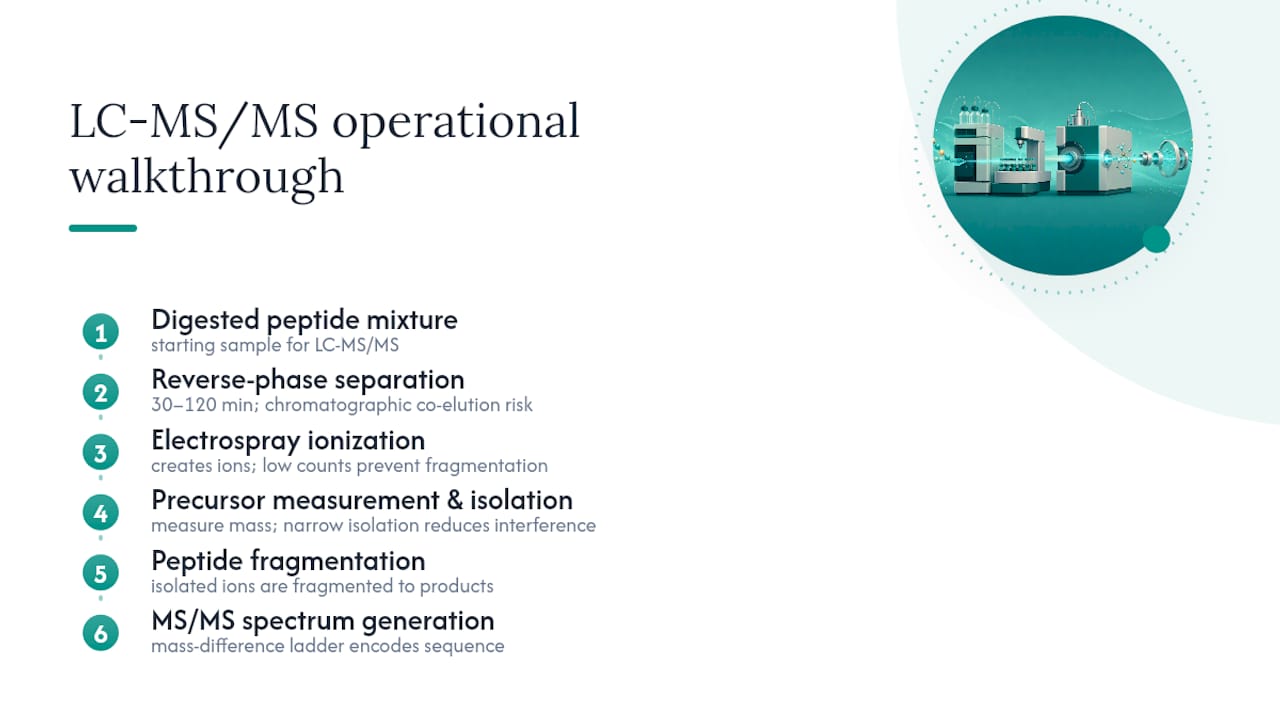
A standard LC-MS/MS run starts with a digested peptide mixture, separates it across a reverse-phase column over 30 to 120 minutes, and feeds eluting peptides into the mass spectrometer through electrospray ionization. The instrument measures precursor mass, then isolates and fragments each peptide ion, generating a tandem MS/MS spectrum that encodes the amino acid sequence as a ladder of mass differences. Most errors in this pipeline don't come from the instrument itself. They come from chromatographic co-elution of near-isobaric peptides, insufficient precursor isolation width, or low ion counts on low-abundance species that never trigger a confident fragmentation event.
Instrument choices and trade-offs
Three platforms cover most peptide sequencing labs:
- Orbitrap-based systems deliver the highest mass accuracy and resolution, which matters most when distinguishing near-isobaric fragments or confidently localizing PTMs by mass shift.
- Quadrupole time-of-flight (Q-TOF) instruments offer fast scan speeds and solid resolution at a lower cost than top-tier Orbitraps, a reasonable middle ground for labs running frequent but not ultra-complex samples.
- MALDI-TOF/TOF systems skip online chromatography entirely, trading some depth of coverage for speed and simplicity, useful for peptide mapping or screening large numbers of fractions quickly.
None of these is universally "best." An Orbitrap running a complex tryptic digest of a poorly characterized proteome earns its cost. A MALDI-TOF/TOF screening synthetic peptide batches for identity confirmation does the job faster and cheaper.
The data-analysis pipeline
Raw spectra become sequences through a defined chain: peak picking, precursor and fragment mass calibration, then either database search (via engines matching spectra to a predicted digest) or de novo assembly of the fragment ladder. Skipping FDR control is one of the most common ways labs overstate confidence in their results.
Manual verification still matters even in automated pipelines. Reviews of de novo sequencing practice consistently stress that automated software can misassign fragment ions, particularly around isobaric residues or when spectra are noisy, so understanding fragmentation rules well enough to sanity-check a handful of key spectra by eye remains a core skill rather than a legacy one.
Common failure modes and how to catch them
Low signal-to-noise ratio spectra produce ambiguous or missing fragment ion series, especially for low-abundance peptides. Isobaric residues, leucine and isoleucine share identical mass and cannot be distinguished by standard fragmentation, and require either chemical derivatization or specialized fragmentation strategies to resolve. Blocked N-termini (acetylation, pyroglutamate formation) will defeat Edman chemistry outright and can also complicate MS fragment ladder interpretation near the terminus.
Pro Tip: When a spectrum gives you a strong b-ion series but a weak y-ion series (or vice versa), don't discard it. Try a complementary activation method on the same precursor before assuming the peptide is unsequenceable. The Hunt Lab's guide to spectral interpretation walks through exactly this kind of triage.
Edman Degradation: Where the Classic Method Still Earns Its Place
Edman degradation sequences peptides by chemically labeling and cleaving one N-terminal residue at a time, identifying each residue via chromatography before the cycle repeats. The chemistry is well understood, doesn't require a mass spectrometer, and gives an unambiguous positional read, one residue confirmed per cycle, rather than a computationally inferred sequence.
Its practical footprint today is narrow but real. It works best when you need to confirm the N-terminal sequence of a short synthetic peptide, verify that a recombinant protein's signal peptide was cleaved correctly, or validate an MS-derived call using an orthogonal, non-mass-based method. Labs doing peptide synthesis QC still reach for it occasionally, particularly when a customer or regulatory reviewer wants confirmation independent of mass spec.
The limitations explain why it's no longer a primary sequencing tool for most research programs:
- Blocked N-termini defeat it entirely. Acetylated, cyclized, or otherwise modified N-terminal residues stop the reaction before it starts, and no amount of extra cycling recovers the sequence.
- Length ceiling. Cumulative yield loss per cycle makes sequences beyond roughly 30 to 50 residues unreliable, since each cycle's incomplete cleavage compounds over the run.
- Throughput. A single Edman run can take hours for a modest read length, compared to an LC-MS/MS run that sequences thousands of peptides in the same timeframe.
- Sample demand. Edman chemistry generally needs more purified material per run than a sensitive MS workflow, a real constraint when your peptide is precious or low-yield.
- No PTM detail. Post-translational modifications beyond simple mass differences (which Edman doesn't measure directly) go undetected.
Think of Edman degradation less as a competitor to mass spectrometry and more as a specialized cross-check, valuable exactly because it fails in different ways than MS does.
De Novo Sequencing vs. Database Search: Choosing the Right Algorithm
Database search wins whenever a reliable reference sequence exists for your organism, construct, or synthetic target, because it's faster, better validated statistically, and less prone to the ambiguity errors that plague reference-free assembly. The engine predicts theoretical fragment masses for every peptide in an in silico digest of the reference proteome, then scores observed spectra against those predictions. When the reference is accurate and complete, this approach is hard to beat on speed and confidence.
De novo peptide sequencing becomes necessary the moment no adequate reference exists: novel antimicrobial peptides, antibody variable regions, venom or toxin peptides, or organisms without a curated proteome. Classic de novo algorithms build sequence tags from spectrum graphs or hidden Markov models, walking the mass differences between fragment peaks to infer residue identity without any external lookup.
Deep learning has changed what's realistically achievable here. Newer architectures have delivered up to 10-fold speed improvements and meaningful precision gains over legacy de novo tools, shifting the practical bottleneck away from algorithm accuracy and toward raw spectral data quality. That's a real reversal from a decade ago, when de novo sequencing was often dismissed as too error-prone for anything beyond partial sequence tags.
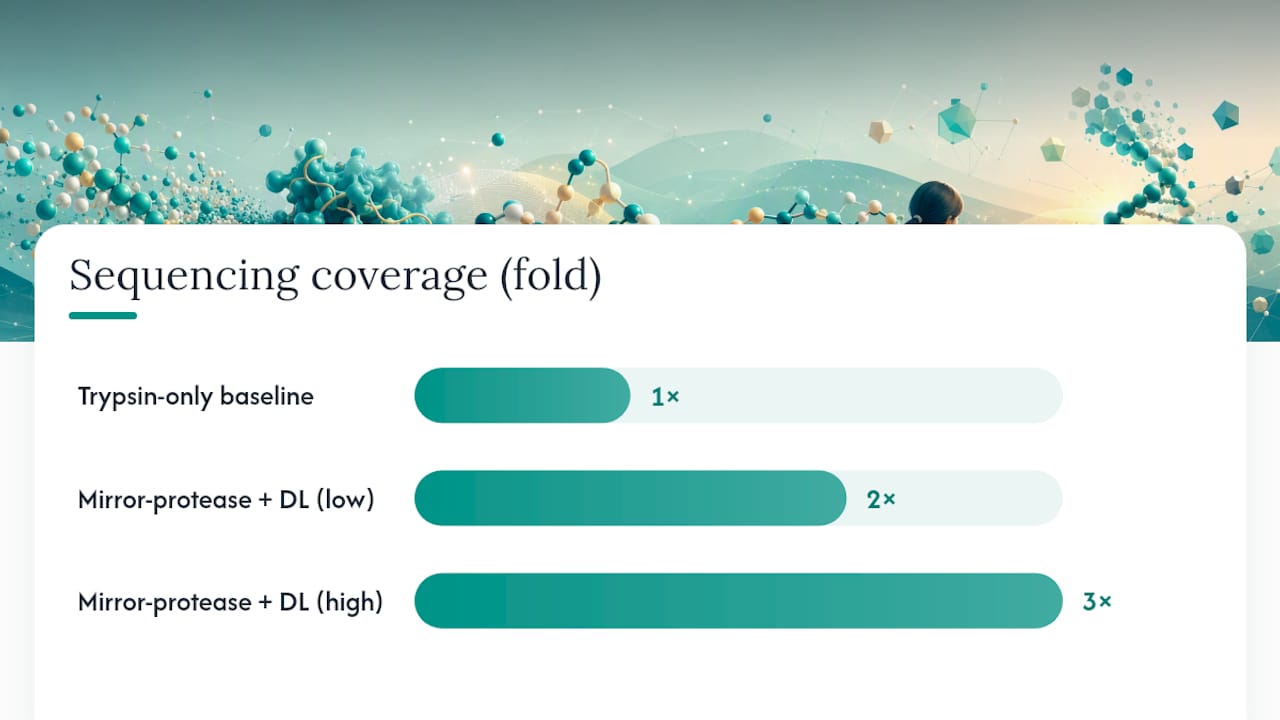
Sequencing coverage jump: Pairing mirror-protease digestion strategies with deep-learning sequencing models produced two- to three-fold increases in high-confidence amino acids sequenced compared with trypsin-only workflows in benchmark datasets, according to the DiNovo system published in Nature Communications.
That gain comes from experimental design, not just software. Digesting the same sample with two proteases that cleave at different, complementary sites generates overlapping fragment sets the algorithm can cross-reference, resolving ambiguous calls that a single-protease digest leaves unresolved. A few practical decision points:
- Reference exists and is trustworthy: run database search first, treat de novo as a sanity check on unmatched spectra.
- No reference, novel target: de novo from the start, ideally with mirror-protease sample prep.
- Partial reference, possible sequence variants: hybrid pipeline, database search followed by de novo re-analysis of unassigned or low-scoring spectra.
- Validating any de novo call you plan to publish or act on: confirm with an orthogonal digestion pattern and manual inspection of raw spectra across multiple charge states.
Sample Preparation and Protease Strategy
Sequence coverage lives or dies on digestion strategy long before a sample ever reaches the mass spectrometer. Trypsin is the default for a reason: it cleaves reliably after lysine and arginine residues, producing peptides in a size range that fragments well under standard MS/MS conditions. But trypsin-only digestion has predictable blind spots. It under-samples regions poor in lysine and arginine, misses cleavage near proline, and can leave PTM-bearing residues buried in fragments too large or too small for confident assignment.
Multi-protease and mirror-protease strategies address this directly. Digesting split aliquots of the same sample with two proteases that cut at different residues, for instance pairing trypsin with a protease cleaving at different sites, generates overlapping, complementary fragment sets. Deep knowledge from mirror-protease workflow studies shows this approach lets sequencing algorithms cross-validate residue calls and recover PTM localization that a single-protease digest would simply never surface.
Enrichment matters just as much for low-abundance targets or PTM-focused studies. Immunoaffinity enrichment, fractionation by strong cation exchange, or targeted phospho-enrichment steps concentrate the peptides you actually care about before they get diluted into a complex background mixture.
A few habits separate reliable sample prep from wasted instrument time:
- Match input amount to method sensitivity. Modern LC-MS/MS can work from nanogram-scale input, but insufficient material still produces sparse, unreliable spectra.
- Watch for artificial modifications introduced during prep. Oxidation of methionine and deamidation of asparagine and glutamine are common prep artifacts, not biology, and should be flagged as variable modifications in any search.
- Report digestion conditions in full. Protease, enzyme-to-substrate ratio, digestion time, and temperature all affect fragment distribution and should appear in any methods write-up.
Split your sample, run a second protease digest in parallel, and let the complementary fragment ladders do the disambiguation work before you spend budget on hardware.*
Fragmentation and Activation Methods: CID, HCD, ETD, and ECD
Collision-based activation (CID and HCD) and electron-based activation (ETD and ECD) produce fundamentally different fragment ion types, and that difference decides how much you can trust a PTM call. CID and HCD accelerate the peptide ion and collide it with neutral gas molecules, breaking the peptide backbone predominantly to generate b- and y-ion series. This works well for standard sequence determination but tends to strip off labile modifications, phosphorylation especially, before the backbone fragments, which means the PTM's mass signature can be lost before it's ever recorded.
ETD and ECD instead transfer an electron to the peptide cation, cleaving N-Cα bonds to produce c- and z-ion series through a gentler mechanism that preserves labile modifications intact. This makes electron-based activation the better choice whenever PTM localization is the actual research question, not just sequence confirmation.
Literature on de novo sequencing practice confirms that combining collision-based and electron-based activation on the same precursor gives complementary fragment coverage. Where CID leaves a gap in the ion series, ETD often fills it, and vice versa. That complementary structure is exactly what improves both sequencing confidence and PTM localization accuracy in practice.
A rough summary of practical differences:
| Activation method | Ion series produced | PTM preservation | Best use case |
|---|---|---|---|
| CID/HCD | b, y | Often lost (labile PTMs) | Standard sequence ID, database search |
| ETD/ECD | c, z | Preserved | PTM localization, isomer discrimination |
| Combined CID + ETD | b, y, c, z | Preserved where ETD applies | Novel peptides, ambiguous PTM calls |
Coverage effect: Running complementary activation modes on the same precursor set, rather than a single method alone, is documented to improve de novo sequencing success and PTM localization relative to relying on one fragmentation type.
Practical artifacts to watch for: ETD efficiency drops for low-charge-state precursors (below 2+), so electron-based activation works best on multiply charged peptides. HCD, meanwhile, can generate a confusing mix of internal fragment ions on longer peptides, which occasionally get mistaken for terminal b- or y-ions during manual review.
Advanced and Emerging Sequencing Approaches
Nanopore-based peptide sequencing threads a single peptide molecule through a nanoscale pore and reads residue-level signal changes as each amino acid passes through, an approach borrowed conceptually from nanopore DNA sequencing. Recent work on exopeptidase-assisted nanopore strategies reports high precision for distinguishing adjacent residues and localizing PTMs directly, without the mass-based inference that MS depends on. It's a genuinely different measurement principle, and that's exactly what makes it valuable for PTM questions MS struggles to resolve cleanly.
Fluorosequencing labels specific amino acid types with fluorescent tags and reads sequential Edman-like cleavage cycles under a microscope, detecting single molecules by fluorescence loss rather than chromatography. Single-molecule mass spectrometry pushes MS itself down to individual peptide detection rather than ensemble averaging. Both approaches demonstrate real feasibility in published method papers, but current throughput and instrumentation maturity keep them out of routine lab rotation for most research groups right now. Treat them as capabilities to track for ultra-low-abundance or single-cell peptide questions, not as replacements for your standard LC-MS/MS pipeline today.
Deep-learning-enabled de novo systems represent the most immediately actionable advance for most labs. Systems like DiNovo pair mirror-protease sample prep with neural sequencing models to push both coverage and speed well past legacy de novo tools, without requiring exotic new hardware. That combination, smarter experimental design plus better algorithms, is a more accessible upgrade path than waiting for nanopore or fluorosequencing platforms to reach routine availability.
Practical takeaways for adoption:
- Nanopore sequencing suits PTM localization questions where mass-based inference has failed you repeatedly.
- Fluorosequencing and single-molecule MS remain best suited to specialized, ultra-sensitive applications, not general-purpose sequencing.
- Deep-learning de novo pipelines with mirror-protease sample prep are the most practical near-term upgrade for labs already running LC-MS/MS.
How to Choose a Peptide Sequencing Method for Your Project
Run through these six questions before committing instrument time to a project:
- What's the research goal? Confirming a known synthetic peptide's identity calls for a different method than discovering a novel sequence from an unknown organism.
- How much sample do you have, and how pure is it? Limited or impure material pushes you toward sensitive MS workflows over Edman chemistry, which demands more purified starting material.
- Do you need PTM mapping? If yes, plan for ETD or ECD fragmentation, or complementary CID/ETD runs, from the outset rather than as an afterthought.
- Is the sequence novel, or does a reference exist? Novel sequences require de novo sequencing, ideally with multi-protease digestion; known references favor database search for speed and confidence.
- What throughput do you need? Single confirmatory peptides tolerate Edman's slower pace; proteome-scale studies require LC-MS/MS's parallel processing capacity.
- What's your instrument access and budget? Orbitrap access changes the calculus versus a Q-TOF or MALDI-only setup, and that access should shape method choice realistically rather than aspirationally.
Default recommendations by scenario: short synthetic peptides needing identity confirmation generally do well with MALDI-TOF or Edman as a cross-check. Complex proteome-wide studies default to LC-MS/MS with database search and strict FDR control. PTM-rich samples need ETD or ECD fragmentation built into the acquisition method from the start. Genuinely novel sequences with no reference call for de novo sequencing paired with mirror-protease digestion for maximum coverage.
Whatever method you land on, document digestion conditions, instrument parameters, search engine and scoring thresholds, and FDR cutoffs in enough detail that another lab could reproduce your identification independently.
Pro Tip: Before trusting a novel de novo call enough to act on it, require the same peptide to show up in fragment spectra from at least two different charge states and, ideally, two different protease digests. A single spectrum, however clean, is not corroboration.
How Peptastic Labs Supports Rigorous Sequencing Work
Every batch ships with documentation, and full Certificates of Analysis are available on request.
That documentation does real work in a sequencing pipeline. A COA with raw chromatogram data lets you confirm the material's purity profile independently before you commit instrument time to characterizing it, and it gives you a reference point when troubleshooting an unexpected fragment pattern, ruling out contamination before you assume an assignment error. Researchers evaluating a vendor's peptide identity claims should look for the specific COA fields that actually confirm identity, not just a purity percentage on its own.
There are protocol-level resources on documenting a peptide research workflow end to end, useful groundwork for labs building out reproducible sequencing methods sections. The company's research page outlines the broader testing and batch documentation standards behind that catalog.
What Researchers Get Wrong About Sequencing Confidence
The biggest gap between what sequencing software promises and what a careful researcher should trust isn't algorithmic. It's the temptation to treat a single high-scoring database match or a clean-looking de novo output as settled fact. Automated pipelines have gotten remarkably good, but expert practice still leans on manual inspection of raw spectra precisely because scoring algorithms can be confidently wrong, especially around isobaric residues or ambiguous PTM sites.
If sequence coverage matters to your project, the highest-leverage change isn't a better instrument. It's redesigning the digestion, running complementary proteases and pairing collision-based with electron-based activation, so the fragment data itself carries less ambiguity into the algorithm. Deep learning has genuinely shifted the bottleneck from software accuracy to raw data quality, which means the lab decisions you make before the sample ever reaches the mass spectrometer now matter more than they used to, not less.
Reproducibility should never be an afterthought either. Report your search parameters, your FDR thresholds, your digestion conditions, and request full documentation, including raw chromatograms, from whoever supplied your starting material. A sequence you can't defend under scrutiny isn't a result yet.
— Tintastic
Sources
For deeper technical grounding beyond this overview:
- Lessons in de novo peptide sequencing by tandem mass spectrometry | PMC
- DiNovo (mirror‑protease deep‑learning system) | Nature Communications
FAQ
What are the main types of peptide sequencing methods?
The three main categories are chemical degradation (Edman sequencing), mass spectrometry (LC-MS/MS and MALDI-TOF), and emerging single-molecule methods like nanopore sequencing and fluorosequencing. MS-based approaches handle the majority of modern research work.
How do you determine the sequence of a peptide?
Most labs determine peptide sequence through LC-MS/MS, fragmenting the peptide ion and reading mass differences between fragment peaks against either a reference database or a de novo algorithm. Edman degradation offers a chemical alternative for short, unblocked peptides needing orthogonal confirmation.
What's the difference between database search and de novo peptide sequencing?
Database search matches observed spectra against a predicted digest of a known, annotated proteome, which is fast when a reliable reference exists. De novo sequencing builds the sequence directly from fragment mass differences with no reference required, essential for novel peptides or unannotated organisms.
What methods are used for protein sequencing beyond peptides?
Full protein sequencing typically combines proteolytic digestion into peptides with LC-MS/MS analysis of the resulting fragments, sometimes supplemented by Edman degradation for N-terminal confirmation. Bottom-up proteomics, digesting first and reconstructing protein identity from peptide fragments, is the dominant strategy in most labs today.
When should I choose Edman degradation over mass spectrometry?
Choose Edman degradation when you need to confirm a short, unmodified peptide's N-terminal sequence independently of mass-based inference, such as validating a synthetic peptide batch. For anything requiring throughput, PTM detection, or work on peptides longer than about 30 to 50 residues, mass spectrometry is the more practical choice.