
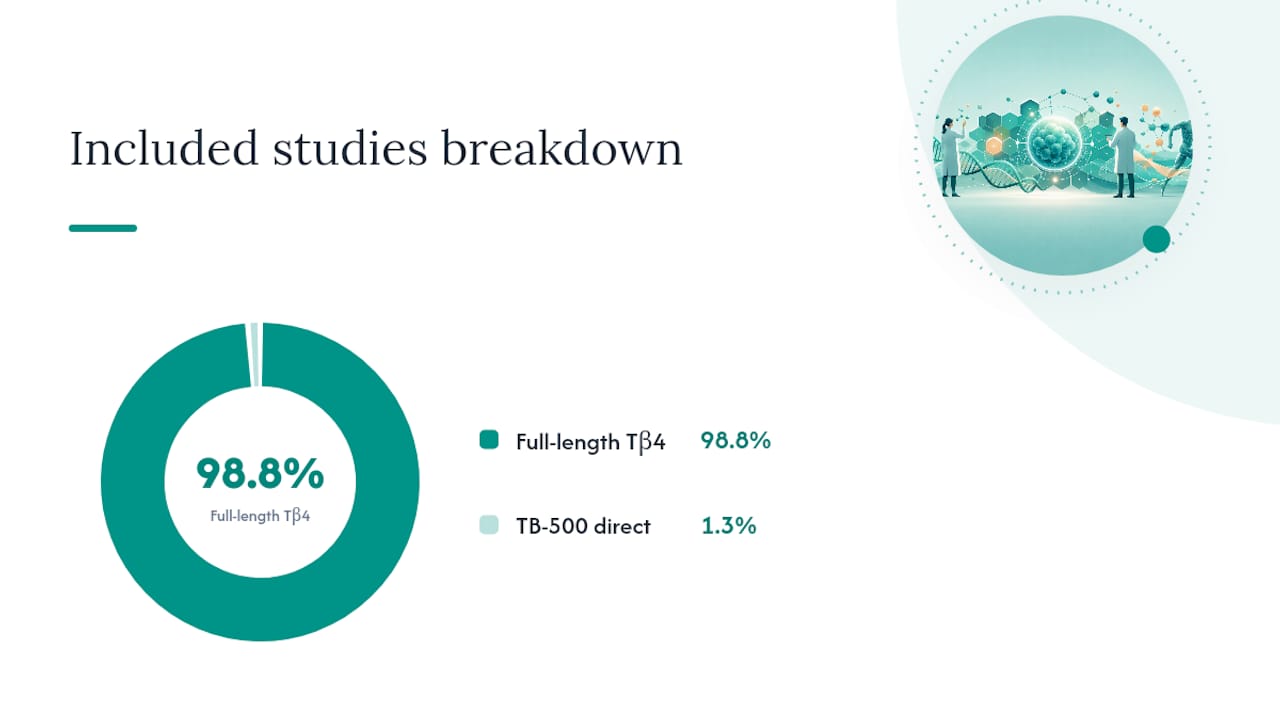
TB-500 is a synthetic peptide fragment commercially derived from the central actin-binding motif of thymosin beta-4 (Tβ4), and the current research consensus is that its tissue-repair evidence base is predominantly preclinical, with direct human data on the fragment itself remaining minimal. A 2026 scoping review that mapped 80 studies found most human evidence concentrated in full-length Tβ4 formulations tested in ocular and wound settings, not in systemic TB-500 fragment studies.
For researchers planning TB-500 tissue research, three points define the current state of the field:
- Molecular identity: TB-500 (commonly written as Ac-LKKTETQ) is a short synthetic peptide fragment capturing the actin-binding region of the full thymosin beta-4 protein. The two are not interchangeable in study design or regulatory terms.
- Strongest evidence contexts: Dermal wound healing and ocular surface repair carry the most consistent preclinical signal; musculoskeletal human data for the fragment specifically remains sparse.
- Critical evidence gap: No large-scale, controlled human trials have tested the TB-500 fragment systemically. Extrapolating full-length Tβ4 clinical outcomes to TB-500 is scientifically tenuous.
Practical takeaway before any study begins: obtain a lot-specific Certificate of Analysis (CoA) with HPLC purity and mass spectrometry identity confirmation, treat the material as investigational, and secure IRB or equivalent ethical approval before any human-subject protocol.
Key Takeaways
TB-500 is a preclinical research tool with a plausible actin-regulation mechanism, minimal direct human evidence as a fragment, and strict RUO regulatory status in the United States.
| Point | Details |
|---|---|
| Fragment vs. full molecule | TB-500 (Ac-LKKTETQ, 17 AA) is not interchangeable with full-length Tβ4 (43 AA) in study design or regulatory terms. |
| Evidence level | A 2026 scoping review of 80 studies found direct TB-500 fragment evidence limited to one mixed study; human data belongs to Tβ4 formulations. |
| Metabolite activity | The metabolite Ac-LKKTE, not the intact TB-500 parent, showed wound-healing activity in fibroblast assays; PK/PD endpoints must include metabolite measurement. |
| Regulatory status | TB-500 is not FDA-approved; sold as RUO material only; human administration requires an IND; classified as a WADA-prohibited derivative. |
| Peptasticlabs sourcing | Peptasticlabs supplies TB-500 at ≥99% HPLC purity with lot-specific CoAs and third-party verification for research protocols. |
Table of Contents
- What TB-500 actually is in tissue research: chemistry and nomenclature
- How TB-500 is believed to work in tissue repair
- What the evidence actually shows: preclinical vs. human studies
- Experimental applications of TB-500 in tissue repair and regenerative medicine
- Safety, dosing in research, and monitoring considerations
- U.S. regulatory and legal status of TB-500
- How to source and verify research-grade TB-500
- Study design and reporting considerations for TB-500 research
- TB-500 vs. BPC-157: how they compare for tissue repair research
- An evidence-first perspective on TB-500 research
- Peptasticlabs supplies verified TB-500 for research protocols
- Sources
What TB-500 actually is in tissue research: chemistry and nomenclature
TB-500 is a commercial designation, not a formal chemical name. The label refers to a synthetic peptide fragment corresponding to amino acids 17–23 of thymosin beta-4, commonly represented as Ac-LKKTETQ. Full-length Tβ4 spans 43 amino acids and carries multiple functional domains beyond actin binding, including regions implicated in anti-inflammatory and anti-apoptotic signaling. The TB-500 fragment retains only the central actin-binding motif, which is why relying on full-length Tβ4 clinical data to justify systemic TB-500 use is scientifically problematic.
The nomenclature problem is real and practically consequential. The scoping review explicitly notes that "TB-500" is used inconsistently across vendors and literature, with some sources applying the label to slightly different sequences or modifications. A product sold as TB-500 by one vendor may not share the exact sequence, acetylation state, or purity of the material tested in the cited study. Researchers must confirm the exact sequence and any post-translational modifications, not just the commercial name.
Pro Tip: Before accepting any TB-500 material for laboratory use, request the lot-specific CoA alongside an HPLC chromatogram showing retention time and purity percentage, plus mass spectrometry confirmation of molecular weight. A vendor who cannot provide both within 48 hours is a sourcing risk. See the CoA verification guide for a field-by-field breakdown of what to check.
How TB-500 is believed to work in tissue repair
The primary proposed mechanism centers on G-actin sequestration. Tβ4 and its fragments bind monomeric actin (G-actin), regulating the pool available for polymerization into filamentous actin (F-actin). This modulation of actin dynamics promotes cell migration in endothelial, epithelial, and fibroblast cell types, a mechanism documented in PubMed-indexed mechanistic studies and supported by a PMC synthesis of translational challenges for Tβ4-related therapies.
Secondary mechanisms proposed in preclinical models include:
- Angiogenesis promotion: Tβ4 upregulates VEGF expression and activates Akt/mTOR signaling pathways in endothelial cells, supporting new vessel formation in ischemic and wound models.
- Anti-inflammatory modulation: Tβ4 fragments appear to suppress NF-κB-mediated inflammatory signaling, reducing pro-inflammatory cytokine output in injured tissue.
- Anti-fibrotic effects: Interactions with TGF-β signaling pathways suggest a potential role in limiting excessive collagen deposition and scar formation, though this is less consistently demonstrated for the fragment specifically.
A critical metabolic caveat applies here. Analytical work using UHPLC-Q-Exactive orbitrap MS/MS found that the metabolite Ac-LKKTE, not the intact TB-500 parent peptide, showed significant wound-healing activity in fibroblast assays. The primary metabolite Ac-LK peaked at 0–6 hours post-administration in rats, while some metabolites persisted up to 72 hours. This means the active agent in some assays may be a breakdown product rather than the administered fragment, with direct implications for PK/PD modeling and assay interpretation.
Practical molecular endpoints to measure in TB-500 studies:
- Cell migration rate (scratch/wound-closure assays in fibroblast or endothelial cell lines)
- Angiogenesis markers: VEGF, CD31, tube formation in Matrigel assays
- TGF-β1 and downstream SMAD signaling for anti-fibrotic endpoints
- Collagen deposition via Masson's trichrome or hydroxyproline quantification
- Metabolite profiling: Ac-LKKTE and Ac-LK levels via LC-MS/MS at defined time points
What the evidence actually shows: preclinical vs. human studies
The evidence pyramid for TB-500 tissue research is heavily bottom-weighted. The 2026 scoping review screened 1,772 records and included 80 studies, with the majority evaluating full-length Tβ4 rather than the TB-500 fragment. Direct TB-500 evidence was minimal. Human data, where it exists, is concentrated in topical and ophthalmic Tβ4 formulations, not systemic fragment administration.
Clinicaltrials lists registered human trials of Tβ4 formulations in wound-related indications such as venous stasis ulcers, illustrating that the human research program has focused on topical delivery of the full-length protein in narrow dermal and ocular indications. No registered Phase II/III trials for systemic TB-500 fragment use in musculoskeletal repair appear in the registry.
Representative studies across the evidence base:
| Study/Reference | Model | Molecule Tested | Route/Dose | Main Outcome | Key Limitation |
|---|---|---|---|---|---|
| PubMed PMID 22962027 | In vitro / animal | Full-length Tβ4 | Topical / subcutaneous | Accelerated cell migration and wound closure | Full-length molecule; not TB-500 fragment |
| UHPLC metabolite study (ScienceDirect) | In vitro / rat | TB-500 and metabolites | Subcutaneous injection | Ac-LKKTE metabolite showed wound-healing activity; parent did not in same assay | Short follow-up; rat model only |
| ClinicalTrials NCT00832091 | Human (venous stasis ulcers) | Tβ4 topical formulation | Topical | Registered trial; topical wound application | Full-length Tβ4, not TB-500 fragment; topical only |
| PMC8724243 (review) | Synthesis of preclinical/early human | Tβ4 and derivatives | Multiple | Summarizes mechanisms and translational gaps | Review-level; highlights absence of robust human data |
| Scoping review (MDPI 2026) | 80 studies mapped | Tβ4 (majority) / TB-500 (minimal) | Multiple | Preclinical signal strong; human data sparse | Direct TB-500 evidence limited to one mixed study |
Risk-of-bias considerations for researchers:
- Most animal studies use inbred rodent strains under controlled wound conditions that do not replicate human chronic wound biology.
- Endpoints in preclinical studies (wound closure rate, histology) do not always map to clinically meaningful outcomes in humans.
- Short follow-up periods (days to weeks) leave long-term safety and durability of effect uncharacterized.
- The fragment-vs-full-molecule distinction is frequently blurred in secondary literature, inflating the apparent evidence base for TB-500 specifically.
Experimental applications of TB-500 in tissue repair and regenerative medicine
The applications with the strongest preclinical signal are those where full-length Tβ4 has been repeatedly tested in controlled animal models and where the actin-regulation and angiogenesis mechanisms are most directly relevant.
Applications with consistent preclinical support:
- Dermal wound healing: Tβ4 accelerates closure in excisional and incisional rodent wound models, with effects on re-epithelialization and granulation tissue formation documented across multiple PubMed-indexed studies.
- Ocular surface repair: Topical Tβ4 formulations have progressed to registered human trials for corneal and conjunctival repair, representing the most clinically advanced application.
- Angiogenesis and vascular repair: Preclinical cardiac and ischemic models show Tβ4 promotes neovascularization via VEGF/Akt pathways, though this work is predominantly in full-length Tβ4.
Proposed musculoskeletal uses and their evidence limitations:
Tendon, ligament, and skeletal muscle repair are among the most commonly cited TB-500 uses in non-peer-reviewed sources. The preclinical rationale is plausible: actin dynamics and cell migration are relevant to tenocyte and myoblast behavior, and anti-inflammatory modulation could reduce fibrotic scarring in injured connective tissue. However, direct controlled studies using the TB-500 fragment in musculoskeletal models are sparse, and no registered human trials exist for these indications. Extrapolating from Tβ4 cardiac or dermal data to tendon repair in humans requires several untested assumptions about fragment bioavailability, tissue distribution, and receptor engagement.
Plausible vs. speculative applications:
- Plausible extrapolation: Dermal wound and ocular surface applications, where the mechanism is well-characterized and Tβ4 human data exists.
- Speculative: Systemic musculoskeletal repair, post-surgical recovery acceleration, and neural regeneration using the TB-500 fragment specifically, absent direct fragment-level evidence in those models.
Safety, dosing in research, and monitoring considerations
No regulatory body has approved TB-500 as a therapeutic for systemic use. Safety data derives primarily from early human trials of full-length Tβ4 in topical and ophthalmic formulations, and from animal studies. Systemic human safety data for the TB-500 fragment itself is limited, and long-term effects are unknown.
Reported and potential adverse effects:
- Injection-site reactions (erythema, swelling) reported anecdotally in non-clinical contexts
- Immune reactions: peptide fragments can be immunogenic; antibody formation has not been systematically characterized for TB-500
- Off-target effects: incomplete understanding of receptor interactions beyond actin binding
- Long-term safety: no chronic toxicology studies for the fragment in humans
Dosing ranges reported in research (research context only):
Preclinical animal studies have used subcutaneous and intraperitoneal routes. Doses in rodent models have ranged widely depending on the model and endpoint, and direct dose translation to human equivalents requires allometric scaling that has not been validated for this fragment. Anecdotal reports in non-clinical settings describe subcutaneous administration, but these are not from controlled trials and carry no regulatory or safety endorsement. Any dosing in a human research protocol must be justified by PK/PD data and reviewed by an IRB.
Monitoring checklist for research protocols:
- Baseline labs: complete blood count, comprehensive metabolic panel, immunoglobulin levels
- Immunogenicity assays: anti-drug antibody (ADA) testing at baseline, mid-study, and endpoint
- PK sampling: plasma collection at defined intervals for parent peptide and metabolite quantification via LC-MS/MS
- Histology endpoints: tissue biopsy at defined time points for collagen deposition, inflammatory infiltrate, and neovascularization scoring
- Adverse event reporting: structured AE log with severity grading per protocol; report serious AEs to IRB within required timeframes
- Follow-up duration: minimum 90-day follow-up recommended to capture delayed immune or off-target effects
U.S. regulatory and legal status of TB-500
TB-500 is not an FDA-approved drug. It is sold commercially in the United States as a "research-use-only" (RUO) material, which means it is not authorized for human administration outside of an approved investigational new drug (IND) application or equivalent institutional protocol.
The FDA's guidance on bulk drug substances used in compounding under Section 503A outlines the restrictions and risk assessments relevant to unapproved peptides. Compounding pharmacies operating under Section 503A may only use bulk drug substances that appear on an approved list or that meet specific criteria; peptides like TB-500 that lack FDA approval face significant procurement and compounding constraints. Researchers procuring TB-500 for laboratory use must operate within institutional biosafety and compliance frameworks, not through compounding channels intended for patient care.
Key regulatory points for U.S. researchers:
- IND requirement: Any human administration of TB-500 outside an approved protocol requires an IND filed with the FDA.
- RUO labeling: RUO designation does not confer safety approval; it restricts use to laboratory research and prohibits clinical or diagnostic use.
- Institutional oversight: IRB approval, biosafety committee review, and institutional compliance sign-off are required before any human-subject study.
- WADA status: WADA and anti-doping authorities have identified Tβ4 derivatives as prohibited substances due to potential tissue-repair and performance effects, as documented in published anti-doping literature. Investigators conducting research with athlete populations must disclose prohibited-substance status in protocol documents and obtain appropriate waivers or exemptions.
How to source and verify research-grade TB-500
Sourcing quality is a direct determinant of data validity. Because "TB-500" is a commercial label applied inconsistently across vendors, a rigorous procurement checklist is non-negotiable. The scoping review explicitly flags vendor labeling variability as a research integrity concern.
Procurement checklist:
- Certificate of Analysis (CoA): Lot-specific, not generic. Must include purity percentage, analytical method, and test date.
- HPLC chromatogram: Confirm purity ≥99% for research-grade material; check retention time against reference standard.
- Mass spectrometry identity: LC-MS or MS/MS confirmation of molecular weight matching the stated sequence (Ac-LKKTETQ, MW approximately 902 Da).
- Endotoxin level: LAL assay result; acceptable threshold for cell-based assays is typically <1 EU/mg.
- Lot number and chain-of-custody: Traceable from synthesis to delivery; required for methods reporting.
- Storage and expiration: Lyophilized powder stability data; temperature and humidity conditions during shipping.
- Third-party testing: Independent laboratory verification, not solely in-house supplier data. See third-party peptide testing guidance for assay type comparisons.
Acceptable analytical methods are HPLC (purity and identity by retention time), LC-MS/MS (sequence confirmation and metabolite profiling), and amino acid analysis for composition verification. For purity standards and HPLC interpretation, the key metric is the area-under-curve percentage for the target peak relative to all detected peaks.
Pro Tip: When reading a CoA, the three fields that matter most are: (1) the HPLC purity percentage with the method stated, (2) the MS-confirmed molecular weight versus the theoretical value for the stated sequence, and (3) the lot number matching the shipped vial label. Red flags that should block use: purity stated as a range rather than a specific value, no lot number, sequence described only as "TB-500" without the amino acid sequence, and test dates more than 12 months before receipt. A batch documentation checklist covers how to record these fields in your experimental methods.

Study design and reporting considerations for TB-500 research
Rigorous TB-500 research requires explicit attention to the fragment-vs-full-molecule distinction at every stage of design and reporting. The most common methodological failure in this field is treating Tβ4 preclinical results as direct evidence for TB-500 efficacy without fragment-specific data.
Study design checklist:
- State the exact molecule: amino acid sequence, acetylation state, molecular weight, and lot number in the methods section.
- Include appropriate controls: vehicle control, and where feasible, a full-length Tβ4 arm to allow direct fragment-vs-parent comparison.
- Justify dose selection with PK/PD rationale: allometric scaling from rodent to human equivalents, or dose-range finding data.
- Include metabolite measurement: design PK sampling to capture Ac-LKKTE and Ac-LK at minimum, given evidence that metabolites may mediate wound-healing activity rather than the intact fragment.
- Pre-register the study protocol on ClinicalTrials.gov or an equivalent registry before enrollment.
Recommended models and endpoints:
- In vitro: Human dermal fibroblast and human umbilical vein endothelial cell (HUVEC) lines for migration and angiogenesis assays; scratch assay with time-lapse imaging.
- Animal models: Excisional wound models in C57BL/6 mice for dermal endpoints; rat Achilles tendon transection for musculoskeletal endpoints; report strain, sex, age, and housing conditions.
- Biomechanical endpoints: Tensile strength and stiffness for tendon/ligament models.
- Histologic endpoints: H&E for cellularity, Masson's trichrome for collagen, CD31 immunostaining for vascularity.
Common pitfalls to avoid:
- Citing full-length Tβ4 animal studies as evidence for TB-500 fragment efficacy without fragment-specific data.
- Omitting metabolite assays, which can confound interpretation of whether the parent peptide or a breakdown product drove the observed effect.
- Using a single time point for tissue collection, missing peak metabolite activity windows (Ac-LK peaks at 0–6 hours in rats).
- Failing to report lot number and CoA data in the published methods section, which prevents replication.
TB-500 vs. BPC-157: how they compare for tissue repair research
TB-500 and BPC-157 are frequently discussed together in regenerative medicine research because both are short synthetic peptides with proposed tissue-repair properties and both are sold as RUO materials. Their mechanisms, evidence bases, and regulatory profiles differ in ways that matter for experimental planning.
BPC-157 (Body Protection Compound 157) is a 15-amino-acid peptide derived from a gastric protein, with proposed mechanisms involving nitric oxide synthesis modulation, growth hormone receptor interaction, and angiogenesis via VEGFR2 signaling. TB-500 acts primarily through actin dynamics and G-actin sequestration. The two pathways are distinct, which is why some researchers stack them in animal models, though no controlled human data supports combined use.
| Dimension | TB-500 (Ac-LKKTETQ fragment) | BPC-157 |
|---|---|---|
| Evidence strength | Predominantly animal/in vitro; direct fragment human data minimal | Predominantly animal/in vitro; no registered human trials identified |
| Primary mechanism | G-actin sequestration → cell migration; VEGF/Akt angiogenesis | NO synthesis modulation; VEGFR2 angiogenesis; GH receptor interaction |
| Typical research uses | Dermal wound healing, ocular surface, angiogenesis models | GI mucosal repair, tendon/ligament models, muscle injury |
| Safety/regulatory status (U.S.) | Not FDA-approved; RUO only; WADA-prohibited derivative | Not FDA-approved; RUO only; no approved human formulation |
| Routes/dosing in studies | Subcutaneous in rodent models; topical for Tβ4 human trials | Subcutaneous or oral in rodent models; no validated human dose |
For researchers choosing between them, the decision should follow the mechanism most relevant to the tissue target. Dermal and ocular models have a stronger Tβ4/TB-500 literature to build on. GI and tendon models have more BPC-157 preclinical data. Neither has sufficient human evidence to justify clinical translation outside a formal IND framework. For broader context on peptides in musculoskeletal applications, the role of peptides in muscle repair provides useful comparative background.
An evidence-first perspective on TB-500 research
The most consequential mistake researchers make with TB-500 is treating the commercial fragment as a well-characterized clinical compound when it is not. The scoping review's finding that 80 mapped studies yielded minimal direct TB-500 fragment data is not a minor footnote. It means the majority of the mechanistic and clinical rationale cited for TB-500 in secondary literature actually belongs to a different, longer molecule with different functional domains.
This matters practically. A researcher designing a musculoskeletal repair study who cites Tβ4 cardiac or wound data as justification for their TB-500 protocol is building on an assumption, not evidence. The metabolite data adds another layer: if Ac-LKKTE is the active agent in fibroblast assays, then a study that administers TB-500 and measures only the parent peptide in plasma is measuring the wrong thing. These are not minor methodological quibbles. They determine whether a study's results are interpretable.
The responsible path is to treat TB-500 as what the evidence currently supports: a preclinical research tool with a plausible mechanism, a limited but growing analytical literature, and no approved human application. Designing studies that directly test the fragment, measure its metabolites, and include full-length Tβ4 comparator arms would advance the field more than another study that assumes equivalence with the parent molecule.
Peptasticlabs supplies verified TB-500 for research protocols
Researchers who need TB-500 with the documentation standards required for publication-grade work can request lot-specific CoAs, HPLC chromatograms, and third-party test results directly from Peptasticlabs before placing an order.
TB-500 from Peptasticlabs is supplied as research-use-only material, not for human administration outside of IRB-approved protocols. Researchers can review batch documentation, confirm sequence identity, and access CoA records through the Peptasticlabs research-grade peptide catalog. For institutions requiring bulk quantities or wholesale documentation packages, direct inquiry is available through the same portal. This is general information; confirm procurement compliance with your institution's biosafety and regulatory office before ordering.
Sources
Key primary literature and regulatory references used in this article:
- Thymosin Beta-4 and TB-500 in Tissue Healing, Regeneration, and Musculoskeletal Repair: A Scoping Review
- Simultaneous quantification of TB-500 and its metabolites in in-vitro experiments and rats by UHPLC-Q-Exactive orbitrap MS/MS and their screening by wound healing activities in-vitro
- PubMed record (PMID 22962027)
- Clinicaltrials
- PMC review article (PMC8724243)
- Bulk drug substances used in compounding under section 503A of the FD&C Act
This article is general information, not a substitute for advice from a qualified doctor. Consult a qualified healthcare professional about your own circumstances before acting on anything here.