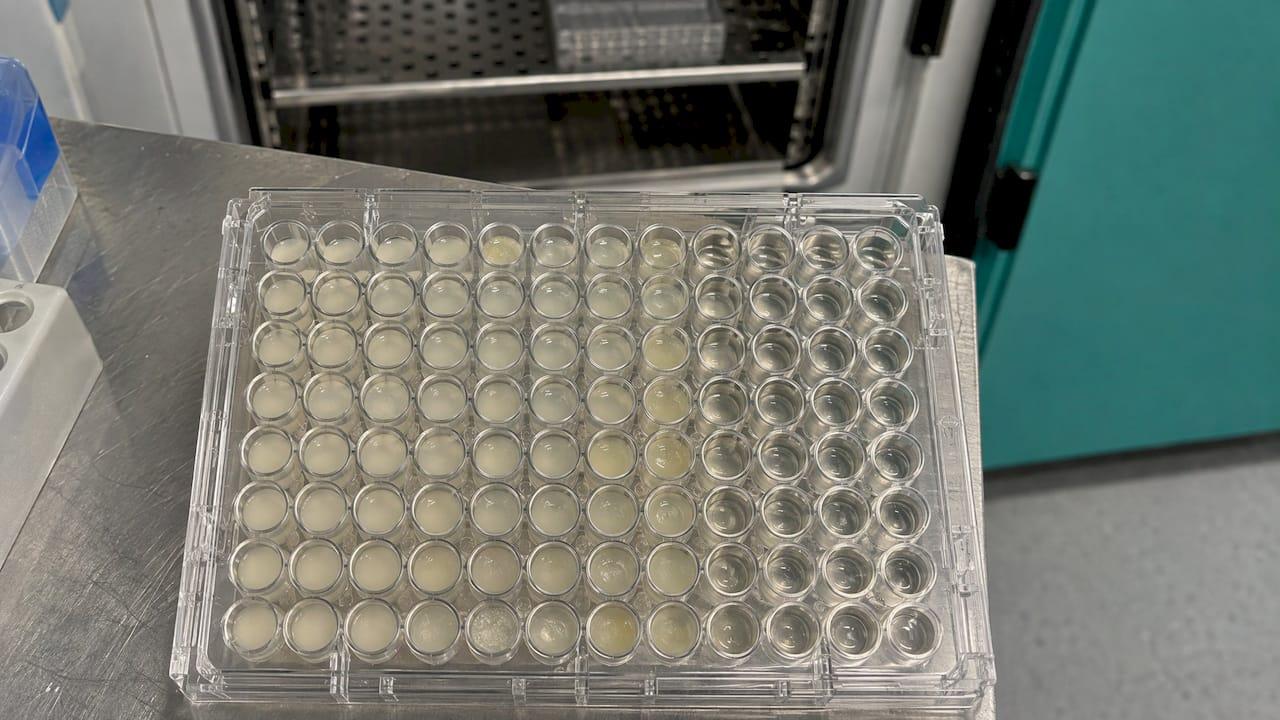
Cathelicidin analogs are synthetic peptides derived from natural cathelicidins, most often human LL-37. They are shortened, substituted or chemically modified to keep antimicrobial and immunomodulatory activity while reducing cytotoxicity, proteolytic breakdown and production cost. This reference covers what the term means, how analogs are designed, which ones are documented, how activity is measured, and what limits the evidence. Everything here is for in vitro and laboratory research context.
TL;DR
- Cathelicidins are a vertebrate host-defence peptide family. Analogs are engineered variants of them, mainly of LL-37.
- Common design levers: N-terminal truncation, residue substitution, D-amino acids or unnatural residues, C-terminal amidation, lipidation.
- Documented analogs include 17BIPHE2, KR-12 variants, OP-145, SAAP-148 and SLP-51.
- Standard readouts: MIC, antibiofilm tests, hemolysis, cytotoxicity, LPS neutralization, serum inhibition.
- Evidence limits: in vitro results may not predict infection conditions, and few cathelicidin-based peptides have reached clinical trials.
Table of Contents
- What cathelicidins and cathelicidin analogs are
- How analogs are designed
- Representative analogs studied
- Endotoxin and immune effects
- How activity is tested
- Limits of the evidence
- Handling analogs in the lab
- Australian research context
- Sourcing peptides for analog and host-defence research
- FAQ
- Sources
What cathelicidins and cathelicidin analogs are
Cathelicidins are a widespread family of vertebrate host-defence peptides. They share a relatively conserved proregion, while the mature peptides differ widely. Mature peptides have direct antimicrobial roles and immunomodulatory roles (Frontiers in Drug Discovery, 2024).
Humans express one cathelicidin gene product, hCAP18, whose active fragment is LL-37. Other species carry different members, including BMAP-27, BMAP-34 and mouse mCRAMP, which have been compared for bactericidal, antibiofilm and immunomodulatory properties in the literature.
In research usage, an analog is a peptide built from a parent sequence with deliberate changes. The parent can be full-length LL-37, a fragment such as KR-12, or a non-human cathelicidin. The goal is a defined structure-activity relationship: change one property, measure the effect.
For a full profile of the parent peptide, see the LL-37 researcher's reference guide.
How analogs are designed
Native cathelicidins have three recurring limitations in the lab: cytotoxicity, rapid enzymatic degradation and high production cost. Analog design addresses each of them. Reviews describe strategies including N-terminal truncation, sequence inversion (retro-analogs) and unnatural amino acid substitutions such as biphenylalanine (Int. J. Mol. Sci., 2025).
| Strategy | Intended effect | Example in the literature |
|---|---|---|
| N-terminal truncation | Lower toxicity, shorter and cheaper synthesis | KR-12 variants from LL-37 |
| Residue substitution | Adjust hydrophobicity, charge, helicity | Substituted KR-12 analogs |
| D-amino acids, unnatural residues | Resist proteases | 17BIPHE2 |
| C-terminal amidation | Stabilize helix, increase net charge | KR12-NH2 |
| Lipidation (fatty acid conjugation) | Increase membrane affinity | C8-KR12-NH2 |
The common aim is to strengthen helical structure and amphipathicity, the two features tied to antimicrobial activity (Int. J. Mol. Sci., 2025).
A worked example: from LL-37 to 17BIPHE2
A primary study built a template containing D-amino acids. It resisted chymotrypsin and was active against E. coli, but not against MRSA. Repairing its hydrophobic defects produced 17BIPHE2, which was active against ESKAPE pathogens (PubMed, 2014). The sequence of steps matters: stability was fixed first, then spectrum.

A second example: lipidated KR-12
KR-12 is the minimal antimicrobial region of LL-37. In one study, conjugating KR12-NH2 with C4 to C14 fatty acids enhanced activity. The best result was C8-KR12-NH2, with MIC values of 1 to 4 μg/mL against ESKAPE strains (Int. J. Mol. Sci., 2020). The same paper reports minimal biofilm eradication concentrations for an S. aureus strain of 256 μg/mL for KR12-NH2 and above 512 μg/mL for LL-37 in Mueller-Hinton medium, which shows how biofilm and planktonic readouts can diverge.
Peptide chain composition drives all of these effects. For background on residues, charge and structure, see the peptide amino acid chain guide.
Representative analogs studied
A 2025 review lists LL-37-derived analogs including 17BIPHE2, KR-12 variants, OP-145, SAAP-148 and SLP-51. Reported effects include antibacterial and antibiofilm activity, and SLP-51 was also tested in mouse infection models (Int. J. Mol. Sci., 2025).
KR-12 analogs designed from LL-37 (KR-12-a2 to a5) were reported with a 4 μM MIC against methicillin-resistant Staphylococcus aureus, along with antiendotoxic activity and no mammalian cell toxicity in that study (Short KR-12 analogs, via ResearchGate). The same source notes the native LL-37 MIC is lower than that of KR-12 (5 μM versus 40 μM), so the shorter fragment trades raw potency for selectivity and simplicity. Analog design is a balance, not a one-way improvement.

Endotoxin and immune effects
Cathelicidin work is not only about killing bacteria. LL-32, an LL-37 variant, neutralizes LPS through peptide-LPS interactions and effects on host-cell membranes. It reduced LPS-induced TNF-α in human macrophages and improved survival in a mouse endotoxin-shock model (PNAS, 2021).
This is why researchers study analogs for dual activity: antimicrobial effect plus control of inflammatory signalling. For wider context on host-defence peptides and immune pathways, see the immune modulation guide, the overview of immunomodulatory peptide paths and the note on TLR peptides in research.
How activity is tested
A typical analog characterization panel has these elements:
- MIC. Broth microdilution against reference strains, reported in μg/mL or μM. Medium matters: results differ between Mueller-Hinton and low-salt media, as the lipidated KR-12 data show (Int. J. Mol. Sci., 2020).
- Antibiofilm assays. Minimal biofilm eradication concentration and biofilm inhibition, run in parallel with MIC because the two can differ by orders of magnitude.
- Hemolysis. Red blood cell lysis as a first selectivity screen.
- Cytotoxicity. Mammalian cell viability assays to set a therapeutic window.
- Endotoxin neutralization. LPS binding, and cytokine suppression such as TNF-α in macrophages.
- Serum and protease challenge. Activity after incubation with serum or enzymes such as chymotrypsin.
- Animal models. Mouse infection or endotoxin-shock models, reported for a few analogs only.
For protocol-level detail, see the antimicrobial peptide assays guide, which covers MIC and hemolysis.
Reporting checklist
- Strain identifiers and growth medium.
- Peptide net charge, length and terminal modification (amide or free acid).
- Purity and identity data per batch (HPLC, mass spectrometry).
- Counter-ion form, since it can influence cell assays.
- Replicate numbers and controls, including the parent peptide.
Limits of the evidence
Limitations recur across the literature: cytotoxicity and hemolytic activity, proteolytic instability and high production cost. Modification strategies aim to improve stability and selectivity while reducing toxicity (Int. J. Mol. Sci., 2025).
Three further points shape how results should be read:
- Serum binding. Apolipoprotein A-I binds LL-37 in human plasma and inhibits its antibacterial activity, and may act as a scavenger that protects host cells (J Biol Chem, 1998). Serum-free MIC values therefore need serum-containing follow-up.
- Model relevance. Membrane-disruption mechanisms described in vitro may not represent conditions during host infections (Frontiers in Microbiology, 2024).
- Clinical translation. Few cathelicidin-based peptides have entered clinical trials despite two decades of effort (Frontiers in Drug Discovery, 2024).
These points define the research questions, not the end of them: stability, selectivity and matrix effects are precisely what analog programs are built to address.
Handling analogs in the lab
Analog performance in an assay depends on sample integrity. Cationic amphipathic peptides adsorb to plastic and can aggregate, which shifts apparent MIC values.
- Store lyophilized material as the batch documentation specifies, and aliquot before reconstitution. See lyophilized peptide handling.
- Test aggregation one residue change at a time: peptide aggregation guide.
- Reduce surface loss at low concentrations: peptide carrier proteins.
Australian research context
Australia's framework combines Commonwealth and state or territory legislation, national standards and institutional governance. Infectious-agent research needs the relevant ethics and safety approvals, including biosafety and biosecurity (NHMRC, 2022). Work involving genetically modified organisms falls under gene technology legislation and the oversight of the Gene Technology Regulator (same NHMRC report).
In practice, confirm with your institutional biosafety committee before handling pathogenic strains or running animal work. Most efficacy figures cited above come from studies run outside Australia, so treat them as reference points for your own validated assays.
Perspective
Analog work depends on one thing before any assay: knowing exactly what is in the vial. A change of one residue or a terminal amide can shift MIC, hemolysis and serum behavior, so an impure or mis-identified batch makes a structure-activity table meaningless.
That is why we document every batch. Each peptide in our catalogue is independently tested by HPLC and mass spectrometry, with a purity target of ≥99%, traceable batch documentation and a Certificate of Analysis available on request. Researchers can match the data to the lot used in their assay and report it.
We see analog research as a discipline of controlled variables. Verified identity and purity are the first variable to lock.
Tintastic
Sourcing peptides for analog and host-defence research
Peptastic Labs supplies research-grade peptides, each HPLC-verified to ≥99% purity, across Metabolic, Cognitive & Neuro, Tissue & Repair, Longevity, Cosmetic Science, Blends, Hormone & Reproductive and Ancillaries & Reagents lines. Certificates of Analysis are available on request, and bulk or wholesale options exist. Browse the full peptide catalogue or visit Peptastic Labs.

Products are supplied for laboratory research only.
FAQ
What is the difference between a cathelicidin and a cathelicidin analog?
A cathelicidin is a natural host-defence peptide with a conserved proregion and a variable mature peptide. An analog is a laboratory variant of that peptide, altered by truncation, substitution, D-amino acids or chemical modification to change stability, selectivity or activity.
Which analogs are most often cited?
LL-37-derived analogs reported in reviews include 17BIPHE2, KR-12 variants, OP-145, SAAP-148 and SLP-51. KR-12 is the most common starting fragment because it is short and retains the core antimicrobial region.
Why do MIC values differ between papers?
Growth medium, salt content, strain, inoculum and peptide form all change the result. The lipidated KR-12 study, for example, reports different biofilm values in Mueller-Hinton medium and in peptone medium. Compare values only under matched conditions.
Do in vitro results show clinical potential?
They show activity under defined conditions. Serum binding, proteases and host-cell effects add complexity, and few cathelicidin-based peptides have reached clinical trials. In vitro data remain the standard first step for ranking analogs.
Sources
- Cathelicidins, a rich seam of antimicrobial peptides, Frontiers in Drug Discovery (2024)
- Antimicrobial Peptides of the Cathelicidin Family, Int. J. Mol. Sci. (2025)
- Transformation of human cathelicidin LL-37 into selective, stable peptide antibiotics, PubMed (2014)
- Lipidated analogs of KR12, Int. J. Mol. Sci. (2020)
- Short KR-12 analogs designed from LL-37, ResearchGate
- Cathelicidin and PMB neutralize endotoxins, PNAS (2021)
- Apolipoprotein A-I binds and inhibits human LL-37, J Biol Chem (1998)
- Recent advances in the therapeutic potential of cathelicidins, Frontiers in Microbiology (2024)
- Gain-of-Function Research Review: Report, NHMRC (2022)