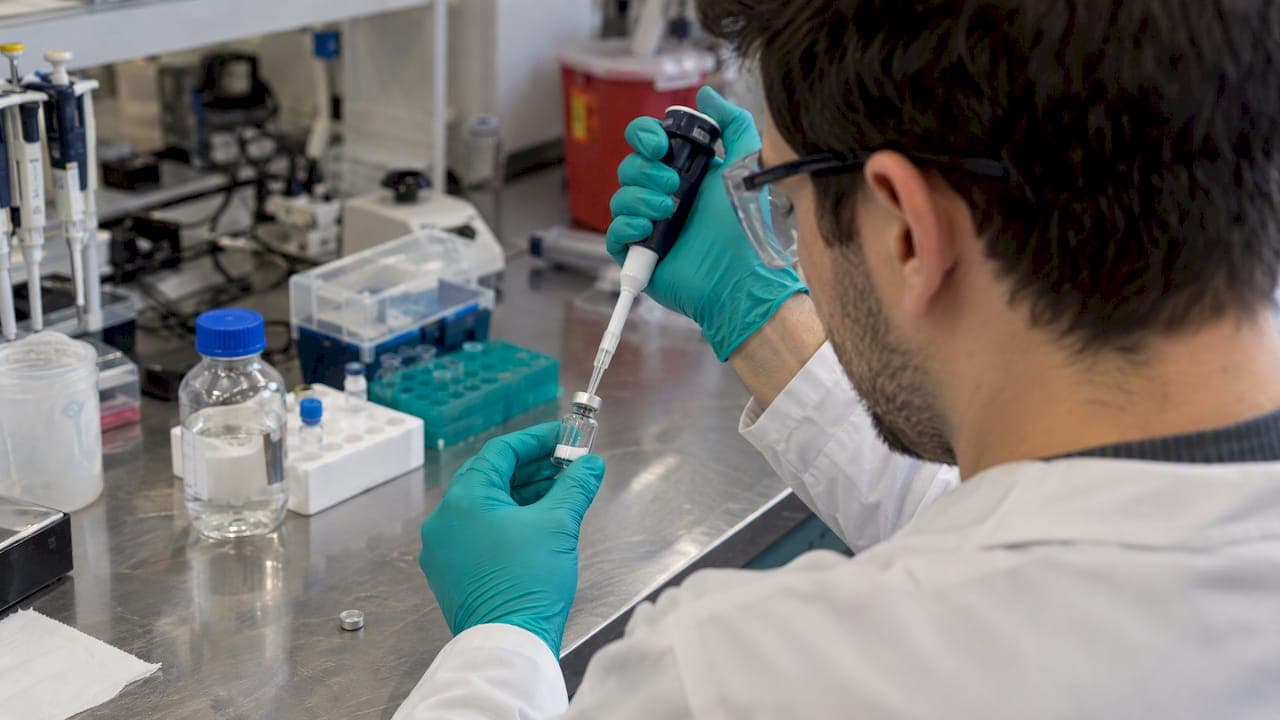
Lyophilized peptides are handled in four steps: store the sealed vial cold, dry and dark; equilibrate it to room temperature before opening; reconstitute gently with a solvent matched to the sequence; aliquot into single-use volumes and avoid repeated freeze-thaw. The powder is the stable form. Most degradation starts once moisture, oxygen or a solvent enters the vial. This guide sets out each step as a bench procedure, with the failure points and the Australian regulatory context.
TL;DR
- Sealed lyophilized vials: store at -20 °C for the long term, dry and protected from light. Short-term, cool and dark is acceptable.
- Equilibrate the closed vial to room temperature, ideally in a desiccator, before opening. A cold vial opened in room air collects condensation.
- Reconstitute by gentle swirling, never vigorous shaking. Choose the solvent for the peptide's chemistry, not by habit.
- Aliquot the solution into single-use volumes. Each freeze-thaw cycle adds physical stress.
- In Australia, a "research use only" label does not change a product's regulatory status under the TGA.
Table of Contents
- Why lyophilized peptides need specific handling
- Receiving and inspecting a shipment
- Storing sealed lyophilized vials
- Equilibration before opening
- Reconstitution step by step
- Aliquoting and freeze-thaw limits
- Storing reconstituted peptide
- Signs a peptide may have degraded
- A handling checklist for the bench
- Perspective: what we see in handling failures
- Australian regulatory context
- Research-grade peptides with batch documentation
- FAQ
- Sources
Why lyophilized peptides need specific handling
Lyophilization (freeze-drying) removes water from a frozen peptide solution by sublimation. The result is a dry cake or powder with little water available for hydrolysis and other chemical reactions. That is why the same sequence lasts far longer as powder than in solution.
Four variables govern stability:
| Variable | Risk | Control |
|---|---|---|
| Temperature | Faster chemical degradation | Freezer storage, limited time at room temperature |
| Moisture | Hydrolysis, clumping, weighing error | Sealed vial, desiccant, equilibration before opening |
| Light | Photo-oxidation of sensitive residues | Amber vial or opaque secondary container |
| Oxygen | Oxidation (for example Met, Cys, Trp residues) | Minimal headspace exposure, reseal promptly |
Peptides are often hygroscopic. A powder that has taken on water weighs more than it should, so every downstream concentration is wrong before reconstitution even starts.
Receiving and inspecting a shipment
Record the following on arrival, before the vial goes into storage:
- Date and time received, and the condition of the outer packaging.
- Vial label against the order: compound name, batch number, quantity.
- Seal and septum intact; no visible liquid, discoloration or collapsed cake.
- Batch number matched to the Certificate of Analysis (CoA). Peptastic Labs supplies batch documentation, with CoAs available on request, and lists each compound as HPLC-verified at ≥99% purity.
- Any transit temperature information, filed with the batch record.
Lyophilized peptides typically tolerate transit at ambient temperature for short periods. If a shipment sat somewhere hot or arrived after a long delay, log it as an excursion and decide against your SOP, not by guesswork. Our note on temperature excursions covers why a log alone does not clear a batch, and the cold chain guide covers 2 °C to 8 °C shipments.
A cake that is slightly different in shape from vial to vial is not a defect by itself. Cake appearance varies with fill volume and freeze-drying cycle. Identity and purity are established by HPLC and mass spectrometry, not by looking at the powder.
Storing sealed lyophilized vials
Temperature
Freezer storage at -20 °C is the standard for long-term storage of unopened lyophilized peptide. Published recommendations for peptide standards set a stability target of at least 3 years at -20 °C for peptides, whether supplied as powder or solution (Hoofnagle et al., PMC). That is a target for qualified standards, not a guarantee for every sequence. Sequence matters: peptides containing Cys, Met, Trp, Asn, Gln or an N-terminal Glu are more prone to oxidation or deamidation, and warrant tighter control.
Practical tiers:
- Long-term (months to years): -20 °C, sealed, desiccated, dark.
- Medium-term (weeks): refrigerator at 2 °C to 8 °C, sealed and dry.
- Short-term (days): room temperature in the unopened vial is generally tolerated, away from heat and light.
Moisture, light, oxygen
- Keep vials in a sealed secondary container with desiccant.
- Use amber vials or wrap in foil if the original vial is clear.
- Do not store in a frost-free freezer that cycles through warming phases. A manual-defrost unit or a dedicated lab freezer holds temperature more evenly.
- Leave the vial sealed until the day of use. Opening it "to check" lets moisture in and shortens shelf life.
For a wider storage framework, see our peptide degradation storage guide.
Equilibration before opening
This is the step most often skipped. A vial taken from -20 °C and opened immediately draws humid room air onto cold powder. Water condenses on the cake and is sealed back in when the vial is closed.

The Hoofnagle recommendations advise equilibrating lyophilized peptide to room temperature, ideally in a desiccator, before opening (PMC4830481).
Procedure:
- Remove the sealed vial from the freezer.
- Place it, closed, in a desiccator or on the bench in a dry container.
- Wait until the vial is at room temperature and no condensation is visible on the glass. A small vial typically needs a short period; a larger one, longer. Set the time in your SOP.
- Wipe the septum with 70% alcohol and let it dry.
- Open or pierce only once.
If you will draw only part of the contents, reconstitute the whole vial and aliquot the solution. Repeatedly opening a powder vial is worse for stability than one controlled reconstitution.
Reconstitution step by step
Reconstitution introduces most of the risks in the workflow: mechanical stress, wrong solvent, contamination and adsorption losses.
Choosing the solvent
Match the solvent to the peptide's physicochemical properties:
- Basic peptides (net positive charge) generally dissolve in water or dilute acetic acid.
- Acidic peptides (net negative charge) generally dissolve in water or dilute ammonium bicarbonate.
- Hydrophobic or neutral sequences may need a small amount of organic solvent such as DMSO or acetonitrile, then dilution with aqueous buffer.
Check the compound's documentation before choosing. Dissolve a small test portion first when working with an unfamiliar sequence.
For multi-use research vials, bacteriostatic water (sterile water with 0.9% benzyl alcohol) is a common diluent because the preservative inhibits microbial growth. See why bacteriostatic water is used with peptides for the reasoning and limits. Benzyl alcohol is not compatible with every application, so confirm against your assay.
Procedure
- Equilibrate the vial (see above) and wipe the septum.
- Calculate the volume from the target concentration. Example: 5 mg of peptide in 2.5 mL of solvent gives 2 mg/mL. Account for the stated net peptide content if your CoA reports it.
- Draw the solvent with a sterile syringe.
- Insert the needle through the septum and direct the stream against the inner wall of the vial, not onto the cake. Add slowly.
- Swirl gently. Do not shake or vortex. Vigorous agitation creates air-liquid interfaces that promote aggregation.
- Allow time to dissolve. The solution should be clear. Persistent cloudiness or particles mean the solvent or pH needs revisiting; do not simply add more agitation.
- Label immediately: compound, concentration, solvent, date, initials, batch number.
Sterile filtration
If you filter the reconstituted solution, pre-wet the membrane with a small volume of solvent (about 0.5 mL in one published lab protocol) so the membrane's adsorption sites are saturated. Filters can otherwise bind a meaningful share of peptide at low concentrations. Choose a low-protein-binding membrane such as PVDF or PES, and verify recovery if concentration accuracy matters.
Aliquoting and freeze-thaw limits
Peptides do not store well in solution, even sterile solution. Bachem's handling guidelines note that solutions should be avoided for storage because of slow chemical degradation (Bachem). When a solution is needed, minimize its life.
Freeze-thaw is the second risk. As water freezes, peptide and buffer salts concentrate in shrinking liquid channels. That can shift pH, particularly in phosphate buffers, and promote aggregation and surface denaturation. Cooler is not automatically better.
Rules:
- Aliquot immediately after reconstitution into single-use volumes.
- Use low-binding tubes sized to the volume, to limit headspace.
- Freeze aliquots rapidly and store at -20 °C, or lower where the sequence is sensitive.
- Thaw one aliquot, use it, discard the remainder. Do not refreeze.
- Keep an aliquot map: how many were made, how many used, and when.
The peptide standards recommendations also say that solutions should ideally be stable for at least 30 days at 4 °C (PMC4830481). Treat that as a benchmark for qualified standards. For your own peptide and buffer, confirm stability experimentally. Our SOP, One Freeze, One Thaw, sets out the freeze-thaw procedure in full, and the article on false degradation in stability testing explains how handling artifacts get mistaken for product failure.
Storing reconstituted peptide
| State | Condition | Practical limit |
|---|---|---|
| Reconstituted, in use | 2 °C to 8 °C, dark | Days to a few weeks; set by your validation |
| Reconstituted with bacteriostatic water | 2 °C to 8 °C, do not freeze the diluent | Commonly used within 14 to 28 days; set by your validation |
| Aliquoted, frozen | -20 °C, single-use | Per stability data for the sequence |
The 28-day figure is a convention for opened bacteriostatic water, not a stability claim for every peptide in it. Sensitive sequences may need a shorter window. Define the limit for each compound in your SOP and record the reconstitution date on every container.
Signs a peptide may have degraded
No single visual check proves anything. Treat these as triggers for analytical review:
- Cake collapsed, discolored, or visibly wet in a vial that was sealed.
- Solution cloudy, with particles or fibers after correct reconstitution.
- Changed color or odor in solution.
- Unexpected drop in assay response or shift in retention time.
- Pellet or film after thawing.
Confirm with HPLC and mass spectrometry against the batch CoA. Compare against a retained sealed vial from the same batch. A shift in HPLC purity of a handled sample against its CoA points first to handling, then to the product, so document the handling history before drawing conclusions.
A handling checklist for the bench
- Batch number matched to CoA on receipt
- Vial stored sealed at -20 °C, dry and dark
- Equilibrated to room temperature before opening
- Septum wiped, single puncture planned
- Solvent chosen for the sequence, volume calculated and double-checked
- Added slowly down the vial wall, swirled gently
- Labeled with compound, concentration, date, initials
- Aliquoted to single-use volumes
- Aliquot map and temperature log kept
Perspective: what we see in handling failures
We test each batch by HPLC and mass spectrometry before release, and we provide batch documentation so a researcher can trace a vial back to its analysis. That documentation covers the product as dispatched. It cannot cover what happens afterward.
In our view, most apparent "bad batch" reports trace to three handling points: opening a cold vial, vigorous mixing, and storing reconstituted stock without aliquoting. All three are preventable with a written SOP and a log. The practical consequence is that purity on a CoA and purity in your assay are two different numbers, and the gap between them is set at the bench.
We recommend retaining one sealed vial per batch as a reference, and recording handling for every vial opened. When a result looks wrong, that record lets you separate a handling problem from a product problem in one comparison.
— Tintastic
Australian regulatory context
Handling guidance does not settle whether a peptide can lawfully be held or supplied. In Australia, peptide products regulated as therapeutic goods must be on the Australian Register of Therapeutic Goods (ARTG) before they can be imported, manufactured, supplied, exported or advertised, with limited exceptions (TGA). The TGA assesses a product by its pharmacology, marketing and intended use, not by its label, so a "research use only" disclaimer does not by itself change its status.
The TGA states that unapproved peptide products have not been assessed for safety, quality or effectiveness (TGA safety alert, updated 9 April 2026). Several compounds are also scheduled under the Poisons Standard, which affects who may possess them.
If you are an Australian researcher or institution, confirm your obligations with the TGA or your institution's compliance office before ordering. We cover related topics in peptide prescription requirements in Australia, HS codes and border clearance, and examples of Australian peptide research use. Peptides supplied by Peptastic Labs are research-grade materials for laboratory research, not for human or veterinary use. Anyone considering a peptide for personal use should speak to a doctor or pharmacist, not follow a lab handling guide.
Research-grade peptides with batch documentation
Peptastic Labs supplies over 22 independently tested compounds, each HPLC-verified at ≥99% purity, across metabolic, cognitive and neuro, tissue and repair, longevity, cosmetic science, blends, hormone and reproductive, and ancillaries and reagents. Certificates of Analysis are available on request, and bulk or wholesale options exist for institutions. Browse the full catalogue or see the Peptastic Labs site.
FAQ
Do you store lyophilized peptides in the freezer?
Yes, for the long term. Sealed, desiccated vials are generally kept at -20 °C, protected from light. Let the closed vial reach room temperature before opening so condensation does not form on the powder.
How do you tell if peptides have gone bad?
Visual signs include a wet or collapsed cake in a sealed vial, cloudiness or particles after correct reconstitution, and color change. These only raise suspicion. Confirm with HPLC and mass spectrometry against the batch CoA, and review the handling history first.
How much solvent should be added to reconstitute a peptide?
There is no universal volume. Calculate it from the target concentration: mass of peptide divided by desired mg/mL. For example, 5 mg in 2.5 mL gives 2 mg/mL. Pick the solvent by the peptide's charge and hydrophobicity, add it slowly down the vial wall and swirl gently.
How long can a peptide stay unrefrigerated?
Sealed lyophilized powder tolerates short periods at room temperature, such as transit, if kept dry and away from heat and light. Reconstituted solutions are far less tolerant and should be kept at 2 °C to 8 °C or frozen as single-use aliquots. Define a limit per compound in your SOP and log any excursion.
Sources
- Recommendations for the generation, quantification, storage and handling of peptides used for mass spectrometry-based assays (PMC)
- Handling and Storage Guidelines for Peptides (Bachem)
- How we regulate therapeutic peptide products (TGA)
- Understanding your responsibilities when importing, compounding and supplying unapproved peptide products (TGA)