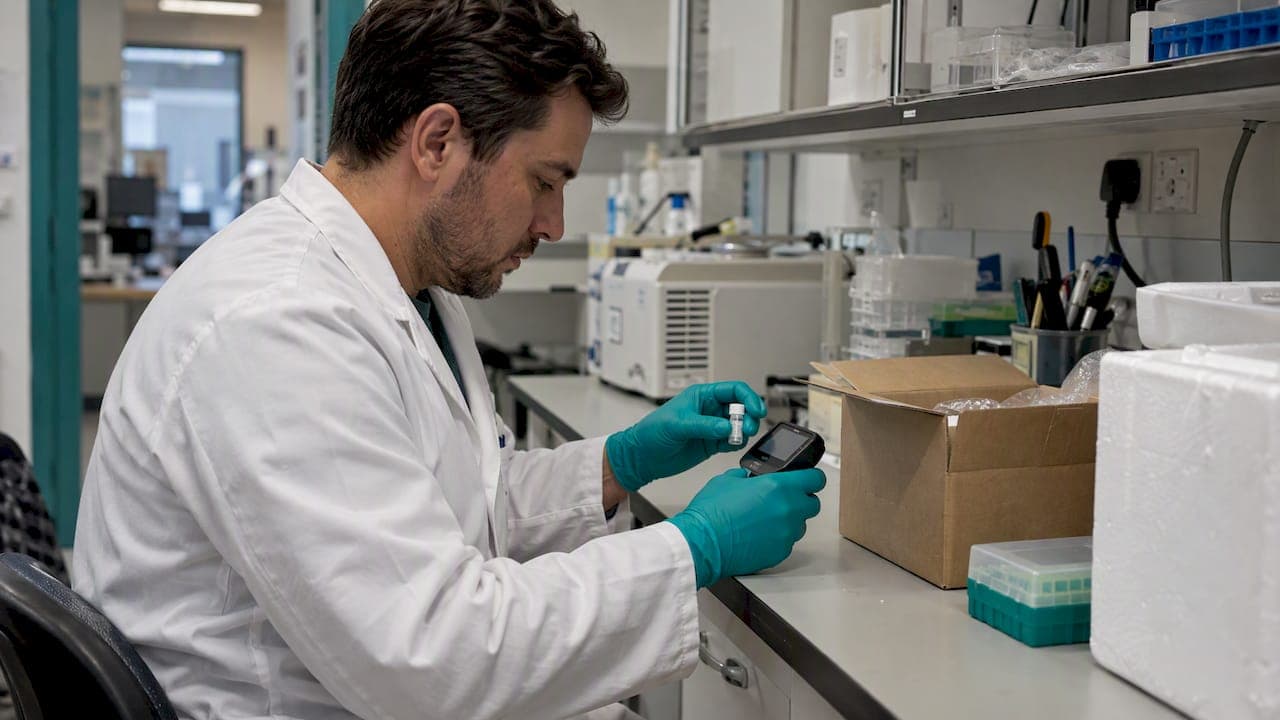
A temperature excursion is any exposure outside the storage conditions on the manufacturer's label, and for peptides it means possible potency or purity loss. Do not assume the vial is safe. Quarantine the material, log the duration and temperature, and compare the batch against its Certificate of Analysis using RP-HPLC and mass spectrometry. At Peptastic Labs, we supply batch documentation so that comparison is possible.
TL;DR:
- Store lyophilized powder at 2–8°C for medium term and minus 20°C or colder for long term; solutions need aliquots and minimal thawing.
- After an excursion, quarantine the vial, record its duration and peak temperature from the logger, then compare reversed phase HPLC and mass spectrometry results against the COA.
- For critical efficacy assays, discard is safest; preliminary work can use a retested lot only when exposure was brief and results match its baseline.
- Use accelerated stability results only to assess brief, mild excursions; long or severe exposures require real time data before material returns to critical work.
Table of Contents
- Why peptides degrade when temperature rises
- Storage guidance by peptide state
- How to assess what an excursion did to a batch
- SOP checklist: prevent, detect and respond
- Peptastic Labs perspective: why documentation makes excursion calls defensible
- How excursions affect different peptide applications
- Regulatory considerations and documentation practices
- Case studies: how real excursions get resolved
- Author perspective: balancing conservatism, cost and integrity
- Order COA-backed peptides with documented cold-chain handling
- FAQ
- Sources
Why peptides degrade when temperature rises
Heat does not create new degradation chemistry. It speeds up pathways that already run slowly at label conditions. Several pathways matter for research peptides:
- Hydrolysis: trace moisture in a lyophilized vial, or the water in a solution, cleaves peptide bonds faster as temperature climbs.
- Oxidation: methionine and cysteine residues are the usual targets, and heat combined with dissolved or headspace oxygen accelerates the damage.
- Deamidation: asparagine and glutamine residues convert to their acidic forms at rates that generally increase with temperature and shift with pH.
- Aggregation and unfolding: elevated temperature and freeze-thaw stress push peptides to associate, which dynamic light scattering (DLS) can detect.
These pathways do not act alone. Temperature amplifies the effect of pH, buffer strength, oxygen and residual moisture. A semaglutide preformulation study found that temperature and pH jointly shape stability, and that buffer choice changed the degradation pattern. The practical consequence: two peptides at the same temperature can fail in different ways, so one excursion rule rarely fits a whole catalog.
Peptides with oxidation-prone residues carry the most risk in warm, oxygen-rich conditions. Sequences with asparagine next to small residues tend to deamidate sooner in solution.
There is also no single agreed definition of stability. Published studies report residual purity or experimental half-life with different metrics, which makes cross-study comparison difficult. Define your own acceptance metric before you test.
Storage guidance by peptide state
Lyophilized powder tolerates brief excursions far better than solution. Removing water removes the medium for hydrolysis and slows molecular motion. In one study of recombinant human epidermal growth factor, freeze-dried formulations degraded roughly 70 to 100 times more slowly than liquid ones at 37 to 50°C, and excipients such as sucrose, trehalose and dextran improved stability further. Those excipients raise the glass transition temperature (Tg), so the solid stays rigid at higher temperatures.
Typical storage bands:
- Lyophilized powder, short term: room temperature tolerance can range from days to weeks, depending on sequence and residual moisture.
- Lyophilized powder, medium term: refrigeration at 2–8°C extends storage to months.
- Lyophilized powder, long term: -20°C or colder is preferred, as NIBSC peptide storage guidance recommends, kept dry, cool and dark.
- Solutions: limited storage life, a pH near 5–6, and aliquots to avoid repeated thawing.
Freezing is not automatically safe for solutions. Freeze-thaw introduces cryoconcentration, ice-water interface stress and pH shifts, and these can damage a peptide more than a brief ambient exposure. This is why single-thaw practice matters; our freeze-thaw SOP covers it in detail. Avoid frost-free freezers for long-term storage, since their defrost cycles produce temperature swings.
Pro Tip: Ask for residual moisture (Karl Fischer) and Tg on the COA when they are available. A drier, higher-Tg lot has more headroom after an excursion.
For more on state-specific handling, see our lab-ready storage guide.
How to assess what an excursion did to a batch
Assessment pairs analytical methods with a study design. Together they tell you whether purity or potency moved outside your acceptance limits.
Core analytics, as described in a review of peptide characterization methods:
- RP-HPLC for purity and degradant peaks, compared against the COA baseline.
- Mass spectrometry to identify chemical modifications such as oxidation (+16 Da) or deamidation (+1 Da).
- DSC and TGA for Tg and decomposition behavior in the solid state.
- DLS for aggregates, with SEC as a complement for aggregation state.
| Question | Method | What you compare |
|---|---|---|
| Has purity dropped? | RP-HPLC | Main peak area against COA baseline |
| What changed chemically? | Mass spectrometry | Mass shifts on new peaks |
| Did the solid soften? | DSC/TGA | Tg and mass loss against reference |
| Did it aggregate? | DLS | Particle size distribution |
For design, stability guidance recommends stress testing in 10°C increments and notes that accelerated data can be used to evaluate short-term excursions such as shipping. Mean kinetic temperature is a useful derived metric for collapsing a variable temperature log into one equivalent value.
Interpret results conservatively. Look for residual purity relative to baseline and for characteristic new peaks. When one method looks ambiguous, run an orthogonal one. Accelerated data can support a short-term "safe to use" call for a brief, mild excursion. A long or severe one calls for real-time data before the lot goes back into critical work. Our guide to avoiding false degradation in stability testing explains how to keep the testing itself from creating artifacts.
SOP checklist: prevent, detect and respond
Build the checklist around three phases.
Prevent
- Ship and store on a validated 2–8°C cold chain with continuous data logging. See our cold-chain SOP.
- Store long-term material at -20°C or colder, never in a frost-free unit.
- Aliquot single-use volumes so nothing is thawed twice.
Handle
- Let sealed vials reach room temperature before opening, so condensation does not wet the powder.
- Reseal under dry inert gas where possible.
- Keep vials dark and dry between uses.
Detect and respond
- Check the logger at receipt and compare it to label limits.
- Quarantine any vial with a gap, a spike or a missing log.
- Order RP-HPLC and mass spectrometry, and compare against the COA.
- Document the decision, the data and who approved it.
Discard criteria should be conservative for anything feeding a critical assay. Re-testing is defensible when the excursion was short, the material is lyophilized, and the analytics match the baseline.
Pro Tip: Write the excursion response into the study protocol before the first shipment arrives. Decisions made in advance are easier to defend than decisions made after an unexpected result.
Peptastic Labs perspective: why documentation makes excursion calls defensible
An excursion decision is only as strong as the baseline behind it. We provide Certificates of Analysis and batch documentation for every catalog compound, with purity verified by HPLC, so you can compare post-excursion chromatograms against the original lot data rather than guessing.
Our batch documentation supports traceability. Before accepting a lot, ask any supplier for raw chromatograms, and for residual moisture or Tg when available. Our note on requesting raw chromatograms explains what to look for. A peer example of COA-backed storage practice is this GHK-Cu storage and COA resource, useful for comparing how documentation is presented.
How excursions affect different peptide applications
Application sets the tolerance. In metabolic research, potency drift directly shifts dose-response curves, so a modest purity loss can look like a pharmacology result. Treat these lots conservatively, and verify with RP-HPLC before any assay that depends on exact concentration.
Cognitive and neuro peptides are often short sequences run at low concentrations, so a small oxidation fraction can change a signal that is already faint. Methionine-containing sequences deserve extra attention after warm exposure.
Tissue repair and longevity peptides are frequently used in longer studies where reproducibility across weeks matters most. Here, batch-level documentation and a consistent storage record matter more than any single measurement.
Cosmetic science peptides may be formulated into matrices where temperature, pH and excipients interact further. An excursion on the raw peptide can compound with formulation stress later, so verify the stock before blending.
Across all categories, the rule is the same: the more a result depends on exact peptide content, the less tolerance an excursion deserves.
Regulatory considerations and documentation practices
Requirements for research-grade peptides can differ from those for marketed drugs, so check applicable institutional and regulatory guidance. Stability guidance can help inform how to assess a deviation, but the relevant limits depend on the validated conditions for the material. That gap is why your own records carry so much weight.
Document each event consistently:
- Lot number, vial identity and storage location.
- Start time, end time and peak temperature, from a logger rather than memory.
- Mean kinetic temperature, if you calculate it.
- The analytical results, with raw chromatograms attached.
- The disposition: use, restrict, re-test or discard, with a named approver.
Keep these records with the study file. Reviewers and collaborators judge reproducibility by whether you can show what the material experienced, and unsupported "it looked fine" decisions fail that test. Check institutional or funder requirements for retention periods, since they vary.
Case studies: how real excursions get resolved
Consider three situations, described generically.
A weekend courier delay. A lyophilized lot arrives after an extended transit with a logger reading above the 2–8°C label range. The lab quarantines it, runs RP-HPLC and mass spectrometry, and compares against the COA. The main peak matches and no new degradant appears. The lab releases the lot with the data filed, and the paper trail is the defense.
A freezer failure. A reconstituted solution sits at room temperature after a unit trips. The peptide contains methionine, so the lab checks for oxidation by mass spectrometry. A new peak at the oxidized mass is present. Because the solution was feeding a quantitative assay, the lab discards it and reconstitutes from fresh powder.
A repeated thaw. A multi-use vial is thawed repeatedly and potency in the assay drifts. DLS shows aggregation. The fix is procedural: single-use aliquots, adopted into the SOP.
The pattern is consistent. Data decides, the baseline makes the data meaningful, and procedure prevents repeats.

Author perspective: balancing conservatism, cost and integrity
Match the discard rule to the stakes. For critical efficacy assays, discard is the safest policy. For preliminary work, re-testing is cost-effective when a COA and clean analytics back it. Batch-level records reduce downstream reproducibility risk, and excursion steps belong in the study SOP so no decision is improvised.
— Tintastic
Order COA-backed peptides with documented cold-chain handling
If you need research-grade material you can defend after an excursion, we offer a range of independently tested compounds across metabolic, cognitive and neuro, tissue and repair, longevity, cosmetic science, blends, hormone and reproductive, and ancillaries and reagents lines. Each batch is HPLC-verified, and Certificates of Analysis are available on request, so you hold the baseline you need before a vial ever leaves the fridge.
Our batch documentation makes post-excursion comparisons straightforward, and bulk options are available for larger programs. Browse the full range in the Peptastic Labs catalogue and request the COA for the lot you want.
FAQ
What happens if peptides reach room temperature?
Lyophilized peptides can tolerate room-temperature exposure better than solutions, because removing water slows degradation. NIBSC guidance describes dry peptides as stable at room temperature for days to weeks. Solutions are more vulnerable and should be tested promptly. Compare purity against the COA with RP-HPLC.
How long does BPC 157 last at room temperature?
No published stability data in our sources gives a figure for this peptide, so we do not state one. Lyophilized peptides generally tolerate short ambient exposure better than solutions. Check the lot with RP-HPLC against its COA.
Will peptides go bad in heat?
They can. Heat accelerates hydrolysis, oxidation and deamidation, and in one study liquid formulations degraded far faster than freeze-dried ones at elevated temperatures. Dry powder with stabilizing excipients holds up best.
What if I forgot to put my peptides in the fridge?
Note how long they sat out and at what temperature, then quarantine the vial. If the peptide is a dry powder and the exposure was brief, analytics will likely confirm it is usable. If it was reconstituted, test before use.
Sources
- Stabilization of a recombinant human epidermal growth factor parenteral formulation through freeze-drying
- The Challenge of Peptide Proteolytic Stability Studies: Scarce Data, Difficult Readability, and the Need for Harmonization
- Draft regional guidelines on stability testing of active substances and pharmaceutical products
- NIBSC - Peptide Storage
- Analytical techniques for peptide-based drug development: Characterization, stability and quality control