
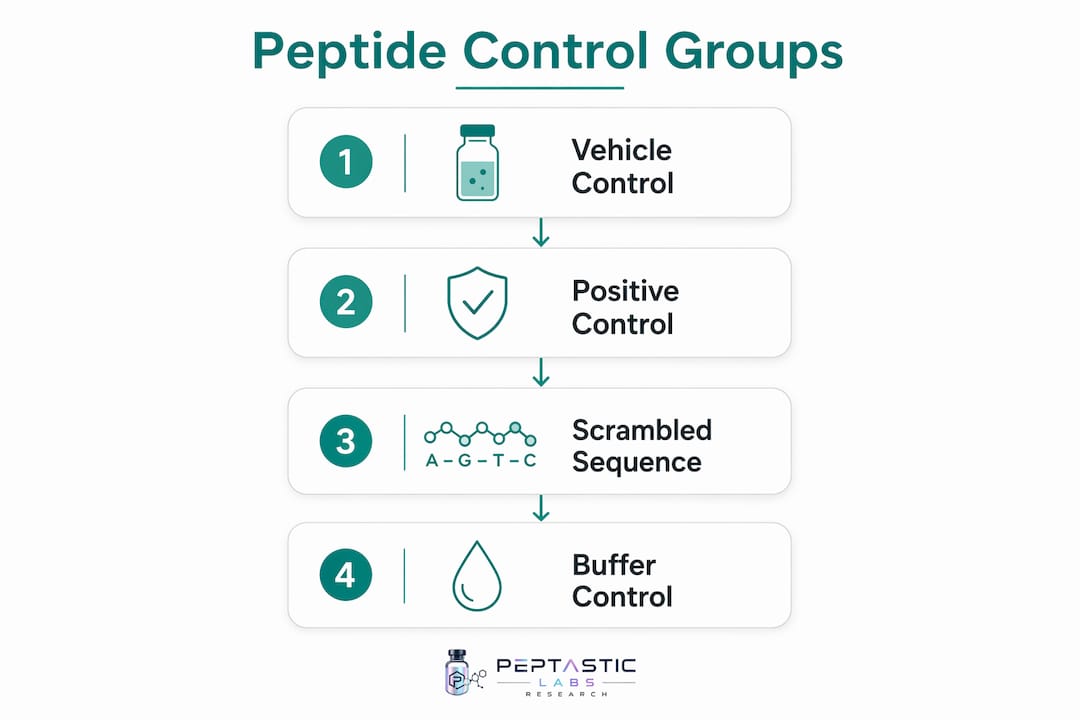
Every interpretable peptide experiment requires three controls at minimum: a vehicle control matched to solvent composition and volume, a validated positive control with a published EC50 or IC50 to confirm assay sensitivity, and a sequence-matched scrambled or inactive-analog peptide to separate receptor-specific activity from non-specific physicochemical effects. Document HPLC purity (≥99% area), mass spectrometry identity confirmation, endotoxin results, and a batch-specific Certificate of Analysis (CoA) for every control vial before running a single experimental arm.
The one-sentence SOP: prepare matched vehicle, validate assay sensitivity with your positive control against its published reference value, then run scrambled and inactive-analog controls head-to-head with the test peptide under blinded, randomized conditions.
- Vehicle control: match solvent identity, concentration, pH, and administration route exactly to the test peptide preparation. DMSO above 0.5% can affect cell viability; TFA at high concentrations is cytotoxic; acidic vehicles can shift pH-sensitive assay readouts.
- Positive control: use a reference compound with a published EC50/IC50 or an endogenous ligand. A functional assay positive control is required to distinguish true negative biology from assay failure.
- Scrambled/sequence-matched control: preserve amino-acid composition and overall charge while randomizing sequence. This controls for non-specific charge and hydrophobicity effects without preserving target-binding motifs.
- Inactive analog (optional but preferred): a point mutant or retro-inverso analog when receptor-binding specificity must be isolated from composition effects.
- Specificity controls: blocking peptides for IHC/ICC, receptor antagonists, or siRNA/knockout models when mechanism attribution is the primary endpoint.
- Documentation per vial: HPLC chromatogram, MS spectrum, CoA, endotoxin certificate, storage history, and reconstitution date. Peptasticlabs supplies batch documentation and HPLC-verified ≥99% peptides for researchers who need this documentation pre-assembled.
Table of Contents
- What control group types belong in a peptide study?
- How to design scrambled controls that stay biologically inert
- What QC does a control peptide require before use?
- How to implement control groups across in vitro and in vivo workflows
- How to interpret unexpected control behavior and troubleshoot failures
- SOP checklist for procuring, validating, and deploying control peptides
- Key Takeaways
- What researchers often get wrong about peptide controls
- Peptasticlabs supports your control-group requirements from sourcing to documentation
- Authoritative sources for reporting peptide control strategies
What control group types belong in a peptide study?
Choosing the right control type depends on the experimental phase and the question being asked. Screening assays need different controls than mechanism studies or in vivo efficacy runs. The five categories below cover the full range.
Vehicle and buffer-only controls
A vehicle control contains every component of the test peptide preparation except the peptide itself: solvent, excipients, pH adjusters, and carrier proteins at identical concentrations. When DMSO is the solvent, the vehicle control must contain the same DMSO percentage as the highest test concentration. Omitting this match converts a solvent artifact into an apparent peptide effect.
Buffer-only controls are appropriate when the peptide is dissolved in aqueous buffer with no organic co-solvent. They establish the assay baseline and confirm that the buffer itself does not activate or suppress the readout.
Positive controls and active comparators
A positive control uses a reference compound with a known, published EC50 or IC50 to confirm that the assay is sensitive enough to detect activity on the day of the run. If the positive control fails to reach expected activity, the run is invalid regardless of what the test peptide shows.
Active comparators go further: they replace an inert control with an established reference compound or endogenous ligand to answer a comparative question. Active comparator studies require the test peptide to demonstrate superior or non-inferior performance against that reference, setting a higher evidence bar than a vehicle-only design.
When an established reference exists, an active comparator gives higher-quality evidence than an inert control and should be used when the research question is comparative efficacy or non-inferiority. This is the distinction between asking "does this peptide do anything?" and "does this peptide outperform what already exists?" The second question demands the active comparator design.
Sequence-based controls
Scrambled peptides keep amino-acid composition identical but randomize the sequence, controlling for non-specific charge and hydrophobicity effects without preserving target-binding motifs. Inactive point mutants substitute one or two residues critical for receptor binding while keeping the rest of the sequence intact. Retro-inverso and D-amino acid analogs are used when the control purpose is to confirm that activity is sequence- and chirality-dependent.

Specificity controls
For IHC and ICC, a blocking peptide pre-incubated with the primary antibody at at least 10 times the antibody working concentration will abolish specific staining if the antibody is genuinely specific. Receptor antagonists serve as specificity controls in functional assays. siRNA knockdown and knockout models confirm that the observed effect depends on the intended molecular target.
Selecting by endpoint
| Endpoint | Recommended controls |
|---|---|
| Binding assay | Vehicle + scrambled composition control + inactive point mutant |
| Functional assay (EC50/IC50) | Vehicle + validated positive control + scrambled control |
| IHC/ICC | Blocking peptide at ≥10x antibody concentration + secondary-only control |
| In vivo efficacy | Vehicle-matched cohort + positive control arm + scrambled/inactive analog arm |
How to design scrambled controls that stay biologically inert
Scrambled peptide design is where most reproducibility failures originate. A poorly designed scrambled control can introduce a new binding motif, aggregate under assay conditions, or behave differently in solution than the test peptide, making it useless as a control and potentially misleading.
-
Preserve amino-acid composition and post-translational modifications. The scrambled sequence must contain exactly the same residues as the test peptide, including phosphorylation, acetylation, or amidation. Run a motif scan against databases such as ELM (Eukaryotic Linear Motif) and ScanProsite before committing to a sequence. Any scrambled candidate that introduces a known binding motif must be discarded and re-randomized.
-
Maintain physicochemical properties. Net charge, hydrophobicity index, and predicted isoelectric point should match the test peptide within a narrow tolerance. Use tools such as the ExPASy ProtParam server to calculate these values for both sequences before ordering synthesis. Mismatched hydrophobicity changes aggregation behavior and solubility, which invalidates the composition-control logic.
-
Avoid cryptic cleavage sites and aggregation-prone stretches. Run secondary-structure predictions (PSIPRED or equivalent) and aggregation predictions (AGGRESCAN or TANGO) on the scrambled candidate. A scrambled sequence that forms a beta-sheet prone region the test peptide does not have will behave differently in cell-based assays regardless of composition identity.
-
Choose the right control type for the control purpose. A scrambled sequence controls for composition and charge. An inactive point mutant controls for receptor-binding specificity while preserving most of the sequence context. A retro-inverso or D-amino acid analog controls for chirality and protease susceptibility. Use the type that matches what you need to rule out.
-
Run small-scale pilot validation before full synthesis. Order a small batch, test solubility across the working concentration range, check for aggregation by dynamic light scattering or absorbance at 340 nm, confirm endotoxin is below threshold, and verify that the scrambled peptide produces no activity across a full dose range in the intended assay. Only after passing these checks should the scrambled control be used in a formal experiment.
-
Validate identity and purity on receipt. HPLC purity ≥99% and MS identity confirmation are required for the scrambled control just as they are for the test peptide. A scrambled control with a synthesis impurity can produce an artifact that looks like residual activity, which undermines the entire control logic. Sequence integrity in peptide research is directly tied to interpretability.
Pro Tip: When the mechanism is uncertain, run a three-part control set: vehicle alone, scrambled composition control, and inactive analog. This separates vehicle effects, non-specific physicochemical effects, and receptor-specific activity into three distinct comparators, giving you unambiguous attribution when any arm shows unexpected signal.
What QC does a control peptide require before use?
Analytical characterization of control peptides follows the same standards as the test peptide. Accepting a lower bar for controls is a common and costly mistake: an impure or mis-quantified control introduces a competing explanation for every result it touches.
Minimum analytical panel
| QC Check | Method | Acceptance Criterion | Why It Matters for Controls |
|---|---|---|---|
| Purity | HPLC (reverse-phase) | ≥99% area | Impurities can produce independent biological effects |
| Identity | LC-MS or MS/MS | Monoisotopic mass ±0.1 Da | Confirms correct sequence; rules out synthesis errors |
| Impurity profile | Orthogonal HPLC + LC-MS | No single impurity >0.5% | Synthesis byproducts can activate or suppress assay readouts |
| Endotoxin | LAL or recombinant factor C assay | <1 EU/mg for cell-based; <0.1 EU/kg body weight for in vivo | Endotoxin activates innate immune pathways and confounds cytokine and viability assays |
| Residual solvents/counterions | Ion chromatography; ICP-MS for metals | Per ICH Q3C limits | TFA and acetate counterions affect cell viability and pH |
| CoA | Batch-specific document | All above parameters reported | Required for manuscript methods and audit trail |
Impurity profiling
Orthogonal separation methods combined with LC-MS identification are the standard for characterizing synthesis-related impurities in peptide APIs. The same logic applies to research-grade control peptides: a single HPLC method may miss co-eluting impurities that a second column chemistry or ion-pairing system would resolve. For control peptides used in cell-based or in vivo work, residual TFA from preparative purification should be reported on the CoA and, if above trace levels, removed by lyophilization from ammonium bicarbonate or equivalent exchange.
Endotoxin thresholds
For cell-based assays, a practical threshold is <1 EU/mg peptide. For in vivo rodent studies, the FDA guidance threshold of <5 EU/kg body weight per hour applies to parenteral administration. Endotoxin testing is not optional for any control peptide used in immune-cell assays, cytokine panels, or in vivo models.
Positive-control benchmarking as an assay sensitivity check
A validated positive control with a published EC50 or IC50 is the only reliable way to confirm that the assay is sensitive enough to detect activity on a given run. If the measured EC50 drifts more than twofold from the published reference value, the run should be flagged and the cause investigated before interpreting test peptide data. This is the core logic behind assay sensitivity validation via positive controls: without it, a negative result for the test peptide is uninterpretable.
Documentation requirements
Every control peptide vial entering a study should have on file: a batch-specific CoA, the HPLC chromatogram, the MS spectrum, endotoxin results, storage temperature log, date of reconstitution, and the reconstitution vehicle. Peptasticlabs provides batch documentation and HPLC-verified ≥99% purity data on request, which researchers can attach directly to manuscript supplementary materials. For a detailed walkthrough of what a CoA should contain, the Certificate of Analysis guide covers the key fields and how to use them in methods reporting.
How to implement control groups across in vitro and in vivo workflows
Correct implementation of controls is as important as correct design. A well-designed scrambled peptide run without blinding or proper randomization still produces uninterpretable data.
Workflow template
- Step 1 — Pilot validation: before the main experiment, run the vehicle control, scrambled control, and positive control at the intended concentration range. Confirm solubility, absence of aggregation, positive-control EC50 within twofold of reference, and vehicle baseline within acceptable limits.
- Step 2 — Assay sensitivity confirmation: run the positive control on every plate or in every animal cohort. A positive control run only at the start of a study does not protect against inter-run drift.
- Step 3 — Randomized, blinded main experiment: assign treatment groups using a random number generator. Label vials with codes that conceal treatment identity from the operator performing the assay or animal handling. Unblind only at the analysis stage.
- Step 4 — Include controls on every plate/run: do not pool controls into a single reference run. Inter-run variability in peptide assays is real, and a control run on a different day than the test arm cannot account for it.
Blinding and handling
Controls must be indistinguishable from the test peptide in appearance, volume, administration route, and schedule. For in vivo studies, injection volume, rate, and timing must match across all arms. Any handling difference between the test and control arms is a competing explanation for any observed difference.
Dosing considerations
Match concentration ranges between test and control peptides. For assay sensitivity validation, run the positive control across a full dose range (at least five concentrations spanning two logs) to confirm the EC50 is within the expected range. For scrambled controls, run at least the highest and lowest test concentrations to confirm absence of activity at both ends of the range.
Replication and power
- Screening assays: n=3 independent experiments as a baseline.
- Lead potency estimates: n=5 or more independent experiments.
- In vivo primary endpoints: perform a formal power analysis using pilot-experiment variability (standard deviation) and the minimum effect size of biological relevance. A power of 0.80 at α=0.05 is the standard minimum. For metabolic peptide study design, the study protocol guide covers power analysis inputs specific to peptide endpoints.
Timeline and sample-handling checklist
- Order control peptide batches with CoA at least two weeks before the pilot run.
- On receipt: confirm HPLC purity ≥99%, run MS identity check, test for endotoxin, log storage temperature.
- One week before main experiment: run pilot validation (solubility, aggregation, positive-control EC50, vehicle baseline).
- Day of experiment: prepare vehicle and control solutions fresh or from pre-validated aliquots; confirm labeling codes; randomize plate or cage assignments.
- Post-run: archive one aliquot of each control vial at the appropriate storage temperature for retrospective analysis.
For IHC/ICC specificity controls, pre-incubate the primary antibody with the blocking peptide at a concentration at least 10 times the antibody working concentration for a minimum of one hour at room temperature before applying to tissue sections.
How to interpret unexpected control behavior and troubleshoot failures
When controls behave unexpectedly, the first instinct is often to question the test peptide. The correct sequence is the opposite: work through the controls in priority order before drawing any conclusion about the test arm.
Priority diagnostic sequence
First: check positive-control performance. If the positive control fails to reach its expected EC50 or IC50, the assay is invalid. Stop. Do not interpret the test peptide data. Investigate reagent integrity, instrument calibration, and assay conditions before re-running.
Second: check vehicle effects. If the vehicle arm differs from the buffer-only baseline, verify solvent composition, concentration, and pH. Re-run a vehicle-matched pilot with fresh solvent preparation. A vehicle effect that was absent in the pilot but present in the main run usually points to a preparation error or a solvent lot change.
Third: check control peptide integrity. Re-run HPLC and MS on the specific vial used in the failed run. Review the storage log and reconstitution record. Test for endotoxin if the assay involves immune-sensitive readouts. Check for visible aggregation or turbidity in the reconstituted solution.
Fourth: check assay reagents and instrumentation. Verify antibody lots, substrate freshness, plate reader calibration, and cell passage number. A recurring failure mode in peptide studies is calculating concentrations from gross weight rather than net peptide content, which can introduce a 10–40% dosing error across all arms simultaneously.
A control that fails is data, not a nuisance. A failed positive control tells you the assay cannot detect activity on that day. A vehicle effect tells you the solvent is confounding the readout. A scrambled control that shows activity tells you the composition itself has biological effects that must be accounted for. Each failure mode points to a specific corrective action — none of them justify discarding the run without investigation.
Pro Tip: Retain a sealed aliquot of every control and test peptide vial used in each run. Store at the recommended temperature with a run-specific label. If unexpected activity appears in retrospective analysis or a reviewer questions a result, you can re-run HPLC/MS on the original material rather than relying on a new batch that may differ.
SOP checklist for procuring, validating, and deploying control peptides
The checklist below is structured as a lab SOP template. Adapt the acceptance criteria to your assay system and have the PI sign off before the main experiment begins.
SOP sections
- Procurement
- Obtain batch-specific CoA from supplier before accepting the shipment.
- Confirm HPLC purity ≥99% (area percent), MS identity, endotoxin result, and counterion content are all reported.
- Verify storage conditions during transit (cold-chain documentation if required).
- Record supplier name, catalog number, batch number, and date received.
- Receipt checks
- Re-confirm HPLC purity on receipt using in-house or third-party analysis.
- Run MS identity confirmation (monoisotopic mass ±0.1 Da).
- Test endotoxin if not reported on CoA or if the assay is immune-sensitive.
- Log storage temperature from receipt to first use.
-
Storage and labeling
- Store lyophilized peptides at −20°C or −80°C per supplier recommendation, desiccated.
- Label vials with: compound name, batch number, date received, storage temperature, and operator initials.
- Avoid repeated freeze-thaw cycles; aliquot into single-use volumes before first use.
-
Reconstitution procedure
- Reconstitute in the vehicle matched to the test peptide preparation.
- Record reconstitution date, vehicle composition, final concentration, and operator.
- Confirm solubility visually and by absorbance at 340 nm (aggregation check).
-
Pilot validation (pass/fail gate)
- Confirm solubility across the full working concentration range.
- Confirm absence of aggregation at the highest working concentration.
- Confirm endotoxin below threshold for the intended assay type.
- Confirm scrambled/inactive control produces no activity across a full dose range.
- Confirm positive control EC50 within twofold of published reference value.
- PI sign-off required before proceeding to main experiment.
-
Assay deployment
- Include vehicle control, positive control, and scrambled/inactive control on every plate or in every animal cohort.
- Use blinded labeling codes; unblind at analysis.
- Randomize plate positions and animal assignments.
-
Data retention and reporting
- Archive HPLC chromatogram, MS spectrum, CoA, endotoxin certificate, and pilot validation data.
- Retain one sealed aliquot of each vial used per run.
- Report control performance (positive-control EC50, vehicle baseline) in the manuscript methods or supplementary materials.
Common errors to avoid
- Calculating concentrations from gross weight instead of net peptide content (causes 10–40% dosing error).
- Omitting scrambled controls in mechanism studies.
- Failing to test for endotoxin in cell-based or in vivo work.
- Running positive controls only at the start of a multi-day study.
- Accepting a CoA without an HPLC chromatogram attached.
Reporting controls in manuscripts
Methods sections should state: control peptide sequence or description, supplier and batch number, purity and identity confirmation method, endotoxin result, vehicle composition, concentration range tested, and pilot validation outcome. Attach the HPLC chromatogram and MS spectrum as supplementary figures. When Peptasticlabs batch documentation is used, cite the CoA batch number and note that independent HPLC verification was performed at ≥99% purity. For procurement guidance, the peptide buying guide checklist covers the documentation fields reviewers most commonly request.
Key Takeaways
Reproducible peptide control groups require matched vehicle, a validated positive control, a sequence-matched scrambled or inactive-analog peptide, and batch-specific HPLC/MS documentation for every control vial before the main experiment begins.
| Point | Details |
|---|---|
| Three-control minimum | Every study needs a vehicle control, a validated positive control, and a scrambled or inactive-analog control at minimum. |
| Purity threshold for controls | HPLC purity ≥99% (area percent) is required for control peptides; impurities produce independent biological effects that invalidate attribution. |
| Positive control as assay gate | If the positive control EC50 drifts substantially from its published reference value, the run is invalid and must not be interpreted. |
| Scrambled design rules | Preserve amino-acid composition and net charge; scan for introduced motifs; confirm no activity across a full dose range in pilot validation. |
| Peptasticlabs documentation | Peptasticlabs supplies HPLC-verified ≥99% peptides with batch CoA on request, reducing pilot time and supporting manuscript-ready documentation. |
What researchers often get wrong about peptide controls
The most persistent failure mode in peptide control design is not a missing control type. It is a documentation gap that only surfaces at peer review. A scrambled peptide ordered without a CoA, run without a pilot validation, and reported in the methods as "a scrambled sequence control was used" gives reviewers nothing to evaluate and gives the lab nothing to fall back on if results are questioned.
The second failure mode is treating the positive control as a one-time setup check rather than a per-run assay validity gate. Assay sensitivity can drift between runs due to reagent lot changes, cell passage number, or instrument calibration shifts. A positive control run only at the start of a study provides no protection against these sources of variability.
There is also a tendency to underestimate vehicle effects. DMSO is the most common example: researchers routinely use it at concentrations that affect cell viability without matching the vehicle control to the exact DMSO percentage in the test preparation. The result is a vehicle artifact that inflates apparent peptide activity. Strict vehicle matching is not a formality.
The broader principle is that control quality and test peptide quality must be held to the same standard. A ≥99% purity requirement that applies to the test peptide but not the scrambled control creates an asymmetry that undermines the entire experimental design. Impurities in control peptides can produce independent biological effects, and high-purity sourcing reduces this risk across both arms.
Peptasticlabs supports your control-group requirements from sourcing to documentation
Researchers who need pre-characterized control peptides with manuscript-ready documentation can source directly from Peptasticlabs. Every compound in the catalog is independently tested and HPLC-verified to ≥99% purity, with batch-specific Certificates of Analysis available on request. Endotoxin testing is supported for cell-based and in vivo applications, and small-batch validation runs are available for researchers who need pilot-scale quantities before committing to a full study order.
Working with a documented supplier reduces the time between receipt and pilot validation. When the CoA arrives with the shipment and includes the HPLC chromatogram, MS identity confirmation, and endotoxin result, the receipt-check step in your SOP becomes a verification rather than a full analytical run. That predictability matters when study timelines are fixed. For researchers sourcing across multiple compound categories, the research-grade peptide guide covers the documentation standards to expect from any supplier. For sourcing considerations and supplier-quality benchmarks, the peptide sourcing overview provides a useful external reference point.
Request a CoA and sample chromatogram before placing your order. Visit Peptasticlabs to submit a procurement inquiry or request technical documentation for your specific control peptide requirements.
Authoritative sources for reporting peptide control strategies
The sources below are appropriate to cite in manuscript methods sections, supplementary materials, and internal SOPs when reporting control group design and peptide QC.
- Vehicle and positive-control logic: Placebo and vehicle controls in peptide studies covers the rationale for vehicle matching and active comparator design.
- Scrambled peptide design: Peptide Research Methodology Best Practices addresses scrambled controls, inactive analogs, and common reproducibility errors including gross-weight dosing errors.
- Peptide API impurity control and HPLC/MS methods: Control Strategies for Synthetic Therapeutic Peptide APIs from the USP panel covers orthogonal separation and LC-MS identification for impurity profiling.
- Regulatory analytical guidelines: Regulatory Guidelines for the Analysis of Therapeutic Peptides and Proteins covers FDA, ICH Q6B, ICH Q1A(R2), and ICH M10 requirements for identity, purity, stability, and bioanalytical method validation.
- FDA CMC expectations for peptide therapeutics: FDA's Katharine Duncan on CMC expectations for therapeutic peptides outlines specification setting, impurity characterization, and stability study requirements from the agency perspective.
- Blocking peptide protocols for IHC/ICC: Blocking peptide protocols for IHC/ICC provides the concentration guidance (≥10x antibody working dilution) and pre-incubation protocol for specificity validation.
- Reference materials for LC-MS calibration: Peptide control for assay validation and calibration covers NIST peptide standards and QconCAT use in quantitative proteomics workflows.
- QC materials and QC software for MS-based assays: Quality Control in the Mass Spectrometry Proteomics Core covers synthetic peptide QC mixtures, spiking strategies, and software tools for tracking assay performance longitudinally.
- Purity standards and HPLC reporting: the peptide purity standards guide covers HPLC reporting conventions and the implications of impurities for research-grade peptides.