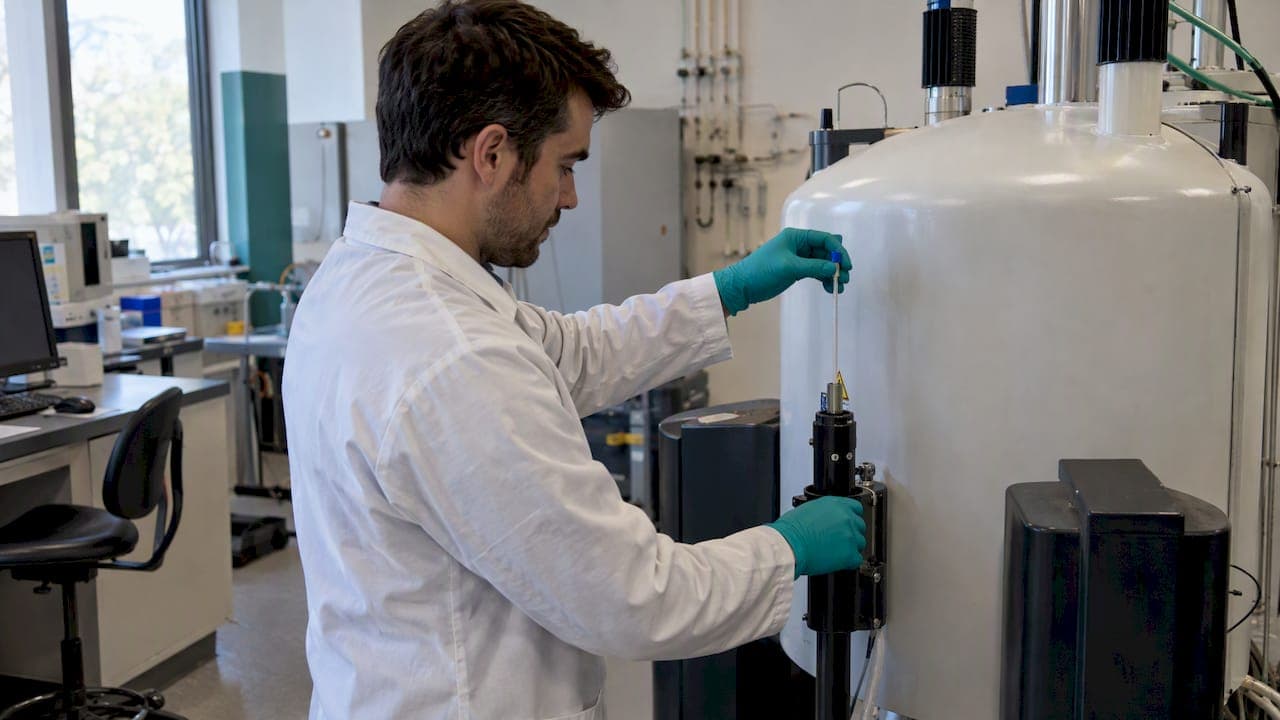
Most synthetic peptides arrive as TFA salts after SPPS and HPLC. For cell assays and downstream development, we recommend exchanging to acetate or HCl. Confirm the residual counterion content on the Certificate of Analysis before any assay, and verify it analytically when the readout is sensitive. For most research directions that lead toward formulation or clinical work, acetate or HCl are the practical, biocompatible choices.
TL;DR:
- TFA above 0.01% can harm cultured cells, so measure residual levels before assays and keep one salt form across every study lot.
- For TFA removal, 2 to 10 mM HCl is often sufficient, while unbuffered concentrations above 10 mM may alter peptide structure.
- Confirm exchange with ion chromatography or fluorine NMR; residual TFA below 1% by weight indicates success, but verify peptide identity afterward.
- Use CoA peptide content, not HPLC purity, to calculate active dose, because labeled powder mass includes counterions and water, and varies by salt form.
Table of Contents
- Why peptides form salts and which counterions you will encounter
- How salt form changes physicochemical properties, assays, and biological readouts
- Practical selection guide: mapping experiments to preferred salt forms
- How to remove or exchange TFA safely, with stepwise lab methods and QC checks
- Formulation implications: pH, buffers, excipients, and storage
- Accounting for counterions in dosing math and CoA interpretation
- Why we ask for counterion data on every lot
- COA-backed peptides and counterion support from Peptastic Labs
- FAQ
- Sources
Why peptides form salts and which counterions you will encounter
A peptide is a multiply charged molecule. Basic side chains (Lys, Arg, His) and the N-terminus carry positive charge at working pH, and each charge needs a negatively charged partner in the solid. Those partners are counterions, and which ones you receive depends on how the peptide was made and purified.
Fmoc solid-phase synthesis releases the chain from the resin with trifluoroacetic acid, and reversed-phase HPLC purification typically runs in TFA-containing mobile phases. The result is that synthetic peptides commonly exist as TFA salts unless someone deliberately exchanges the counterion afterward. A vial labeled "peptide, 5 mg" therefore holds peptide plus whatever counterion survived purification and lyophilization.
The counterions you are most likely to meet fall into a few groups:
- Trifluoroacetate (TFA): the synthesis and purification default, strongly acidic, tightly associated with basic residues.
- Acetate: the usual target of exchange for biological work and a common form in marketed peptide drugs.
- Chloride (HCl salt): common in formulation and analytical workflows, with a strongly acidic conjugate acid that demands pH awareness.
- Sulfate, succinate, tartrate, gluconate: less common anionic options chosen for specific solubility or formulation goals, as cataloged in a review of counterion effects on peptide structure and activity.
- Sodium, ammonium, and arginine-based cations or counterions: relevant for acidic peptides and for self-buffering designs.
The same review describes hydrophobic ion pairing (HIP), a strategy that pairs a charged peptide with a lipophilic counterion. HIP raises lipophilicity, which can improve encapsulation in lipid nanocarriers and oral absorption. It also changes solubility and analytical behavior, so a HIP-prepared peptide is not interchangeable with a plain acetate or HCl lot.
Counterions are not inert packing material. They affect lipophilicity, self-assembly, solubility, and encapsulation efficiency. Newer formulation approaches even select counterions that contribute to the formulation itself, such as arginine in self-buffered systems. That flexibility comes with a cost in dosing arithmetic, which we cover in the dosing section below.
Never assume counterion identity from a product description. A listing that says "peptide acetate" tells you what the supplier intended, not what the vial contains. The identity and residual level belong in analytical data, not in marketing text.
How salt form changes physicochemical properties, assays, and biological readouts
Salt form touches three areas of a study: spectroscopy, cell-based readouts, and physical stability. In each, the counterion can move your data without any change to the peptide sequence.
Spectroscopy and structural work
TFA has a strong infrared absorption band that can obscure the amide I band, the region researchers rely on to read secondary structure. If you are estimating helix or sheet content by IR, residual TFA can distort or hide the very signal you want. Work on optimizing HCl concentration for TFA removal documents this interference and shows why removal is often a prerequisite for accurate IR analysis. The same acidic counterion can also affect secondary structure measurements by other methods, so structural studies should start from a characterized salt form.
Cell-based assays
TFA is not benign in culture. The mandatory reference on this topic reports:
TFA is cytotoxic at concentrations above 0.01% in cell-based assays, per a recent review of counter-ions in peptides. A peptide lot with substantial TFA content can reduce viability or shift proliferation readouts independently of the peptide's own activity.
That bias is the practical danger. A dose-response curve built from a TFA salt can mix peptide effect with counterion toxicity, and the two cannot be separated after the fact. Quantify or remove residual TFA before cell work, and keep the same salt form across a study so that lot-to-lot differences do not masquerade as biology.
Aggregation and stability
Counterions interact with pH, ionic strength, and excipients, so no single salt form is universally "stable." A review of factors affecting peptide aggregation lists sequence, concentration, pH, net charge, excipients, and counterions among the variables, and cites examples where salts changed fibril structure and aggregation propensity. A companion analysis reaches a similar conclusion: physical stability depends on the interplay between counterion, solution pH, and ionic strength, so salt selection belongs inside a broader formulation strategy.
The practical consequences for experimental design:
- Treat salt form as one variable among several, not as a fix for aggregation on its own.
- Hold pH, ionic strength, and buffer identity constant when comparing salt forms.
- If a peptide aggregates in one salt form, test a second salt form at the same pH before changing the sequence or concentration.
- Record the salt form in your methods section. A readout that reproduces only with one counterion is a finding, not a nuisance.
Stability testing artifacts can also masquerade as salt effects. Our guide on preventing false degradation in peptide stability testing covers how handling and analytical choices create apparent degradation that has nothing to do with the counterion.
The evidence is not uniform across peptides. A study of long-acting injectable peptide hydrogels found no significant difference between TFA and HCl salts for certain properties relevant to use, while noting that the impact is context dependent. That is the honest summary: some systems tolerate the swap, others do not, and you only learn which by testing your own peptide.
Practical selection guide: mapping experiments to preferred salt forms
The core rule: accept TFA for synthesis and purification, then exchange before cell assays, potency measurements, or formulation work. The hydrogel study above notes that most marketed therapeutic peptides are acetate or HCl salts, and that salt form can carry regulatory and environmental considerations. If your research is heading toward a clinical candidate, matching that convention early avoids a late and costly change.
Use this ordered checklist to choose a salt form:
- Identify the downstream use. Cell assay, structural spectroscopy, animal study, or formulation development each tolerate different counterions.
- Check the current counterion on the CoA. If the lot is TFA and the use is anything beyond chemical characterization, plan an exchange.
- Default to acetate for biological work. It is biocompatible, produces a well-behaved lyophilizate cake, and aligns with clinical-stage conventions, as laid out in the counter-ion overview.
- Choose HCl where the workflow favors it. Certain formulations and analytical methods run well on chloride salts, but acid strength and pH exposure must stay controlled to avoid degradation.
- Reserve specialty counterions for specific formulation goals. Arginine and similar choices can create self-buffering systems, at the cost of heavier salt mass per milligram of active peptide.
- Lock the choice for the whole study. Mixing salt forms across experiments is a source of avoidable variance.
Pro Tip: Before ordering, state your intended assay and required salt form in the same message as your quantity request. Specifying acetate or HCl up front is faster and cheaper than exchanging a TFA lot after it arrives.
When acetate is the better choice
Acetate suits cell culture, in vivo work, and anything with a regulatory trajectory. It avoids the cytotoxicity concern attached to TFA and gives a more manageable solid. Its weaker acidity also makes it gentler on acid-sensitive sequences during exchange.
When HCl is practical
Chloride salts fit some analytical workflows and formulations. The caution is acid strength. A published case shows how salt form and pH interact: octreotide acetate in a lyotropic liquid crystal system needed pH adjustment to about 5.7 to reach stability comparable to the hydrochloride formulation. The lesson generalizes: the salt you pick sets constraints on the pH you can use, and the reverse is also true.
When to consider specialty counterions
If your formulation goal calls for self-buffering or modified delivery, an arginine-based or similar counterion may be justified. Account for the larger salt mass in every dosing calculation, and require peptide content data on the CoA rather than inferring it.
Solvent and buffer choices should be settled alongside the salt form. Our notes on peptide solvent compatibility help when you are planning reconstitution and exchange conditions together.
How to remove or exchange TFA safely, with stepwise lab methods and QC checks
Four method families cover most exchange needs. Each trades speed against risk to the peptide.
- Lyophilization with acetic acid cycles: milder and safer for sensitive sequences, but slower and requiring multiple cycles.
- Controlled low-concentration HCl cycles: effective and fast, but aggressive HCl can degrade peptides, so concentration matters.
- Ion-exchange resins: convert the counterion in solution, useful when you want a defined target salt and can accept some handling loss.
- RP-HPLC exchange: swaps the counterion during a chromatographic run, convenient when repurification is already planned.
A critical evaluation of these approaches found that exchange is nontrivial: aggressive ion exchange with strong acids such as HCl can degrade sensitive sequences, while multi-cycle lyophilization with acetic acid is slower but safer. The same evaluation defines success by reproducible, documented removal of TFA, not by intent. Running the procedure is not the same as completing it.
HCl concentration and pH cautions
If you use the HCl route, concentration is the main safety control. TFA removal by lyophilizing from 0.1 M HCl is convenient, but high HCl concentrations above 10 mM unbuffered may modify peptide structure. The same work reports that concentrations between 2 and 10 mM are often adequate to remove TFA without structural modification.

For acid-sensitive sequences, avoid sustained exposure to pH below 1. Peptides containing Asp-Pro bonds, Asn or Gln prone to deamidation, or acid-labile modifications deserve the milder acetate route or a lower HCl concentration with fewer cycles. Our protocol write-up on TFA removal methods, protocols, and QC standards goes through the bench steps in detail.
Confirming that the exchange worked
Do not trust a completed protocol without measurement. The QC options:
- 19F-NMR: one analytical technique used to assess counterion exchange.
- Ion chromatography (IC): quantifies anionic counterions, including TFA, acetate, and chloride, in one analysis.
- Capillary electrophoresis: an alternative separation-based quantification of counterions.
- HPLC and mass spectrometry: can be used to assess peptide identity after exchange.
A residual TFA value below 1% (w/w) indicates successful exchange, according to the counter-ion review, which also stresses careful pH control to avoid degradation during the process. Ask for IC or 19F-NMR data on the CoA rather than accepting a statement that the lot is "TFA-free."
Always pair counterion QC with a purity and identity check after exchange. A lot can clear the TFA threshold and still have lost peptide to degradation along the way.
Formulation implications: pH, buffers, excipients, and storage
Salt form and formulation are one decision, not two. The counterion sets the starting pH of a reconstituted solution, and the buffer you add must hold that pH where the peptide is stable.
pH and buffer selection
For aqueous formulations, pH optimization and buffer selection are the most practical stabilization approaches, with co-solvency, air exclusion, viscosity enhancement, PEGylation, and polyol excipients as complementary tools. Many peptides show lower deamidation rates in the pH 3 to 5 range, so a buffer that maintains pH in that window is a common starting point for injectable formulations. The right window still depends on the sequence. Test the peptide you have, not the average peptide.
Practical buffer guidance:
- Match the buffer to the counterion where possible. An acetate peptide in an acetate buffer adds no new anion to the system.
- Check the buffer's capacity at your target pH. A buffer used far from its pKa gives little protection.
- Avoid phosphate when you are working in cold storage and freeze-thaw conditions that can cause pH shifts on freezing.
- Verify the pH of the final reconstituted solution, not only the buffer stock.
Excipients and co-solvents
Excipients can slow degradation and reduce interface-driven aggregation. The same review lists glycerol, propylene glycol, PVP, and polysorbates among the options, and notes that viscosity and surface protectants matter. Polysorbates protect against adsorption and air-water interface stress, polyols stabilize through preferential exclusion, and viscosity enhancers slow diffusion-limited degradation.
Each excipient adds a variable to your assay as well. A surfactant that protects the peptide in the vial may interfere with a binding assay or a cell membrane readout. Confirm that the excipient is compatible with the downstream measurement before committing to it.
Where salt form complicates formulation
The octreotide case is the clearest example. Octreotide acetate in a lyotropic liquid crystal system required pH modulation to stabilize the acetate form, because pH adjustment to about 5.7 was needed to match the stability of the hydrochloride formulation. Formulation teams working on long-acting systems should expect similar interactions: the hydrogel work cited earlier shows that salt effects depend on the specific peptide and system, so a salt form validated in one carrier does not transfer automatically to another.
Storage and packaging
Salt form interacts with storage conditions as well. Lyophilized acetate and TFA salts differ in hygroscopicity and cake structure, and moisture uptake accelerates hydrolysis and deamidation. Store lyophilized material sealed and cold, protect it from light and humidity, and allow vials to reach room temperature before opening to avoid condensation. Container material matters too: peptides can adsorb to some plastics and glass surfaces, so low-binding containers help at low concentrations.
Pro Tip: Record the exact pH of your reconstituted peptide solution at the start and end of a stability study. A pH drift of even a few tenths often explains a degradation trend better than the salt form does.
Accounting for counterions in dosing math and CoA interpretation
The mass in the vial is not the mass of peptide. Counterions can account for a material fraction of lyophilized powder, and failing to correct for them produces potency errors that compound across a dose series. A TFA ion weighs roughly 114 Da while acetate weighs about 59 Da, according to the counter-ion review, so two lots with identical label mass can contain different amounts of active peptide. Heavier counterions, such as arginine, push the correction further.
The approach is the same each time. The worked steps:
- Confirm the counterion identity. Read it from the CoA or from your own IC or 19F-NMR result, not from the product name.
- Find peptide content. Use the reported percent peptide or peptide mg per vial. If the CoA gives only HPLC purity, ask for peptide content, because purity describes peptide-related impurities and says nothing about salt and water mass.
- Calculate active peptide mass. Multiply the weighed or labeled mass by the peptide content fraction. For an illustrative case, say a vial holds 5 mg of powder and the CoA reports 80% peptide content: the active peptide is 4 mg.
- Adjust the reconstitution volume. Dissolve to the concentration you want in active peptide, not in total powder.
- Document the correction. Write the content fraction and counterion in your lab notebook so a later lot with a different salt can be compared fairly.
The CoA items worth requesting:
- HPLC purity
- Mass spectrometry identity
- Total peptide content
- Ion chromatography or capillary electrophoresis for residual counterions
- 19F-NMR where residual TFA is the concern
The documentation question comes up often enough that we maintain a peptide analytical documentation guide for reading these reports line by line. For the conversion math itself, our walkthrough of CoA-backed reconstitution and dosing math covers the arithmetic with worked inputs.
Vendor-neutral examples help here too. A partner article on COA and assay choices for retatrutide and cagrilintide shows how assay choice shapes what a CoA can and cannot tell you.
Why we ask for counterion data on every lot
Reproducibility problems in peptide work are often attributed to biology when they belong to chemistry. A readout that shifts between lots may reflect a different counterion, a different residual TFA level, or a different peptide content, and none of those show up if the only document in the file is a purity percentage. Our view is that a CoA without counterion data is an incomplete record, and that researchers should say so to their suppliers.
Three habits protect a study. First, require IC or 19F-NMR results on the CoA whenever residual TFA could touch your readout, which means every cell assay and every structural measurement. Second, contact the supplier before ordering to discuss salt form, because a custom exchange arranged up front is easier to document than a rescue after a failed experiment. Third, ask for exchange records when a lot is sold as acetate or HCl, so the claim rests on data and not on a label.
Careful exchange and QC protect two things at once: the biological validity of the result, and your ability to repeat it a year later with a new lot. The labs that avoid retractions and irreproducible curves are usually the ones that wrote the salt form into the protocol on day one.
— Tintastic
COA-backed peptides and counterion support from Peptastic Labs
If you want salt form questions settled before a vial reaches your bench, we supply research-grade peptides with HPLC verification and Certificates of Analysis available on request. Our batch documentation and third-party verification are meant to provide transparency about our peptides.
What you get when you order from us:
- Independently tested compounds: each batch verified by HPLC and mass spectrometry.
- Certificates of Analysis on request: request a Certificate of Analysis for your batch.
- Traceable batch documentation: identity, purity, and lot records you can cite in your methods.
- Technical guidance: we can discuss salt form and counterion exchange needs before you place an order.
Our catalogue covers Metabolic, Cognitive & Neuro, Tissue & Repair, Longevity, Cosmetic Science, Blends, Hormone & Reproductive, and Ancillaries & Reagents lines. Browse it, then contact us with your target salt form and assay type to request CoA-backed batches.
FAQ
Which salt form is best for cell-based assays?
Acetate or HCl is generally preferred over TFA for cell work. TFA is cytotoxic above 0.01% in cell-based assays and can bias results, so exchange it and confirm the residual level on the CoA.
How do I know my peptide's TFA was actually removed?
Measure it. Ion chromatography, 19F-NMR, or capillary electrophoresis can quantify residual TFA, and a value below 1% (w/w) indicates successful exchange. Ask for that data on the CoA instead of relying on a label.
Can HCl exchange damage my peptide?
It can if the acid is too strong. Unbuffered HCl above 10 mM may modify peptide structure, while 2 to 10 mM is often adequate for TFA removal. Acid-sensitive sequences may do better with milder acetic acid lyophilization.
Why does the vial mass not equal the peptide mass?
Lyophilized powder contains counterions and water as well as peptide. Heavier counterions raise the total mass for the same active amount, so use the peptide content reported on the CoA to calculate the dose.
Does salt form change stability and aggregation?
It can, but it acts together with pH, ionic strength, and excipients. Aggregation depends on many intrinsic and external factors, so test your own peptide and hold other variables constant when comparing salts.
Sources
- Pmc
- Elimination and exchange of trifluoroacetate counter‐ion from cationic peptides: a critical evaluation of different approaches
- Designing Formulation Strategies for Enhanced Stability of Therapeutic Peptides in Aqueous Solutions: A Review - PubMed
- [Impact of counterion and salt form on the properties of long-acting injectable peptide hydrogels for drug delivery
- Queen's University Belfast](https://pure.qub.ac.uk/en/publications/impact-of-counterion-and-salt-form-on-the-properties-of-long-acti/)