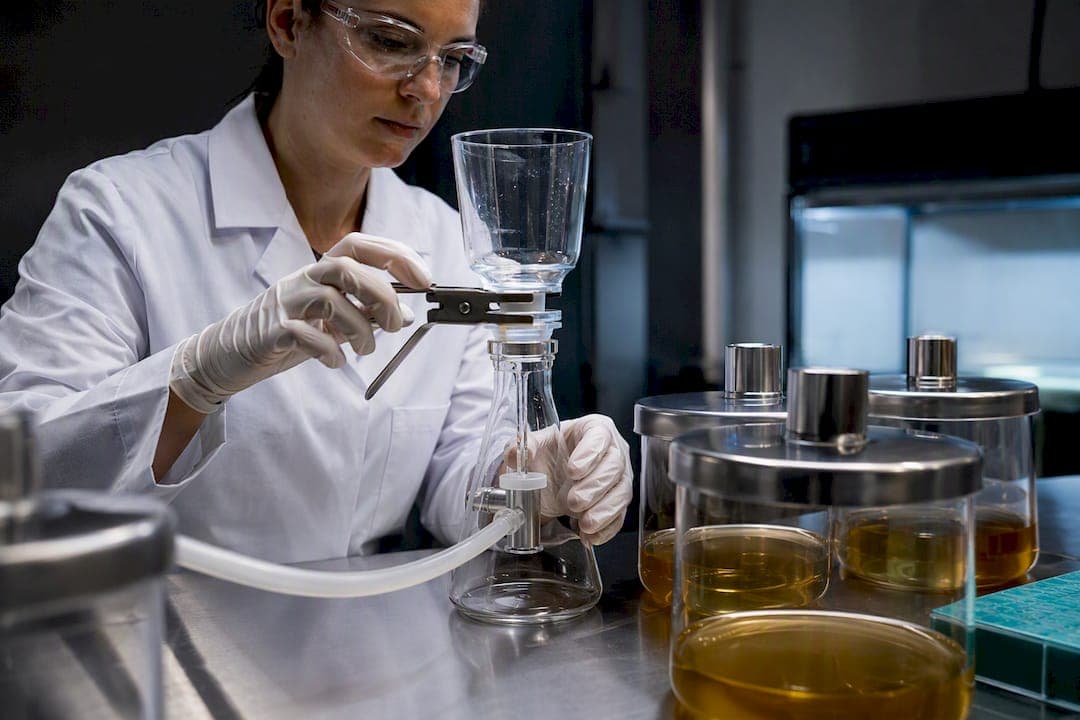
A peptide is not sterile because a supplier says so. Sterility testing means a validated USP <71> test, a 14-day incubation in two growth media, showing zero viable organisms in the sample tested. Treat any research peptide as non-sterile unless a batch-specific USP <71> report exists.
TL;DR:
- Peptides are not automatically sterile; only a validated USP <71> test with a 14-day incubation confirms sterility, and research peptides lack this unless specified.
- The USP <71> standard requires testing with two media at specific temperatures over 14 days, with minimum sample counts scaled to batch size, and regulators add facility and process expectations.
- Membrane filtration is preferred for filterable products, while direct inoculation is used for viscous or non-filterable formulations, but both require controls and method validation.
- Rapid testing methods like ATP, PCR, and flow cytometry can flag contamination early but do not substitute the 14-day USP <71> assay for final batch release.
- Always request explicit batch-specific USP <71> sterility data and actual method details from suppliers, and verify lab accreditation before relying on sterility certificates.
Table of Contents
- What Standards Govern Peptide Sterility Testing?
- How Are Membrane Filtration and Direct Inoculation Performed?
- Do Rapid Test Methods Replace USP <71>?
- How Should Peptides Be Prepared for Sterile Use?
- What Should a Sterility Certificate of Analysis Include?
- When Is Sterility Testing Legally Required?
- How Does Purity Documentation Relate to Sterility?
- What Sterility Priorities Actually Matter for Lab Leaders
- How to Request Documentation From Peptastic Labs
- Where to Verify These Standards Directly
- Sources
- FAQ
What Standards Govern Peptide Sterility Testing?
Sterility claims only carry weight when they trace back to a recognized pharmacopoeial method. The United States Pharmacopeia chapter USP <71> is the reference standard most labs test against, and it specifies exact conditions rather than a general concept of "clean."
The core requirements:
- Two growth media. Fluid thioglycollate medium (FTM) targets anaerobic and aerobic bacteria; soybean casein digest medium (SCDM) targets fungi and aerobic bacteria.
- Two incubation temperatures. FTM runs at 30 to 35°C; SCDM runs at 20 to 25°C.
- A 14-day observation window. Samples sit undisturbed for 14 days with periodic checks for turbidity or visible growth.
- Minimum sample-unit counts. USP <71> specifies how many units and what volume must be tested based on batch size, so a single vial cannot represent an entire lot.
Regulators layer their own expectations on top of the pharmacopeial method. The TGA's sterility testing guidelines detail clean-room and facility expectations for labs performing sterility work on therapeutic goods, and the WHO's sterility testing standards align closely with the same pharmacopeial logic on an international scale.
The EMA's guideline on synthetic peptides adds a manufacturing-level distinction: terminal sterilization, which sterilizes the finished product in its final container, gives the highest sterility assurance and should be the default choice for synthetic peptides unless the peptide degrades under that process. Aseptic processing, building the product from sterile components in a controlled environment, is acceptable only with justification for why terminal sterilization was not feasible.
One distinction trips up more researchers than any other: sterility and endotoxin are different quality axes entirely. A batch can pass USP <71> with zero viable organisms and still carry bacterial endotoxin from dead cell fragments, which triggers pyrogenic reactions independent of live contamination. Endotoxin gets its own test, USP <85> using the LAL (limulus amebocyte lysate) method. Purity, sterility, and endotoxin status are three separate measurements, and a document proving one says nothing about the other two.
How Are Membrane Filtration and Direct Inoculation Performed?
USP <71> recognizes two primary test methods, and picking the right one depends on the product's physical properties, not convenience.
Membrane filtration is the preferred method for most water-soluble or filterable products because it physically removes any inhibitory substances that might mask contamination:
- Pass the sample through a sterilizing-grade membrane filter, typically 0.45 µm pore size for sterility testing purposes (distinct from the 0.22 µm filters used for sterilizing liquids during prep).
- Rinse the filter with an appropriate diluent to wash away any residual antimicrobial or bacteriostatic agents that could suppress microbial growth during incubation.
- Cut or transfer the filter (or filter halves) directly into FTM and SCDM.
- Incubate both media for the full 14 days at their respective temperatures and observe for turbidity.
Direct inoculation skips the filtration step and adds the sample straight into the growth media. It becomes necessary when a product cannot be filtered, viscous formulations, oils, or devices that can't pass through a membrane without being destroyed, but it carries a real tradeoff: any antimicrobial property in the sample dilutes into the media and can suppress the very growth the test is designed to detect.
Sensitivity differs meaningfully between the two. Membrane filtration generally offers better detection because it concentrates organisms on the filter surface and removes interfering substances. Direct inoculation depends more heavily on adequate dilution ratios to neutralize any residual antimicrobial activity. USP <71> also sets minimum sample and unit counts scaled to batch size, so testing one vial from a batch of a thousand tells a lab far less than testing the number of units the chapter actually requires.
Neither method means anything without controls. Every run needs a positive control (a known microorganism spiked into media to confirm the media can support growth), and the lab must have already run growth promotion testing on that specific lot of media before using it for product testing. This is where method suitability testing comes in: confirming the product itself doesn't inhibit microbial growth, which would produce a false negative.
Pro Tip: Ask any lab for their growth promotion and bacteriostasis/fungistasis data on the specific media lot used for your sample. A sterility "pass" without this backing evidence is not a validated result, it's an assumption.
Do Rapid Test Methods Replace USP <71>?
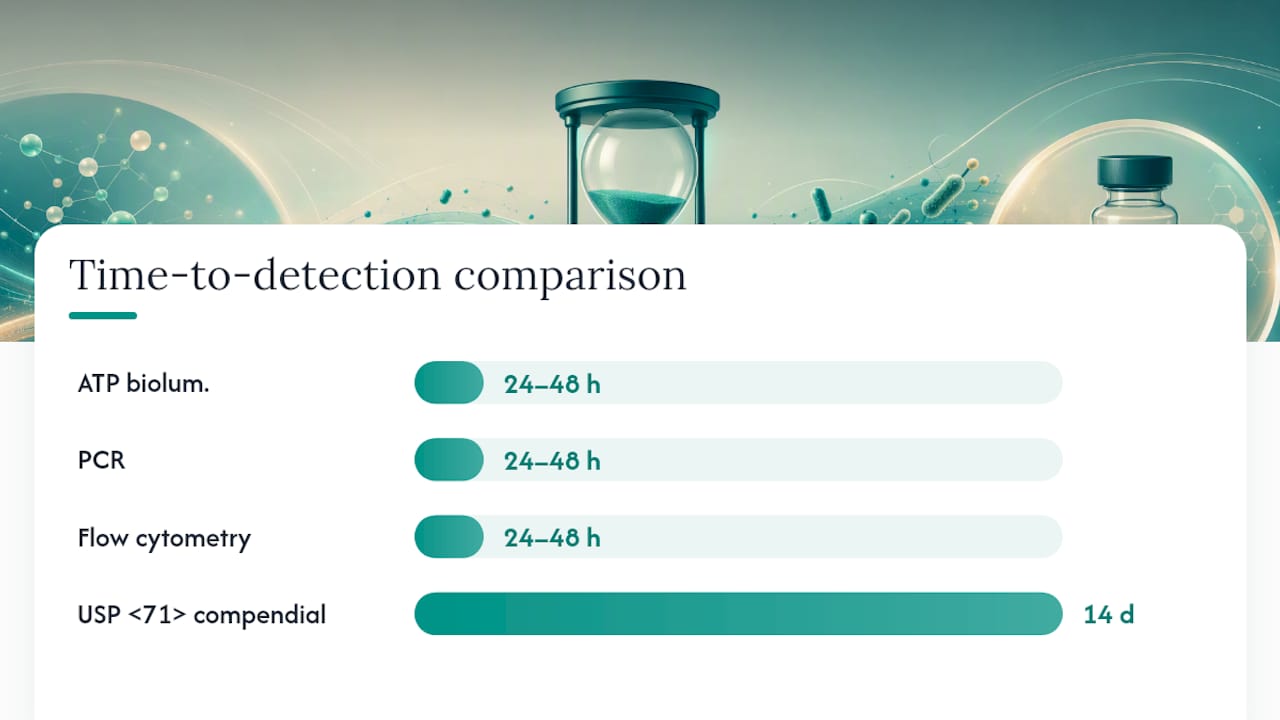
No. Rapid methods can flag gross contamination in 24 to 48 hours, but none of them substitute for the 14-day compendial test at final release unless a regulator has specifically validated and accepted that alternative method for that product.
Three technologies dominate rapid screening:
- ATP bioluminescence detects adenosine triphosphate, a molecule present in all living cells, using a light-emitting enzyme reaction. It flags metabolically active contamination fast but can't distinguish bacterial ATP from residual cellular material in a peptide formulation.
- PCR (polymerase chain reaction) detects microbial DNA, which means it can pick up genetic material from dead organisms just as readily as live ones. A positive PCR result doesn't confirm viable contamination, and a negative result doesn't guarantee sterility if inhibitors in the sample suppressed amplification.
- Flow cytometry counts particles and can differentiate some viable from non-viable cells using fluorescent stains, but it requires careful calibration against the specific peptide matrix being tested.
The practical use case for all three is batch triage: screening incoming lots early to catch obvious contamination before committing time and reagents to a full 14-day USP <71> run. That saves resources on batches that were never going to pass anyway. Treating a rapid-method pass as equivalent to final sterility release, however, is a compliance gap most auditors will catch immediately.
How Should Peptides Be Prepared for Sterile Use?
Research-grade peptides typically arrive lyophilized (freeze-dried) and are not manufactured under sterile fill/finish conditions. That means the responsible assumption is non-sterile until proven otherwise, and reconstitution technique becomes the primary contamination control point in most research settings.
- Work in a clean, still-air environment (a laminar flow hood if available) and disinfect the vial stopper and work surface before opening anything.
- Reconstitute using sterile water or bacteriostatic water for injection, drawn with a sterile syringe and needle. Our needle gauge and syringe guide covers equipment selection for this step.
- If sterile filtration is part of your workflow, pass the reconstituted solution through a 0.22 µm sterilizing-grade filter. This reduces viable microbial load but does not touch endotoxin, dead cell fragments pass straight through a 0.22 µm membrane, and filtration can cause measurable product loss with low-concentration peptide solutions due to surface adsorption.
- If the formulation contains a bacteriostatic agent, any downstream sterility test on it requires a neutralizer validated for that specific compound, confirmed through method suitability testing, or the antimicrobial carryover will suppress growth and produce a false pass.
- Store reconstituted product per the manufacturer's stability data and minimize repeated needle entries, each puncture is a contamination opportunity regardless of how the vial started out.
Pro Tip: If your workflow calls for injectable use, endotoxin testing (LAL/USP <85>) matters just as much as sterility. A 0.22 µm filter and clean technique lower bioburden risk but say nothing about endotoxin already present before you started. Our guide on why sterility matters in peptide research walks through the broader risk picture.
What Should a Sterility Certificate of Analysis Include?
A sterility COA is only as useful as the specifics it discloses. Vague assurance language is the first warning sign; verifiable method detail is what separates a real result from a marketing claim.
A defensible COA should show:
- The exact method cited, USP <71>, not a generic "tested for sterility" statement.
- Which media were used (FTM and SCDM) and the incubation temperatures and duration.
- The testing lab's name and accreditation status, ideally ISO 17025 or an equivalent GLP-recognized standard.
- Batch and sample-unit identification tying the result to a specific production lot, plus the testing date.
- Evidence that positive controls and growth promotion testing were performed on that media lot.
Red flags to reject outright: a "sterile" claim with no method named, a rapid-test result (ATP or PCR) presented as final release data, missing incubation dates, or a lab name you can't independently verify. Any of these means the Certificate of Analysis is not backed by a validated procedure.
When a batch fails sterility testing, the manufacturer's obligation is not optional: batch destruction or quarantine, a documented investigation into the contamination source, and revalidation before any related batch ships. If a supplier can't produce underlying lab documentation on request, dates, method details, accreditation number, that absence is itself the answer.
When Is Sterility Testing Legally Required?
The regulatory bar shifts sharply depending on end use. Research-only peptides sold for laboratory study carry no blanket legal requirement for sterility testing in most jurisdictions, though responsible suppliers still document what they can. Therapeutic or clinical-use products are a different matter entirely: batch release for anything administered to humans or animals under a therapeutic claim typically requires validated sterility data before that batch can legally ship, per TGA guidance and equivalent frameworks elsewhere.
For procurement, build a short checklist before you order:
- Confirm the testing lab's accreditation (ISO 17025 or GLP status).
- Request a dated COA naming USP <71> specifically, not a generic sterility statement.
- Ask what media and incubation conditions were used.
- Retain all documentation for the batch's full shelf life for audit traceability.
Turnaround for a full USP <71> run is rarely faster than 14 days by design, plus a few days for sample prep and reporting. Cost varies by lab and sample volume, driven mainly by the number of units tested and whether method suitability validation is being run alongside the sterility test itself.
How Does Purity Documentation Relate to Sterility?
That level of analytical rigor confirms identity and concentration with real precision.
It does not confirm sterility. Researchers planning sterility-dependent work should treat purity documentation and sterility documentation as two distinct requests: verify purity through the standard COA, then ask explicitly whether batch-specific USP <71> data exists before assuming a peptide is suitable for any application requiring sterile handling.
What Sterility Priorities Actually Matter for Lab Leaders
Accredited testing and documented COAs beat convenience every time. Where sterility data doesn't exist for a batch, run a harm-reduction stack: aseptic reconstitution, sterile filtration where the formulation allows it, and endotoxin testing before anything reaches an injectable protocol. Keep SOPs and traceability records for every in-lab sterile step, because that paper trail is what makes a result defensible later.
— Tintastic
How to Request Documentation From Peptastic Labs
Peptastic Labs is built around one advantage researchers rarely get elsewhere: batch-level transparency you can actually verify, not just a purity number on a label.
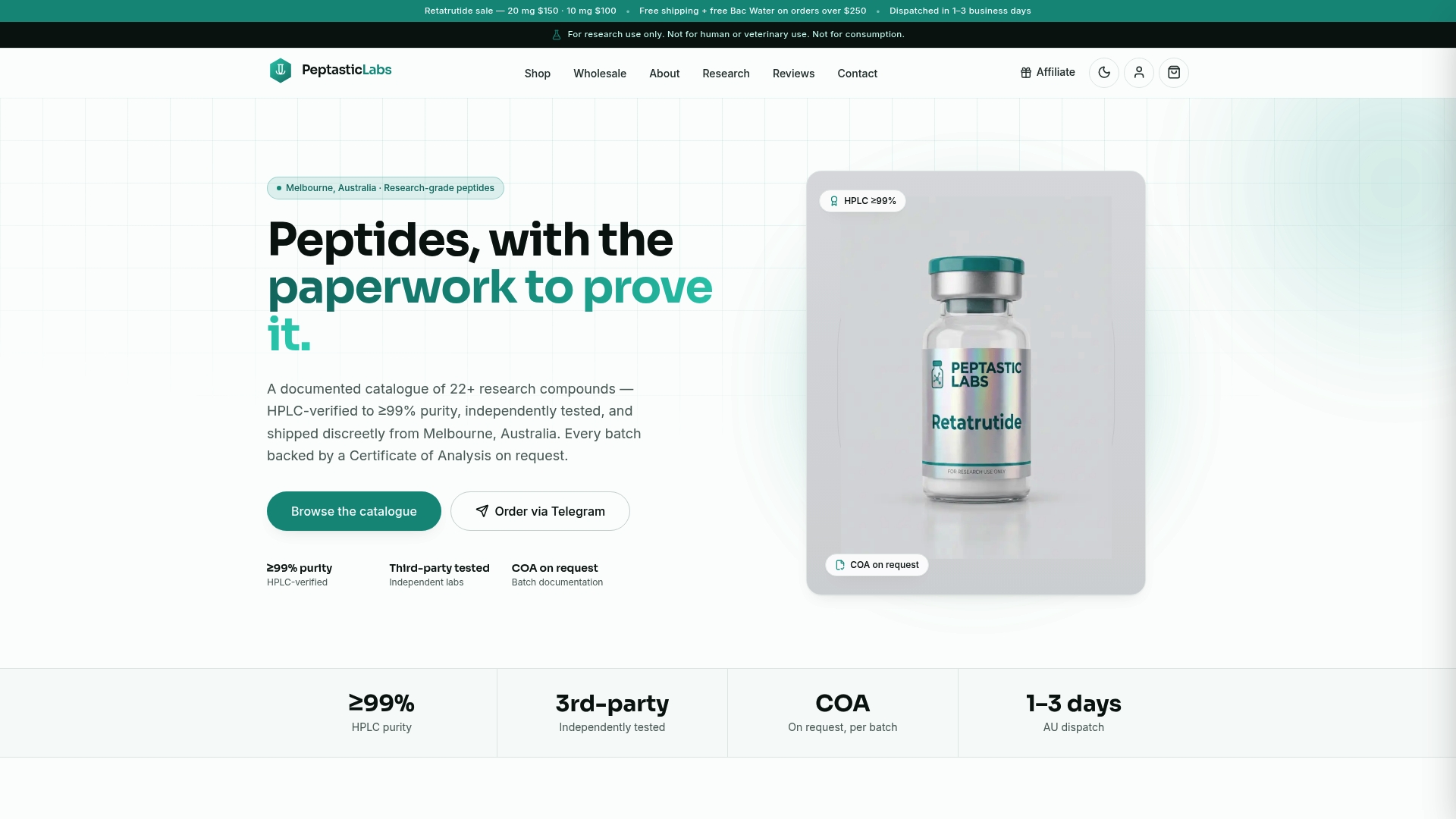
Purity documentation is not sterility documentation, and this distinction should be made explicitly rather than letting a purity COA imply more than it proves. If your research requires sterility assurance, ask directly whether batch-specific USP <71> data exists before you plan downstream sterile use, and pair that request with verification of the testing lab's accreditation status. For anything requiring reconstitution, our guide on what defines a research-grade peptide explains the gap between research-grade supply and sterile pharmaceutical manufacturing in more detail.
Visit Peptastic Labs to browse the current catalog, request a Certificate of Analysis for a specific batch, or reach out with sterility documentation questions before placing a bulk or wholesale order.
Where to Verify These Standards Directly
- TGA sterility testing guidelines
- WHO sterility testing standards
- EMA synthetic peptides guideline
- Medical device technical file compliance reference
This article is general information, not a substitute for advice from a qualified doctor. Consult a qualified healthcare professional about your own circumstances before acting on anything here.
Sources
- TGA guidelines for sterility testing of therapeutic goods
- WHO sterility testing standards
- Sterility Testing for Peptides: Methods and Standards in 2026 (FormBlends)
FAQ
Is There a Reliable Way to Test Peptide Purity?
Yes, high-performance liquid chromatography (HPLC) is the standard method, separating and quantifying compounds to verify purity percentage and detect synthesis byproducts. Purity testing is separate from sterility testing and answers a different question entirely.
Why Does Sterility Testing Take 14 Days?
USP <71> requires a full 14-day incubation because slow-growing organisms, particularly some fungi and fastidious bacteria, can take that long to produce visible turbidity in growth media. Cutting the window short risks a false negative on a genuinely contaminated batch.
How Much Does Peptide Sterility Testing Cost?
Cost depends on the lab, sample volume, and whether method suitability validation runs alongside the test, so no single figure applies across labs. Expect testing that includes proper method suitability and growth promotion controls to cost more than a bare-bones incubation run, reflecting the added validation work.
What Are the Main Methods of Sterility Testing?
The two USP <71> compendial methods are membrane filtration, generally preferred for filterable liquids, and direct inoculation, used when a product can't pass through a filter. Rapid methods like ATP bioluminescence, PCR, and flow cytometry supplement these for early screening but don't replace the 14-day test for final release.
Does a Peptide Supplier's Purity Certificate Confirm Sterility?
No. Researchers needing sterility assurance should request batch-specific USP <71> data explicitly rather than inferring it from a purity result.