SNAP-8 (acetyl octapeptide-3) is a synthetic eight-residue cosmetic peptide studied for its proposed interference with SNARE-complex assembly, the protein machinery that lets nerve terminals release acetylcholine. Most of the measurable evidence sits in its close relative, acetyl hexapeptide-8 (Argireline), and in delivery studies that ask whether the peptide reaches its target through skin. This guide sets out what is established, what is proposed and what a research group should document before running work with it. It is written for researchers and informed readers in Australia who source research-grade peptides.
TL;DR
- SNAP-8 is proposed to mimic a region of SNAP-25 and compete in SNARE-complex assembly. This differs from botulinum neurotoxin A, which cleaves SNAP-25 by proteolysis.
- Human data are mostly for the related hexapeptide Argireline: a 2025 review found 10 eligible human studies, with varied wrinkle and scar outcomes.
- Delivery is the central research question: the peptide is hydrophilic and relatively large, and reaching neuromuscular junctions after topical use is unestablished.
- Vehicle matters. Porcine skin work showed a multiple water-in-oil-in-water emulsion delivered significantly more peptide than simpler emulsions.
- Reliable results need a verified peptide: identity and purity by HPLC and mass spectrometry, with a batch-matched Certificate of Analysis.
Table of Contents
- What SNAP-8 is
- SNAP-25 and SNARE biology in brief
- How the proposed mechanism differs from botulinum toxin
- What the human and formulation studies measured
- SNAP-8 versus Argireline in research
- Skin penetration enhancers for peptides
- Evidence gaps to design around
- Search results you will meet, and how to read them
- Why material verification belongs in the protocol
- Sourcing research-grade peptides in Australia
- FAQ
- Sources
What SNAP-8 is
SNAP-8 is the trade name for acetyl octapeptide-3. Cosmetic patent literature describes peptides of this class as sequences derived from the protein SNAP-25 and capable of at least partially inhibiting neuronal exocytosis. Exocytosis is the process by which a cell releases the contents of a vesicle, here the neurotransmitter acetylcholine, to the outside.
The parent compound is Argireline. A 2020 review in the International Journal of Molecular Sciences gives its sequence as Ac-Glu-Glu-Met-Gln-Arg-Arg-NH2 and describes it as covering the N-terminal fragment domain of SNAP-25. SNAP-8 is discussed in the literature as the longer, octapeptide counterpart in the same design family, so the mechanistic questions overlap.
Two naming points avoid errors in a methods section:
- Report the INCI-style name (acetyl octapeptide-3) alongside the trade name SNAP-8, because the trade name is not a chemical identifier.
- Do not substitute Argireline data for SNAP-8 data. State which peptide each cited result used.
SNAP-25 and SNARE biology in brief
SNARE proteins drive membrane fusion. SNAP-25, syntaxin and synaptobrevin assemble into a core complex that pulls a vesicle against the cell membrane so its contents can be released. A 2024 all-atom molecular-dynamics study suggests that SNARE helices zipping into the juxtamembrane linkers initiates microsecond-scale fusion, forming a hydrophobic nucleus that expands to a stalk-like structure and then a fusion pore.

Because SNAP-25 is a required component, it is a natural target for anything that disrupts assembly. That is the logic behind SNAP-25-derived peptides: a short fragment resembling part of SNAP-25 could compete for a place in the complex. It is a proposed mechanism, and it is tested in vitro, not assumed.
How the proposed mechanism differs from botulinum toxin
The two are often compared and often confused. They act differently.
| Feature | Botulinum neurotoxin A | SNAP-8 / Argireline (proposed) |
|---|---|---|
| Molecular action | Protease cleaves SNAP-25 | Fragment competes in SNARE assembly |
| Effect on SNAP-25 | Permanently altered protein | No cleavage proposed |
| Evidence base | Established biochemistry | Proposed; target engagement being studied |
| Duration drivers | Protease longevity, persistence of cleaved SNAP-25 | Not established |
The toxin side is well documented. A 1993 study by Blasi and colleagues showed that botulinum neurotoxin A inhibits transmitter release by selective proteolysis of SNAP-25, and that the isolated light chain cleaves SNAP-25 in vitro. A 2006 review by Dolly and Aoki states that removing nine amino acids from the C-terminal of SNAP-25 disables its function, and that the long duration reflects protease longevity, persistence of cleaved SNAP-25 and remodelling of treated synapses.
A peptide that competes for assembly would, if it works as proposed, be reversible and would not remove part of SNAP-25. The 2020 review cited above reports Argireline as having similar potency but lower efficacy than botulinum toxin in its catecholamine-release experiments. For a study design, this means the correct comparison is mechanism-by-mechanism, never an equivalence claim.
What the human and formulation studies measured
Human studies
The closest human evidence is for acetyl hexapeptide-8. A 2025 Journal of Drugs in Dermatology review ran a PRISMA-guided search in August 2024 and found 10 eligible human studies involving 302 women and 10 men. Included studies reported varying decreases in wrinkle or scar prominence. PRISMA is a reporting standard for systematic reviews.
The studies used diverse endpoints, which makes direct pooling hard:
- 3-D skin topography
- hydration and elasticity measurements
- photography
- investigator and participant evaluations
- quality-of-life questionnaires
If you plan a new study, pick endpoints from this list and record the instrument, the site measured and the time points, so results can be compared with earlier work.
Skin delivery studies
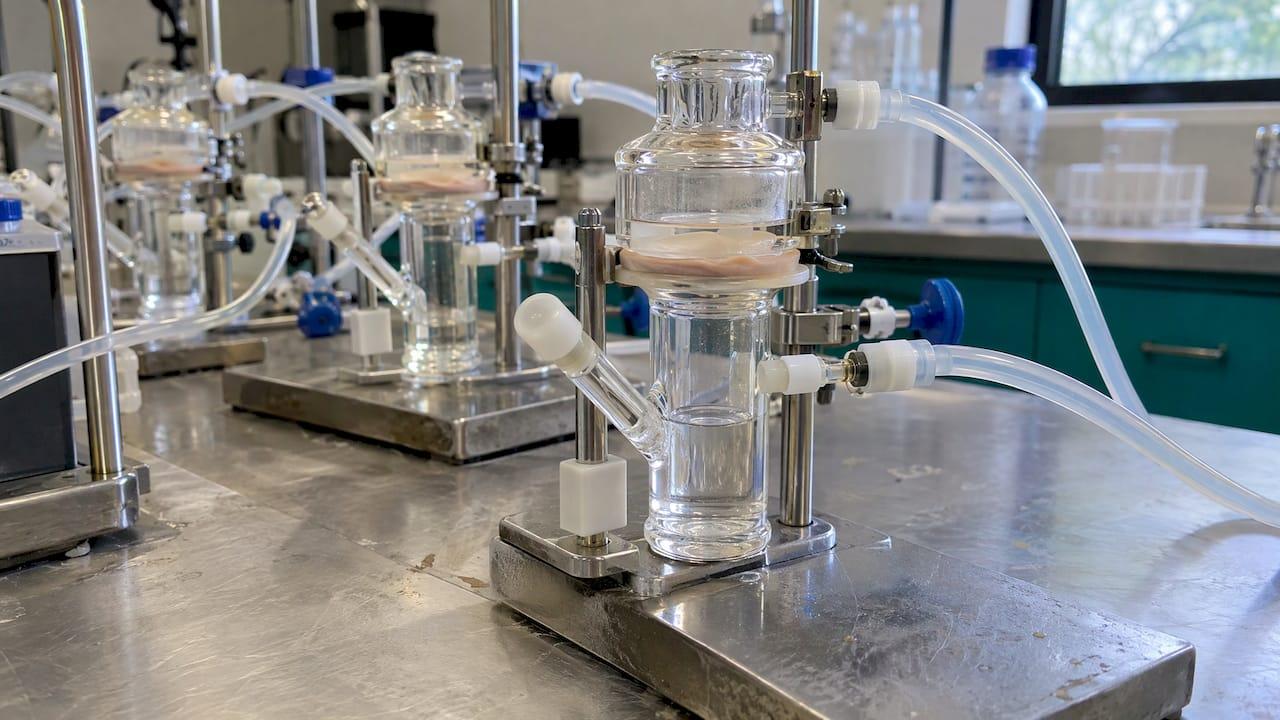
Delivery is where the most transferable data sit. Hoppel and colleagues (2015) quantified acetyl hexapeptide-8 by LC-MS/MS and used Franz diffusion cells and in-vitro tape stripping on porcine ear skin to compare emulsion vehicles. Franz cells are two-chamber devices that measure how much of a compound crosses a skin sample over time. Tape stripping removes the outer skin layer by layer to see where the compound sits.
They reported significantly greater delivery from a multiple water-in-oil-in-water emulsion than from simple oil-in-water or oil-rich water-in-oil emulsions. The PubMed record attributes the enhanced delivery from water-rich emulsions partly to increased absorption of the vehicles into skin, assessed with ATR-FTIR (an infrared method) and tape stripping. This is a vehicle and porcine-skin finding. It is not proof of target engagement in living human facial tissue.

SNAP-8 versus Argireline in research
The two peptides share a design rationale and, for the most part, a body of evidence. Here is how the literature lines up.
- Proposed mechanism: both are described as modulating neuromuscular activity through SNARE-related interference. A 2025 International Journal of Molecular Sciences review describes Argireline's proposed anti-wrinkle action as modulation of neuromuscular activity.
- Study evidence: the human and delivery data cited above are for Argireline (acetyl hexapeptide-8). Treat any SNAP-8-specific claim as needing its own source.
- Delivery limits: the same review notes that dermal delivery and access to neuromuscular junctions remain uncertain.
For the Argireline side in depth, see our guide to Argireline research measurements. For the wider category, evidence for cosmetic peptides and QC rules covers how the classes differ.
Skin penetration enhancers for peptides
A hydrophilic, charged peptide struggles to cross the lipophilic outer skin layer, the stratum corneum. The 2025 review states that the peptide is hydrophilic and relatively large, which limits passage. Three research approaches address this.
- Vehicle design. The multiple-emulsion result above is one example. Water-rich systems changed how the vehicle itself was absorbed into skin.
- Molecular modification. In a 2018 Scientific Reports study, Lim and colleagues compared four Argireline-related peptides (Arg0 to Arg3), assessed permeation through human skin in vitro and tested inhibition of glutamate release in neurons from human dental-pulp stem cells. The work identifies charge and hydrophilicity as barriers and investigates modification to alter them.
- Chemical penetration enhancers. A 2021 review of transdermal delivery systems for biomolecules discusses them and emphasizes that many can cause skin irritation, so enhancer effects need to be assessed alongside tolerability.
The practical design rule: when you add an enhancer, measure peptide delivery and peptide stability in the same experiment, and record irritation endpoints in parallel. An enhancer that raises delivery but degrades the peptide gives a misleading result.
For delivery routes more broadly, see neuropeptide delivery methods researchers verify.
Evidence gaps to design around
The 2025 review lists the main limitations. Stating them in a protocol makes it stronger.
- Model limits: many data come from in-vitro or ex-vivo skin, and the multiple-emulsion comparison used porcine rather than living human skin.
- Formulation specificity: results apply to the tested formulation, not to the peptide in general.
- Target uncertainty: reaching neuromuscular junctions after topical use is unestablished.
- Endpoint diversity: different instruments in human studies reduce comparability.
What would demonstrate target engagement? A study would need to show that the peptide reaches the relevant tissue at an effective concentration and alters SNARE assembly or acetylcholine release there, in a model relevant to the claim. Until a study does, describe SNAP-8 outcomes as proposed mechanism plus measured endpoints, and keep the two apart in your write-up.
Search results you will meet, and how to read them
Searching this topic returns pages with large figures, such as percentage wrinkle reductions at 28 days and side-effect rates. Check each against a primary source before reuse. A usable citation names the study, the peptide actually tested, the concentration, the vehicle, the number of participants and the instrument. A figure with none of these is not a data point for a methods section.
Why material verification belongs in the protocol
Peptide results depend on what is in the vial. Three items belong in every SNAP-8 or Argireline protocol:
- Identity: mass spectrometry confirming the expected molecular weight and sequence.
- Purity: HPLC percentage with the method and wavelength noted.
- Traceability: the batch number on the Certificate of Analysis matching the vial.
These matter most in delivery studies, where you quantify small amounts by LC-MS/MS. Degradation products or counter-ion variation add noise that can look like a vehicle effect. Store lyophilized material as the supplier's documentation instructs, and record reconstitution solvent, concentration and time before use.
The Peptastic view
In cosmetic peptide work, the weakest link is usually the input, not the assay. A delivery experiment on porcine skin, with LC-MS/MS quantification, assumes the compound is what the label says and at the stated purity. If it is not, the result cannot be interpreted.
That is why we build around documentation. Every compound in our catalogue is independently tested, with HPLC verification to ≥99% purity, mass spec identity checks, traceable batch documentation and Certificates of Analysis available on request. Our Cosmetic Science line sits alongside Metabolic, Tissue & Repair, Longevity and other categories, so a group running skin studies and metabolic work can source from one place.
Our position is simple: research claims should rest on verified material. Verified identity and purity let you attribute an outcome to the peptide, the vehicle or the model, which is the question the literature on SNAP-8 and Argireline is still working to answer.
Tintastic
Sourcing research-grade peptides in Australia
Peptastic Labs supplies independently tested, research-grade peptides to researchers and institutions, with HPLC and mass spec testing on each batch, batch documentation and Certificates of Analysis on request. The Cosmetic Science range and the other lines are listed in the full catalogue. Orders can be placed online, including by pre-filled Telegram or WhatsApp checkout, and bulk and wholesale options are available for larger programs.
Before ordering, note the batch documentation you need for your protocol, such as the CoA, so it can be requested with the order. Related reading: skin signal peptides and the evidence and how peptides drive collagen production.
FAQ
What is SNAP-8?
SNAP-8 is the trade name for acetyl octapeptide-3, a synthetic eight-residue peptide in the family of SNAP-25-derived cosmetic peptides. It is studied for proposed interference with SNARE-complex assembly. Its design relates to Argireline, and most human data are for that hexapeptide.
Is SNAP-8 the same as Argireline?
No. Argireline is acetyl hexapeptide-8, a six-residue peptide covering the N-terminal fragment domain of SNAP-25. SNAP-8 is a longer octapeptide in the same design family. Both are proposed to act on SNARE assembly, but published human and delivery studies mostly used Argireline, so cite each peptide by name.
How does SNAP-8 differ from botulinum toxin?
Botulinum neurotoxin A is a protease that cleaves SNAP-25, and its long duration reflects that enzymatic action. SNAP-8 is proposed to compete in SNARE assembly without cleaving the protein. Research treats them as different mechanisms, not equivalents.
Which vehicle has been studied for peptide skin delivery?
In a 2015 porcine ear skin study, a multiple water-in-oil-in-water emulsion delivered significantly more acetyl hexapeptide-8 than simple oil-in-water or oil-rich water-in-oil emulsions. It is a vehicle comparison in porcine skin. Results should be confirmed in the model your protocol uses.
Sources
- Cosmetic anti-ageing skin care compositions (US patent 8865651)
- Cosmeceutical Peptides in the Framework of Sustainable Wellness Economy (Errante et al., 2020)
- Molecular mechanism underlying SNARE-mediated membrane fusion (2024)
- Botulinum neurotoxin A selectively cleaves the synaptic protein SNAP-25 (Blasi et al., 1993)
- The structure and mode of action of different botulinum toxins (Dolly and Aoki, 2006)
- Acetyl Hexapeptide-8 as a Topical Alternative to Botulinum Toxin: Review of Literature (JDD, 2025)
- Topical delivery of acetyl hexapeptide-8 from different emulsions (Hoppel et al., 2015)
- Acetyl Hexapeptide-8 in Cosmeceuticals: A Review of Skin Permeability and Efficacy (IJMS, 2025)
- Enhanced Skin Permeation of Anti-wrinkle Peptides (Lim et al., Scientific Reports, 2018)
- Transdermal Delivery Systems for Biomolecules (2021)