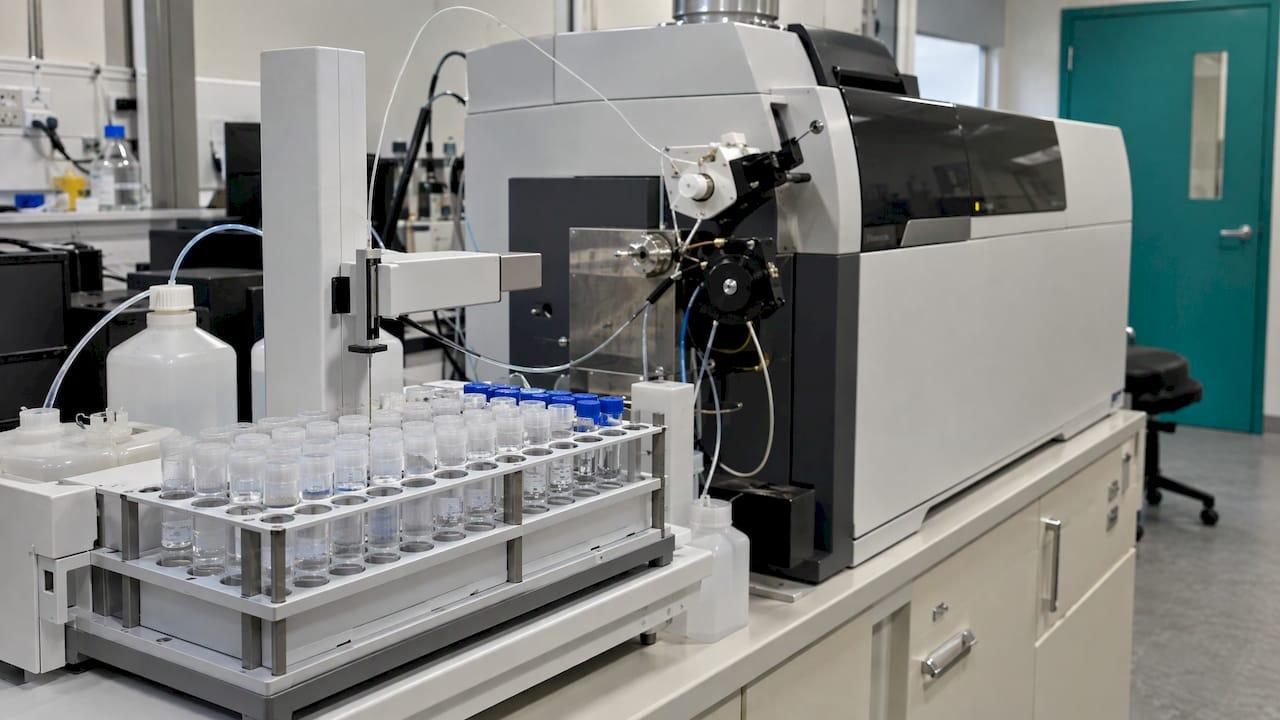
Heavy metals in peptides come from the supply chain, not from the peptide itself: catalysts, reagents, water, glassware and purification equipment. An HPLC purity figure does not measure them, so a batch needs documentation that covers identity, purity and elemental impurities separately. Our catalogue of research-grade peptides is independently HPLC and mass spec tested, with batch documentation and Certificates of Analysis (COA) available on request.
This guide is for researchers and Australian buyers who want to understand the issue: which metals matter, where they come from, which limits are reference points, and how to read a batch report.
TL;DR
- Arsenic, cadmium, lead and mercury are the priority elements. ICH Q3D(R2) places all four in Class 1, the most toxic group.
- Sources: catalysts, processing equipment, containers, reagents, solvents, water.
- HPLC purity (for example ≥99%) and elemental impurity testing are different measurements. Read them separately.
- ICH Q3D(R2) is adopted guidance in Australia, not a statutory limit for research-only materials. Treat its figures as reference points.
- Batch-specific documentation, with the method and units stated, is the useful evidence. Generic claims are not.
Table of Contents
- Which heavy metals matter in peptides
- What the evidence shows
- Where heavy metals come from
- What HPLC purity does and does not tell you
- Australian rules and reference limits
- Peptides versus collagen and other supplements
- How to read a batch report
- Storage and handling
- Perspective
- Ordering research peptides in Australia
- FAQ
- Sources
Which heavy metals matter in peptides
Heavy metals are metallic elements that are toxic at low exposures. In pharmaceutical guidance they are called elemental impurities. ICH Q3D(R2), the international guideline hosted by Australia's Therapeutic Goods Administration (TGA), sorts elements by toxicity and by how likely they are to occur:
| Class | Elements | Meaning |
|---|---|---|
| 1 | Arsenic, cadmium, lead, mercury | Highest toxicity; always assessed |
| 2A | Cobalt, nickel, vanadium | Likely to occur; assessed |
| 2B and 3 | Several other elements | Lower probability or lower toxicity depending on route |
For reference, the same document lists permitted daily exposures (PDEs) for Class 1 elements, in micrograms per day. Cadmium is 5 oral, 2 parenteral (injected) and 3 inhalation. Lead is 5 for all three routes. Arsenic is 15 oral, 15 parenteral and 2 inhalation. Mercury is 30 oral, 3 parenteral and 1 inhalation. These are limits for finished medicines, and they show how small the amounts of concern are.
What the evidence shows
Published evidence on peptide contamination is thin and comes mostly from products outside regulated supply. A 2018 study from Belgium analyzed ten frequently encountered falsified peptide drugs bought from three suspected illegal internet pharmacies. It found arsenic and lead contamination, with some arsenic concentrations up to ten times the ICH toxicity limit for parenteral drugs. The authors also ran arsenic speciation by HPLC-ICP-MS and reported that all arsenic in the examined samples was inorganic.
Two points keep this in proportion:
- The samples were falsified products from unregulated sellers. They do not describe every peptide on the market.
- The authors note that limited sample material pushed some limits of quantification above the applicable ICH limits. They could not exclude possible exceedances for mercury and nickel in some samples.
The practical lesson is about sourcing. Where a supplier controls materials, documents batches and publishes verifiable results, the risk picture is different from anonymous or unlabeled product.
Where heavy metals come from
Peptides are made by chemical synthesis, then purified and freeze-dried. Metals can enter at several points.
Catalysts and reagents
The TGA's guidance on impurities in prescription medicines says residual metals used as process catalysts should be restricted using safety- and quality-based criteria. ICH Q3D(R2) says elemental impurities may come from intentionally added catalysts, processing equipment, container-closure systems or components of the product.
Equipment, glass, solvents and water
The Belgian study describes likely contamination routes as leaching from laboratory equipment, glass, reactors or containers, and low-quality reagents, solvents or water. It also names groundwater and glass as possible arsenic sources. Raw material quality and equipment hygiene therefore matter as much as the synthesis route.
Controls that reduce the risk
ICH Q3D(R2) recommends a risk-based approach. Where levels may exceed the control threshold, additional controls can include process purification, upstream controls, material or excipient specifications, and specifications on the drug substance or finished product. In plain terms: control inputs, purify, and test the result.
What HPLC purity does and does not tell you
HPLC (high-performance liquid chromatography) separates a sample into components and compares peak areas. The TGA notes that many pharmacopoeial impurity tests judge compliance by comparing the HPLC peak areas of impurities with those of standards. That is an organic-impurity approach: truncated sequences, deletion peptides, related substances.
A purity of ≥99% by HPLC therefore describes the share of the target peptide among the peptide-related species detected. Mass spectrometry confirms identity by molecular weight. Neither is an element-specific measurement. Heavy metals are measured with a technique built for elements, such as ICP-MS (inductively coupled plasma mass spectrometry), which the Belgian study used for elemental profiling.
The result: a high HPLC purity is necessary evidence of peptide quality, and elemental testing is a separate line on a report. For more on how the two analytical methods differ, see our HPLC vs LC-MS comparison. For the wider set of impurity classes, see peptide impurity profiling and residual solvents and COA checks.

Australian rules and reference limits
Three facts shape how an Australian researcher should read any limit.
- ICH Q3D(R2) is adopted guidance. The TGA's 30 July 2024 announcement lists Q3D(R2) among the international scientific guidelines adopted in Australia, and notes that adopted guidelines are not mandated by legislation. It is a benchmark, not a blanket statutory limit for research-only materials.
- Scope. ICH Q3D(R2) applies to new finished drug products, including those containing synthetically produced polypeptides. It does not apply to products used during clinical research stages.
- Peptide-specific wording. The TGA's 2013 guidance says the usual ICH Q3A/Q3B qualification thresholds do not apply to synthetic peptides, although their toxicological principles remain relevant to product-related peptide impurities. That concerns organic impurities, not metals.
Other numbers you will meet online belong to other products. For example, the TGA's medicinal cannabis quality guidance sets maximums of 3.0 mg/kg arsenic, 0.5 mg/kg cadmium, 5.0 mg/kg lead and 0.5 mg/kg mercury for cannabis plant material. Those are plant-material limits and are not peptide limits. The same page also shows good reporting practice: results in mg/kg, not ambiguous ppm.
For the supply side, our guides cover TGA peptide rules, research peptide compliance and prescription requirements. Peptides intended for human use are a matter for a doctor and the TGA. Research peptides are supplied for laboratory research only.

Peptides versus collagen and other supplements
Search results for this topic mix two different things. Collagen peptides and protein powders are food or supplement ingredients, tested against food-style limits and often reported in ppm or mg/kg for the whole product. Synthetic research peptides are single, chemically synthesized compounds, made in small batches, where contamination depends on the synthesis route, reagents and equipment. A collagen result tells you nothing about a synthetic peptide batch, and the reverse holds too. Compare like with like: the same compound type, the same method, the same units.
It also helps to separate remediation literature from contamination. Many top results discuss peptides that bind metals for environmental clean-up. That research is about peptides as tools against metals, not about metals inside a peptide product.
How to read a batch report
A useful report is batch-specific and states what was measured and how. Check these points:
- Batch or lot number matching the vial in your hands.
- Identity by mass spectrometry: observed mass against theoretical mass.
- Purity by HPLC, with the method and detection wavelength stated.
- Elemental impurities, where reported: which elements (at least arsenic, cadmium, lead, mercury), which technique, and the result.
- Units in mg/kg or µg/g, not an unexplained ppm.
- Limits of quantification. A limit above the reference limit cannot show compliance. The Belgian study shows this problem directly.
- Date and testing laboratory, so the result can be traced.
To compare a result with a reference, convert units first. A result in µg per gram of peptide, multiplied by the grams used per day, gives µg per day, the unit of the PDE tables. The PDE depends on the route, so match the route in the table to your experimental setting and treat the figure as context, not a pass or fail rule.
Storage and handling
Contamination does not only arrive at the factory. Glass, reconstitution water and repeated vial access can add problems. Our guide to peptide vial contamination covers causes, warning signs and prevention. Reagent-grade water and clean glassware are basic controls in any lab protocol.
Perspective
Heavy metals are a documentation question. A peptide with a strong HPLC trace can still come from a route that used catalysts or equipment nobody tracked, and the trace alone will not show it.
Our approach is to treat each batch as its own record. Every peptide batch is independently HPLC and mass spec tested, with traceable batch documentation, and COAs are available on request. Researchers get identity and purity data tied to the lot they receive, across more than 22 compounds, each verified to ≥99% purity by HPLC.
We recommend that researchers read reports the way this guide describes: batch number, method, units, and the date. That habit separates a supplier with a traceable record from a supplier with a general claim.
Tintastic
Ordering research peptides in Australia
Our catalogue covers metabolic, cognitive and neuro, tissue and repair, longevity, cosmetic science, blends, hormone and reproductive compounds, and ancillaries and reagents. Each is supplied with batch documentation, and COAs are available on request. Bulk and wholesale options are available. Orders can be placed online, including through Telegram or WhatsApp pre-filled checkout. Browse the full peptide catalogue.
Importing from overseas adds its own costs and rules. See our guide to peptide import GST in Australia.
FAQ
Are there heavy metals in peptides?
They can be. A 2018 Belgian study of falsified peptide drugs from suspected illegal internet pharmacies found arsenic and lead contamination. Those were unregulated products, so the result reflects sourcing rather than peptides in general. Batch-level documentation is how a researcher tells the difference.
Does an HPLC purity result show heavy metals?
No. HPLC compares peptide-related peaks and gives purity, while mass spectrometry confirms identity. Heavy metals are measured with an element-specific technique such as ICP-MS and appear as a separate result on a report.
Is there an Australian legal limit for heavy metals in research peptides?
The TGA has adopted ICH Q3D(R2) as guidance, but it states that adopted guidelines are not mandated by legislation. Its figures are reference points for finished medicines. Limits in other TGA guidance, such as for medicinal cannabis, apply to those products only.
Which metals should a report cover?
Arsenic, cadmium, lead and mercury are the Class 1 elements in ICH Q3D(R2), so they are the first four to look for. Cobalt, nickel and vanadium are Class 2A and are the next group to check.
Sources
- ICH Q3D(R2) Elemental impurities, Step 5 (TGA-hosted)
- Impurity profiling of the most frequently encountered falsified peptide drugs on the Belgian market, 2018
- TGA: Complying with requirements relating to impurities in prescription medicines
- TGA: Adoption of international scientific guidelines in Australia, 2024
- TGA: Complying with the quality requirements for medicinal cannabis