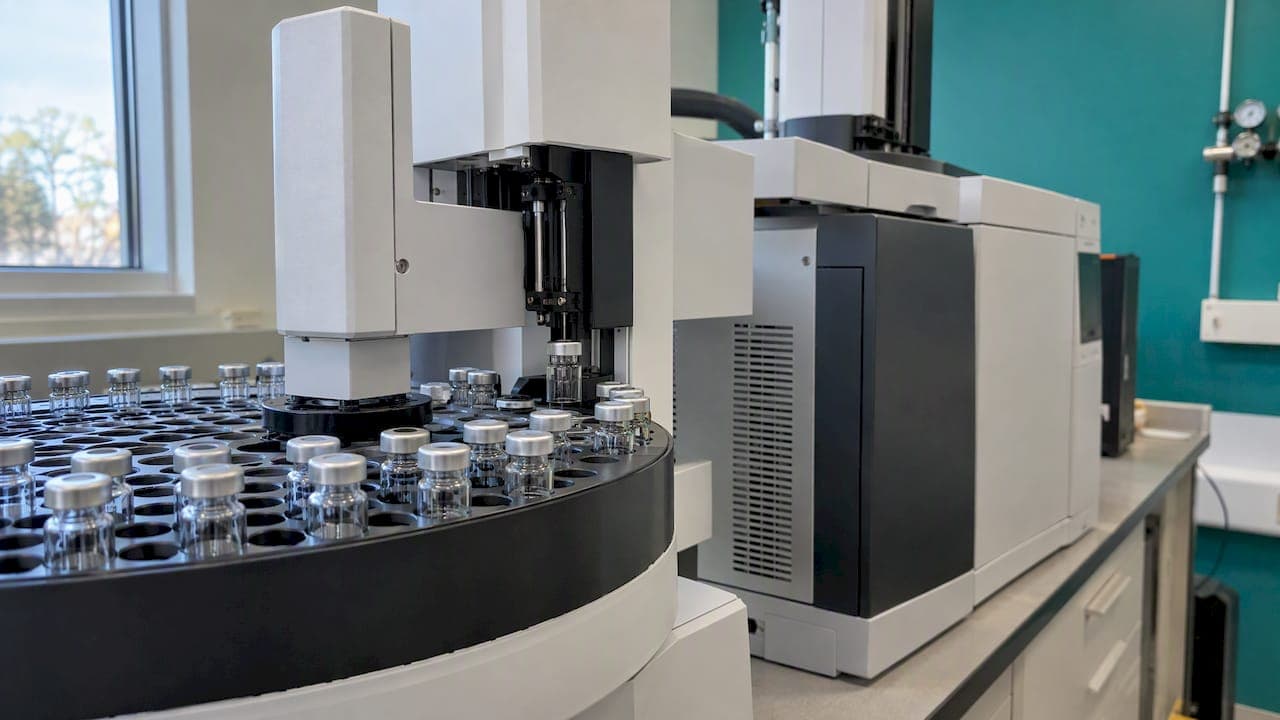
Residual solvents are volatile organic chemicals left in a peptide after synthesis, cleavage and purification. They are not part of the peptide structure. An HPLC purity figure does not measure them. They are quantified with a separate method, headspace gas chromatography (HS-GC), and water is measured separately again, usually by Karl Fischer titration. This guide covers where residual solvents come from, which limits are used as reference points in Australia, how the tests work and what to read on a certificate of analysis (COA).
All Peptastic Labs products are supplied for laboratory research only.
TL;DR
- Residual solvents are volatile process chemicals (for example DMF, acetonitrile, dichloromethane) that remain after synthesis and purification. They are separate from peptide-related impurities.
- HPLC purity does not detect them. HS-GC is the dedicated method. Moisture is a third, separate measurement (Karl Fischer or loss on drying).
- ICH Q3C, adopted by the TGA as a guideline, groups solvents into Class 1 (avoid), Class 2 (limit) and Class 3 (low toxic potential). It is the usual reference for limits.
- On a COA, check which tests are listed, the method named, the limit applied and whether a result is reported or simply absent.
Table of Contents
- What residual solvents are in a synthetic peptide
- Where they come from in solid-phase synthesis
- Why HPLC purity does not show residual solvents
- Limits: ICH Q3C and the Australian context
- How residual solvents are measured: headspace GC
- Moisture: Karl Fischer versus loss on drying
- Reading a COA for solvents and moisture
- Why it matters for study design
- Our perspective
- Research peptides from Peptastic Labs
- FAQ
- Sources
What residual solvents are in a synthetic peptide
The ICH Q3C guideline defines residual solvents as organic volatile chemicals used or produced in making drug substances or excipients that are not completely removed by practical manufacturing techniques. It sorts them by toxicity risk into three classes. The same document says they offer no therapeutic benefit, so they should be removed as far as possible.
For research peptides the definition matters for a practical reason. A lyophilized vial contains more than peptide. The non-peptide fraction can include counterion, water, residual solvents, peptide-related impurities and sometimes a bulking agent. Each has its own test.
Where they come from in solid-phase synthesis
Most research peptides are made by solid-phase peptide synthesis. The peptide is built on a resin, one amino acid at a time, with a wash after each coupling and deprotection step. The European Medicines Agency notes that this process requires extensive washing of the resin with solvents, and that the purge of every reagent and solvent should be addressed by data or risk analysis.
Typical solvents in the chain:
- Synthesis and washing: dimethylformamide (DMF), N-methylpyrrolidone (NMP), dichloromethane (DCM).
- Cleavage: trifluoroacetic acid (TFA) and scavenger mixtures. TFA also appears as the counterion in the final salt.
- Purification: acetonitrile and water in the HPLC mobile phase, sometimes alcohols.
- Precipitation and drying: ether or other organic solvents, then lyophilization.
Lyophilization removes most volatile material. How much remains depends on the sequence, the final wash steps and the drying cycle. This is why two lots of the same peptide can differ in solvent content even when HPLC purity is identical.
Why HPLC purity does not show residual solvents
Reversed-phase HPLC with UV detection (commonly at 214 nm) reports area percent. That is a relative measure of the UV-absorbing species that elute from the column under one set of conditions. It is not a mass fraction. Solvents such as DMF or DCM are volatile, present at low levels and do not behave like peptide peaks, so a chromatogram built for peptide-related impurities is not a solvent test.
The EMA lists purity, assay or content, counter-ion identity and content, water content, residual solvents, elemental impurities, endotoxins and microbiological purity as separate specification tests. Each answers a different question.
| Test | Question it answers | Typical method |
|---|---|---|
| Purity | What share of detected peptide-related peaks is the target? | RP-HPLC, UV |
| Identity | Is the molecular mass correct? | Mass spectrometry |
| Net peptide content | How much of the vial mass is peptide? | Amino acid analysis or nitrogen-based assay |
| Water | How much water is present? | Karl Fischer |
| Residual solvents | Which volatile solvents remain, and how much? | HS-GC |
For more on the limits of UV-based purity, see our guide to peak purity and COA checks and the comparison of HPLC and LC-MS in peptide QC.
Limits: ICH Q3C and the Australian context
The TGA adopted ICH Q3C (R8) as a non-mandatory guideline for applicants and sponsors under the Therapeutic Goods Act 1989 (published 30 July 2024). Research-use peptides are not registered medicines, so these limits are not a legal specification for them. They are the accepted benchmark for reading a solvent result.
ICH Q3C groups solvents as follows, per the TGA-published guideline:
- Class 1: solvents to be avoided, including known or strongly suspected human carcinogens and environmental hazards.
- Class 2: solvents to be limited, because of possible irreversible or significant reversible toxicity.
- Class 3: low toxic potential, with permitted daily exposure (PDE) of 50 mg or more per day.
Class 2 limits for solvents common in peptide work, from the same document:
| Solvent | Concentration limit | PDE |
|---|---|---|
| Acetonitrile | 410 ppm | 4.1 mg/day |
| N,N-Dimethylformamide | 880 ppm | 8.8 mg/day |
| N,N-Dimethylacetamide | 1090 ppm | 10.9 mg/day |
| Methanol | 3000 ppm | 30.0 mg/day |
| N-Methylpyrrolidone | 530 ppm | 5.3 mg/day |
The EMA guideline states that residuals of reagents and solvents should comply with ICH Q3C thresholds or be toxicologically qualified. The European Pharmacopoeia applies the same principles to existing active substances and excipients, and where only Class 3 solvents are used, a loss on drying test may be applied instead of a specific determination.
Our guide on impurity profiling to TGA and ICH expectations covers how to document these tests.

How residual solvents are measured: headspace GC
The standard approach is static headspace gas chromatography with flame ionization detection (GC-FID). USP <467> describes three procedures (A, B and C) for water-soluble and water-insoluble articles, all using capillary or wide-bore columns, a static headspace injector and FID.
The European Pharmacopoeia chapter 2.4.24 presents two systems. System A is preferred. System B is normally used to confirm identity. In the published procedure, 0.200 g of material is dissolved, diluted to 20.0 mL and 5.0 mL is transferred to a headspace vial.
The chapter also states that the procedures may identify most unknown Class 1 and Class 2 solvents, serve as limit tests, and quantify Class 2 solvents above 1000 ppm. It also notes that some solvents, including NMP, formamide and sulfolane, are not readily detected under the standard headspace conditions. A method for NMP therefore needs to be chosen and validated for it specifically.
Why results depend on the method
The result is method-defined. The fraction of a solvent that enters the vapour depends on the partition coefficient, equilibration temperature, diluent, moisture and dissolved solids. Two laboratories can therefore report different numbers for the same lot. A COA that names the method, diluent and limit is more informative than one that gives a bare figure.
Moisture: Karl Fischer versus loss on drying
Water is a different measurement from solvents, and it matters for net peptide content and stability. Lyophilized peptides are often hygroscopic, so water can be a significant share of vial mass.
Two methods are common:
- Karl Fischer (KF) titration is a chemical reaction specific to water. It covers water of crystallization and surface-absorbed water and is not affected by residual volatile solvents.
- Loss on drying (LOD) measures all mass lost on heating. That includes water and any other volatile component, such as residual solvents. It can also include material created by degradation.
The two give identical values only if water is the sole volatile component, released easily, in a thermally stable sample. For peptides, coulometric KF is the usual choice for small samples. The USP reference standards work for synthetic peptides, for example, determined residual moisture by coulometric KF, opening vials in a dry nitrogen environment to limit moisture uptake.
This handling point applies in the lab too. A vial opened in humid air takes up water quickly. For reconstitution and solvent choice, see the peptide solubility guide and the notes on solvent compatibility.
Reading a COA for solvents and moisture
A COA is a record of what was tested. Use this checklist.
- List the tests present. Purity, identity (MS), water and residual solvents are separate lines. If a category is absent or blank, there is no result for it.
- Do not infer across categories. A high purity figure supports only the detected chromatographic profile under the stated conditions. It does not establish solvent absence.
- Check the method. HS-GC for solvents, KF or LOD for moisture. The method name tells you what the number means.
- Check the limit. Compare each reported solvent with its ICH Q3C limit (for example 880 ppm for DMF, 410 ppm for acetonitrile).
- Read non-detects correctly. A non-detect means the analyte was below the method's detection capability in the tested sample. A named solvent panel covers only the solvents named.
- Match the batch. The lot number on the COA must match the vial.
- Ask for raw data when needed. Chromatograms show what the summary table omits. See our note on requesting raw chromatograms.
The EMA's list of specification tests gives a useful frame: purity, content, counterion, water, solvents, elemental impurities and endotoxin each need their own line before a batch is characterized as a whole.
Why it matters for study design
Residual solvents and water both change what is in the vial. Solvents at the ppm level are small by mass, but they can matter for cell-based work, where DMF or acetonitrile may affect assays. Water and counterion change net peptide content, so a weighed amount of powder is not the same as the same amount of peptide. This affects stock concentration, dose-response work and comparison between lots.
Practical consequences:
- Record lot number, purity, water and net content with each experiment.
- Calculate stock concentrations from net peptide content where it is available, not gross powder weight.
- Keep a control compound in the design, as covered in why control compounds matter.
- Follow laboratory solvent handling practice when dissolving. See peptide solvent safety.
Our perspective
Peptide quality is a set of separate measurements, and each needs its own method. At Peptastic Labs, each batch is independently tested by HPLC and mass spectrometry, with traceable batch documentation. Our catalog of more than 22 compounds is verified to ≥99% purity by HPLC.
We read a COA the way the EMA frames specification: purity, identity, water and solvents are different questions. Purity and identity are the foundation. Batch traceability lets a researcher tie every result to the vial on the bench.
Certificates of Analysis are available on request, and our documentation is built so that a researcher can see which tests were run on which lot. That transparency is the point of the process, from sourcing and in-house checks to third-party verification.
Tintastic
Research peptides from Peptastic Labs
Peptastic Labs supplies research-grade peptides across metabolic, cognitive and neuro, tissue and repair, longevity, cosmetic science, blends, hormone and reproductive categories, plus ancillaries and reagents. Each compound is independently tested and HPLC-verified to ≥99% purity, with batch documentation and COAs on request. Bulk and wholesale options are available. Products are for laboratory research only.
Browse the full research peptide catalogue to find compounds by category.
FAQ
Does ≥99% HPLC purity mean a peptide has no residual solvents?
No. HPLC purity is the area share of the target peak among detected peptide-related peaks. Volatile solvents are not measured by that method. Solvents are quantified separately, usually by headspace GC, and each result needs its own line on the COA.
How is peptide moisture tested?
Karl Fischer titration is the specific method for water. Loss on drying measures all mass lost on heating, so it also counts volatile solvents. For lyophilized peptides, coulometric KF on a small sample is common, with the vial opened under dry conditions.
Which solvent limits apply to research peptides in Australia?
No registered-medicine specification applies to research-use material. The TGA has adopted ICH Q3C as a non-mandatory guideline for medicines, and it is the usual benchmark. Examples are 880 ppm for DMF, 410 ppm for acetonitrile and 530 ppm for NMP.
What does a non-detect result mean on a COA?
It means the analyte was below the detection capability of that method in the tested sample. It applies only to solvents on the tested panel. It does not show the absence of unlisted volatile compounds.
Why can two labs report different solvent numbers for the same lot?
Headspace results depend on partition behavior, equilibration temperature, diluent, moisture and dissolved solids. If these differ between procedures, reported values can differ even when each procedure is internally consistent. Compare results only when the methods match.
Sources
- ICH Q3C(R6) Guideline for Residual Solvents
- ICH Q3C original guideline text
- EMA Guideline on the Development and Manufacture of Synthetic Peptides
- TGA: Adoption of international scientific guidelines in Australia
- TGA: ICH Q3C(R5) Impurities, guideline for residual solvents
- European Pharmacopoeia chapter 5.4, limiting residual solvent levels
- Analytical methods for residual solvents determination, Acta Poloniae Pharmaceutica
- European Pharmacopoeia 2.4.24, identification and control of residual solvents
- USP: Reference Standards to Support Quality of Synthetic Peptide Therapeutics
- News-Medical: Karl Fischer versus Loss-On-Drying