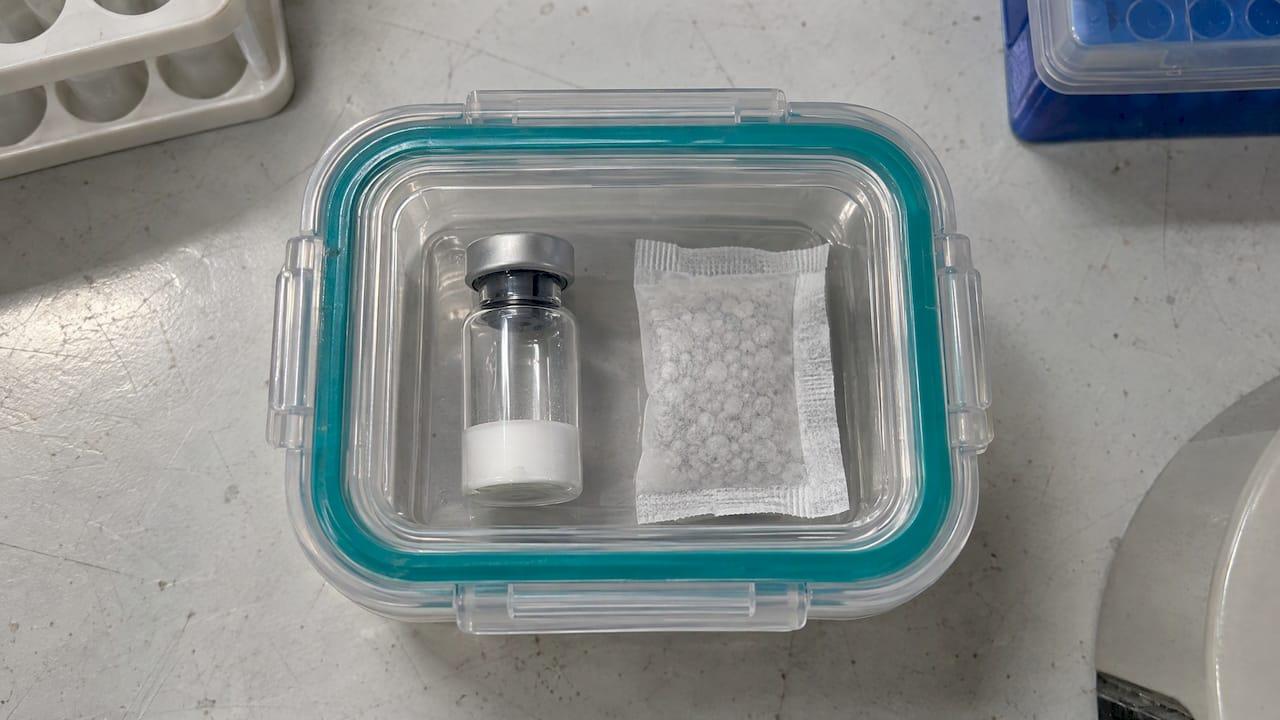
A desiccant protects a freeze-dried peptide by holding the air around the vial at very low humidity. The vial stays sealed, the desiccant sits outside it in a second closed container, and the vial is warmed to room temperature before it is opened. That is the whole routine. The reasons behind each part decide whether it works, and they are set out below for researchers, gym-based peptide enthusiasts and anyone in Australia storing lyophilized material.
Peptastic Labs supplies research-grade peptides, each verified at ≥99% purity by HPLC, with Certificates of Analysis on request. A batch that leaves the lab at that purity only stays there if storage keeps moisture out.
TL;DR
- Lyophilized peptides are often amorphous, so they can take up water vapor into the bulk of the powder, not just onto the surface.
- Moisture is a stability variable: it affects chemical stability, physical stability and biological activity.
- Put the sealed vial inside a second airtight container with desiccant. Keep the desiccant outside the vial, never in contact with the peptide.
- Let a cold vial reach room temperature before opening, so condensation does not form on the powder.
- A desiccant protects dry powder. It has no role once the peptide is reconstituted.
Table of Contents
- What hygroscopicity means for a peptide
- What the evidence shows for desiccant packaging
- How to set up desiccant storage, step by step
- Quick reference: setup choices
- Desiccant and reconstitution are separate stages
- Moisture, degradation and false results
- Climate notes for Australian storage
- Perspective
- Sourcing peptides with the documentation to match
- FAQ
- Sources
What hygroscopicity means for a peptide
Hygroscopic means a material draws water vapor from the surrounding air. For peptides, the effect depends on how the solid is built.
A review in the European Journal of Pharmaceutics and Biopharmaceutics explains that freeze-drying and spray-drying can leave peptides partly or fully amorphous. Amorphous solids take water vapor into their bulk structure. Crystalline solids are limited to adsorbing it on the particle surface. The same review reports significant effects on chemical stability, physical stability and biological activity, depending on the peptide's polarity, the temperature and the relative humidity (RH).
In practice, a freeze-dried cake is dry and porous, and it is built to absorb. A few minutes of open-air exposure on a humid Melbourne or Brisbane day, or one opening of a cold vial, can add water the peptide then carries into storage.
Water matters for three reasons:
- Chemical. Water takes part in hydrolysis and lets other degradation pathways run faster. Purity measured by HPLC drifts down.
- Physical. The cake can collapse, clump or become sticky, which makes weighing and dissolving less reproducible.
- Functional. Biological activity can fall even when the sequence is nominally intact.
Hygroscopicity varies by sequence. Peptides rich in charged or polar residues tend to be more sensitive than very hydrophobic ones, which is why one storage routine is applied to the whole shelf.
What the evidence shows for desiccant packaging
The clearest quantitative evidence comes from a 2009 Pharmaceutical Research study on solid-state PTH(1–34), a peptide hormone. The authors sealed it in nitrogen-purged foil pouches with a 3.5 g molecular sieve desiccant and reported more than two years of stability at ambient temperature. At 25°C and 60% RH, purity stayed at about 99% at 18 months.
The contrast is the useful part. In a headspace at 66% RH with no desiccant, oxidation reached 22% over 12 months. With the sachet pulling the RH down to 0.12%, oxidation fell to 2.5%.
Three points follow for a research lab or a home fridge:
- The humidity of the air around the powder is a controllable variable, and controlling it changes degradation by a large factor.
- The result came from a system: barrier pouch, nitrogen purge and desiccant working together. A sachet in an open box is not the same system.
- The study is one peptide in one format. It shows what is possible, not a guaranteed shelf life for every sequence.
The regulatory guidance points the same way. The TGA-hosted ICH Q5C guideline on stability testing of biotechnological products calls for monitoring the moisture level of powders and lyophilised products. It also says that where humidity-protecting containers are not used, appropriate stability data should be provided. Moisture is treated as a measured stability attribute, not an afterthought.
How to set up desiccant storage, step by step
The aim is a sealed vial inside a second dry, sealed space. Each step below has a common failure point.
1. Keep the original vial closed
The stopper and crimp seal are the first barrier. Check that the cap is intact and the stopper is seated before storing. Do not open a vial just to inspect the cake; the powder is visible through the glass. A vial opened and re-closed without need has been exposed to room air for no benefit.
2. Choose an airtight secondary container
Use a small container with a gasket seal: a screw-top jar, a snap-lock box with a rubber seal or a foil barrier pouch. The desiccant only works if the container does not let in new humid air. A loose lid or a zip bag opened many times slowly defeats it.
Size matters. A small container with a modest amount of desiccant reaches low humidity quickly and holds it. A large box with a small sachet takes longer and saturates sooner.
3. Place the desiccant beside the vial, not in it
Put the desiccant sachet in the secondary container next to the vial. Never add desiccant beads or powder to the vial, and never let loose desiccant touch the peptide or the stopper. Desiccants are sealed in porous sachets for a reason: dust or particles in a research sample is a contaminant. Keep the sachet in its own pouch so it cannot shed onto vial surfaces.
4. Pick a desiccant type that fits the temperature
Common options are silica gel and molecular sieve. Molecular sieve holds humidity very low and is the type used in the PTH(1–34) study above. Silica gel is widely available and works well at room temperature and fridge temperatures. Whichever you use, choose a sachet with a colour indicator or log a replacement date, so you know when it is spent.
5. Match the storage temperature to the product
Desiccant handles moisture, not temperature. The storage temperature for a peptide still comes from its documentation. Where an Australian medicine label is involved, Therapeutic Goods Order No. 69 sets the permitted storage statements, such as below 25°C, 2°C to 8°C (refrigerate, do not freeze) and below -18°C (deep freeze). Any desiccant arrangement has to stay consistent with the stated conditions for that specific product.
For research peptides, the equivalent is the storage guidance supplied with the batch. Our guides on peptide shelf life and how long peptides remain stable in storage cover lyophilized versus reconstituted timelines in detail.
6. Warm the container before opening it
This is the step that most often goes wrong. A fridge or freezer container opened in a warm room draws humid air onto cold surfaces, and water condenses on the vial and, if the vial is opened, on the powder. Take the whole secondary container out and leave it closed until it reaches room temperature. Then open it, take what you need and reseal promptly.
Where possible, do this once. Repeated cycles of cooling and warming multiply condensation risk. Our freeze-thaw SOP sets out a one-freeze, one-thaw approach for the same reason.
7. Replace or recharge the desiccant on a schedule
Desiccant saturates. Silica gel with an indicator changes colour; sachets without an indicator need a fixed replacement interval. Write the date on the container. A saturated sachet releases moisture back into the space under some temperature swings, so an old one is worse than a tidy empty container.
Quick reference: setup choices
| Choice | Works well | Common failure |
|---|---|---|
| Secondary container | Gasketed jar or foil barrier pouch | Loose lid, bag opened daily |
| Desiccant position | Sachet beside the vial | Loose beads in contact with vial or stopper |
| Desiccant amount | Small container, enough sachet to dry it quickly | Large box, one small sachet |
| Opening routine | Warm to room temperature, then open | Opening straight from the fridge |
| Maintenance | Indicator or dated replacement | Sachet left until saturated |
| Temperature | As per batch or label guidance | Treating desiccant as a substitute for cold storage |
Desiccant and reconstitution are separate stages
People searching how to use freeze-dried peptides often mix two things: protecting the dry powder and handling it after solvent is added. They have different rules.
A desiccant belongs only to the dry stage. Once the peptide is dissolved, there is no powder to protect, and a desiccant in the fridge does nothing for a solution. After reconstitution the variables are different: solvent, pH, temperature, freeze-thaw cycles and time. ICH Q5C states that stability after reconstitution of freeze-dried products should be demonstrated for the conditions and maximum storage period specified on the labelling. In a research setting that translates to using the documented reconstitution protocol and keeping a record of how long the solution is held.
For the dissolved stage, see our guides on lyophilized peptide handling, reconstitution and aliquoting, dosing math and CoA-backed reconstitution for Australian labs and pH stability.
Peptastic Labs products are supplied for laboratory research. This article covers storage of the material, not administration, and nothing here is guidance for human use.

Moisture, degradation and false results
For researchers, a wet peptide is also a data problem. If a vial has taken on water, an assay result can reflect handling, not the compound. Weighing is a good example: a hygroscopic powder gains mass as it sits on the balance, so the mass recorded is partly water and the concentration of the stock is off.
Simple controls reduce this:
- Weigh quickly, from a vial that has reached room temperature.
- Record the opening date, the number of openings and the desiccant change date for each vial.
- Aliquot a stock once, instead of opening one vial many times.
- Compare against the batch's Certificate of Analysis when results look off, before assuming the compound is the cause.
Our pieces on preventing false degradation in stability testing and peptide degradation in storage go into how to separate real degradation from handling artefacts. If a shipment saw heat in transit, the temperature excursion guide and the 2°C to 8°C cold chain SOPs cover documentation.
Climate notes for Australian storage
Humidity differs widely across the country. Coastal and tropical areas run humid for much of the year, and a container opened there takes on more moisture than one opened in a dry inland room. Summer room temperatures also push peptides toward the upper end of storage ranges. Two habits help in any state: keep the secondary container in the fridge or freezer as the batch guidance specifies, and open it only after it has warmed, in the driest room available.
Perspective
We treat moisture as a quality variable, not a packaging detail. A peptide verified at ≥99% purity by HPLC leaves us with a number on a page. What the researcher measures at the bench depends on how that vial is kept afterwards.
Our position is that the Certificate of Analysis and the storage routine belong together. The CoA, available on request, tells you what was in the batch. A sealed vial in a dry secondary container, warmed before opening, is how you keep the result of your own assay close to that number.
That is why we publish handling guidance alongside the catalogue: shelf life, reconstitution, freeze-thaw and cold chain. Independent testing, traceable batch documentation and careful storage are one chain, and each link affects the data.
Tintastic
Sourcing peptides with the documentation to match
A storage routine is easiest to judge when you know the starting point. Peptastic Labs offers more than 22 independently tested compounds across metabolic, cognitive and neuro, tissue and repair, longevity, cosmetic science, blends, hormone and reproductive, and ancillaries and reagents. Each is verified at ≥99% purity by HPLC, and Certificates of Analysis are available on request. Bulk and wholesale options are available for labs that stock larger quantities.
Browse the full Peptastic Labs catalogue to see the compounds and their documentation.
FAQ
Can I put desiccant directly inside a peptide vial?
No. Keep the desiccant in a sachet in the secondary container, beside the sealed vial. Loose desiccant in contact with the powder or stopper adds particles and contamination risk without any benefit, because the sealed vial is already the primary barrier.
Do peptides need a desiccant once they are reconstituted?
No. A desiccant protects dry powder from water vapor. After reconstitution the peptide is in solution, and stability depends on the solvent, pH, temperature, number of freeze-thaw cycles and time held. Follow the documented reconstitution protocol for those.
Why shouldn't I open a vial straight from the fridge?
A cold vial in warm air collects condensation. If the vial is open, that water can land on a hygroscopic powder and start degradation. Leave the sealed secondary container at room temperature until it has warmed, then open it.
Is a desiccant enough on its own for long-term storage?
No. It controls humidity only. Temperature, light and the number of openings still matter, and the batch guidance sets the storage temperature. In the PTH(1–34) study, desiccant worked as part of a barrier pouch with a nitrogen purge, not alone.
How often should I change the desiccant?
When an indicator shows it is spent, or on a fixed schedule written on the container. Containers that are opened often saturate sooner than ones opened rarely. Do not leave a saturated sachet in place.
Sources
- Water vapor sorption by peptides, proteins and their formulations, European Journal of Pharmaceutics and Biopharmaceutics (1998)
- Demonstrated Solid-State Stability of Parathyroid Hormone PTH(1–34), Pharmaceutical Research (2009)
- ICH Q5C: Quality of Biotechnological Products, Stability Testing (TGA)
- Therapeutic Goods Order No. 69, General (legislation.gov.au)