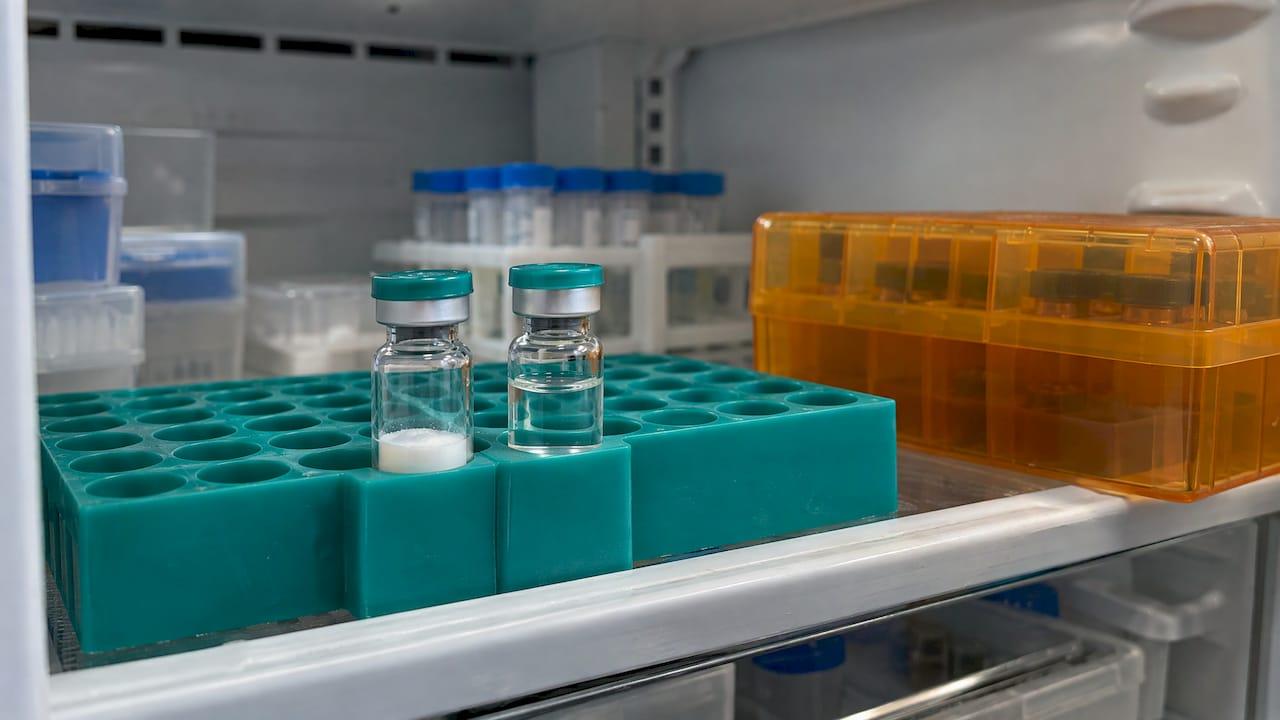
Shelf life depends on the physical state. A lyophilized (freeze-dried) peptide, sealed, desiccated and kept cold and dark, stays stable for years. The same peptide in solution is stable for days to weeks. Sequence, pH, light, oxygen, moisture and freeze-thaw cycling shift both figures. No single number fits every compound, so the batch documentation and the product-specific expiry date decide.
This guide covers research-use peptides only. It sets out typical storage windows, the factors that shorten them, how to assess a temperature excursion, and how to read expiry data.
TL;DR
- Lyophilized peptide: stable for years at -20°C or colder, sealed, dry and protected from light. Short periods at ambient temperature are usually tolerated; long ones are not.
- Reconstituted peptide: short-lived. Days to weeks refrigerated, longer only as single-use frozen aliquots.
- Main degradation routes: moisture uptake, oxidation, deamidation, aggregation, light damage, repeated freeze-thaw.
- Sequence matters. Methionine, cysteine, tryptophan and asparagine residues raise risk.
- Expiry dates and Certificates of Analysis for the specific batch outrank any general rule.
Table of Contents
- Shelf life by state: lyophilized vs reconstituted
- Lyophilized peptide stability
- Reconstituted peptide stability in solution
- What changes shelf life
- When peptides get warm: assessing a temperature excursion
- Signs a peptide has degraded
- Reading expiry dates and stability data
- Perspective
- Research-grade peptides with batch documentation
- FAQ
- Sources
Shelf life by state: lyophilized vs reconstituted
Lyophilization removes most of the water that drives hydrolysis and other chemical reactions. That is why the powder form carries the long shelf life. Once solvent is added, reaction rates rise, microbes become a concern, and the peptide can aggregate.
| State | Typical storage | Typical stability window | Main risks |
|---|---|---|---|
| Lyophilized, sealed | -20°C or colder, dark, desiccated | Years (commonly quoted: 2 to 5 years at -20°C, longer at -80°C) | Moisture on opening, oxidation, light |
| Lyophilized, short ambient exposure | Room temperature, dry, dark | Days to a few weeks for most sequences | Accelerated degradation if warm or humid |
| Reconstituted, refrigerated | 2 to 8°C | Days to a few weeks | Chemical degradation, microbial growth, aggregation |
| Reconstituted, frozen aliquots | -20°C or colder | Weeks to a few months | Freeze-thaw damage if aliquots are reused |
These ranges are conventions used across supplier guidance, not guarantees. Each peptide behaves differently, and a figure that suits one sequence can be wrong for another.
Lyophilized peptide stability
Why the powder lasts
Low water content slows hydrolysis, deamidation and most oxidation pathways. A sealed vial under low temperature keeps the peptide in its most stable form. Lyophilized material is often hygroscopic, though. Moisture absorbed from air lowers the net peptide content and can reduce stability.

Opening the vial
The most common avoidable loss happens at the bench. A cold vial opened in room air pulls in condensation. Standard practice:
- Remove the vial from the freezer.
- Let it reach room temperature inside a desiccator or sealed bag.
- Open, weigh or reconstitute promptly.
- Reseal, purge with dry inert gas if available, and return to cold storage.
Our lyophilized peptide handling guide covers storage, reconstitution and aliquoting in sequence.
Light and container
Light can degrade aromatic residues such as tryptophan, tyrosine and phenylalanine. Keep vials in their original amber or opaque packaging, in a box, away from bench lighting. See peptide light sensitivity for what degrades and how to protect it.
Reconstituted peptide stability in solution
What to expect
Reconstituted peptide is the weak point. Supplier guidance generally puts refrigerated solutions at roughly one to two weeks, and frozen solutions at a few months, with a longer figure at -80°C. Treat those as upper bounds for stable sequences. Sequences containing methionine, cysteine, asparagine or glutamine often need shorter limits.

Published research shows how variable this is. A peer-reviewed study of lyophilized teriparatide PTH(1-34) found some reconstituted preparations precipitated during storage while others remained stable for up to twelve weeks. The authors link this to freezing and drying stress, which can leave the peptide prone to aggregation and subvisible particle formation. The same compound, prepared differently, gave different outcomes.
Storage conditions that help
- Use a suitable solvent. Bacteriostatic water suppresses microbial growth in multi-draw vials. Our note on why bacteriostatic water is used with peptides explains the role of the preservative.
- Control pH. Many peptides are most stable in slightly acidic, sterile buffer. Deamidation of asparagine is generally faster at neutral to basic pH and rises with heat. Details in peptide pH stability.
- Aliquot once. Divide the solution into single-use volumes so each portion thaws one time. See the freeze-thaw SOP.
- Limit oxygen. Dissolved oxygen and trace metals speed oxidation of methionine and cysteine. Use degassed solvent and minimal headspace. Our peptide oxidation control guide gives vial-level steps.
- Keep it cold and dark. Return solution to 2 to 8°C immediately after use, and do not leave it on the bench.
- Label everything. Record date of reconstitution, solvent, concentration and aliquot number.
Long-term storage in solution
Long-term storage of a peptide in solution is not good practice, even in sterile, oxygen-free conditions, because slow chemical degradation continues. If the work allows, keep the bulk as powder and reconstitute only what the next experiment needs.
What changes shelf life
| Factor | Effect | Control |
|---|---|---|
| Amino acid sequence | Met and Cys oxidize; Asn and Gln deamidate; Trp, Tyr, Phe are light-sensitive | Check sequence before setting storage limits |
| Moisture | Reduces net content, speeds hydrolysis | Desiccate, equilibrate before opening |
| Temperature | Higher temperature accelerates nearly every pathway | Cold chain, minimal time out |
| pH | Drives deamidation and hydrolysis | Buffer to a suitable range |
| Oxygen and metals | Oxidation | Inert gas, clean glass or low-bind plastic |
| Light | Damages aromatic residues | Opaque packaging |
| Freeze-thaw | Aggregation, precipitation | Single-use aliquots |
| Excipients | Alter aggregation tendency | Match to the peptide |
Excipients are a good example of the last point. A 2024 peer-reviewed study in the European Journal of Pharmaceutical Sciences used differential scanning calorimetry to assess aggregation during freeze-thaw cycling. In glucagon solutions, lactose stabilized better than trehalose, and a higher excipient-to-peptide ratio reduced aggregation tendency. Stability is a property of the whole formulation, not only the peptide.
For aggregation specifically, our guide to preventing peptide aggregation recommends testing one variable at a time.
When peptides get warm: assessing a temperature excursion
Transit delays, a failed freezer or a bench left out overnight all happen. Useful questions, in order:
- How warm? Mild excursions around room temperature differ from heat above 35°C.
- How long? Hours and days are different problems.
- What state? Lyophilized powder tolerates far more than a solution.
- What sequence? Oxidation- or deamidation-prone peptides are less forgiving.
- What does the record say? Without a temperature log, the history is uncertain.
A commonly used rule of thumb places short ambient exposure of lyophilized powder at minimal impact, with measurable degradation beginning after a day or more at higher ambient temperatures and significant loss likely with prolonged heat. It is a screening guide only. A log does not clear a batch by itself; analytical confirmation does. Our temperature excursion article sets out how to document and decide.
Signs a peptide has degraded
Appearance is an incomplete check, but it catches obvious failures:
- Cloudiness, haze or visible particles in solution
- Gel-like or collapsed cake in a vial that was previously a clean powder
- Color change, especially yellowing
- Odor change
- Reduced activity in a control assay
Solution that looks clear can still have lost potency. Precipitate, on the other hand, calls for a decision on whether to recover or discard. See peptide precipitation: diagnose, recover or discard.
Reading expiry dates and stability data
A general rule is a starting point. The documents that travel with the batch are the evidence.
What to check
- Batch number and date of manufacture. Traceability ties every figure to one lot.
- Expiry or retest date. Applies to the sealed product under the stated storage condition only.
- Certificate of Analysis. Purity by HPLC, identity by mass spectrometry, appearance, and content.
- Storage statement. Temperature, light and humidity conditions assumed by the date.
- Reconstitution guidance. Any solvent and in-use period given for that product.
How stability is formally established
In regulated pharmaceutical development, stability protocols are built around guidance such as ICH Q1A(R2), which defines the stability data package for new drug substances and products, including storage conditions and trial duration. Research-grade peptides are not registered medicines, but the logic carries over: a date is only as good as the storage condition and the data behind it.
Practical in-lab approach
- Record receipt date, lot and storage location.
- Assign an in-use limit to every reconstituted solution, shorter than the sealed expiry.
- Re-check purity by HPLC if material has been stored past its date or after an excursion.
- Discard solution that is cloudy, or past its in-use limit, rather than extending it.
- Keep a log so results can be traced to a specific preparation.
Our peptide degradation and storage guide provides a lab-ready checklist for these steps.
Perspective
Shelf life questions usually start as storage questions, but they end as documentation questions. A general figure of years for powder and weeks for solution is a reasonable planning range. It does not replace batch data.
We test each batch independently by HPLC and mass spectrometry, hold traceable batch documentation, and supply Certificates of Analysis on request. Our approach is designed so a researcher can tie an expiry date and a purity figure to the exact lot in the freezer.
Our recommendation is plain: keep bulk material lyophilized, reconstitute only what the next experiment requires, aliquot once, and log everything. Stability problems that look like product failures are often handling or record gaps that a documented workflow catches early.
Tintastic
Research-grade peptides with batch documentation
Peptastic Labs supplies independently tested, research-grade peptides at ≥99% purity, HPLC-verified, across metabolic, cognitive, tissue repair, longevity, cosmetic and other categories, with Certificates of Analysis on request. Bulk and wholesale options are available. Products are for laboratory research use only.
Browse the full peptide catalogue or visit Peptastic Labs to request batch documentation with an order.
FAQ
How long do lyophilized peptides last?
Sealed, desiccated and kept at -20°C or colder, lyophilized peptides are commonly kept for years, and colder storage extends that. The exact figure depends on the sequence and the batch expiry date. Always follow the date and storage statement on the batch documentation.
How long does a reconstituted peptide last in the fridge?
Refrigerated at 2 to 8°C, reconstituted peptides are generally treated as usable for days to a couple of weeks. Some sequences need less. Set an in-use limit per compound, and discard solution that turns cloudy or shows particles.
Can peptides be stored at room temperature?
Lyophilized powder usually tolerates short periods at room temperature, such as during shipping, if kept dry and dark. Longer storage accelerates degradation. Solutions should not stay at room temperature beyond the time needed for use.
Does freezing a reconstituted peptide extend its life?
Frozen single-use aliquots last longer than refrigerated solution. Repeated freeze-thaw cycles cause aggregation, so thaw each aliquot once and do not refreeze it.
Sources
- Stability of lyophilized teriparatide PTH(1-34), ScienceDirect
- DSC reveals the excipient impact on aggregation propensity, European Journal of Pharmaceutical Sciences
- ICH Q1A(R2) Stability testing of new drug substances and drug products, EMA