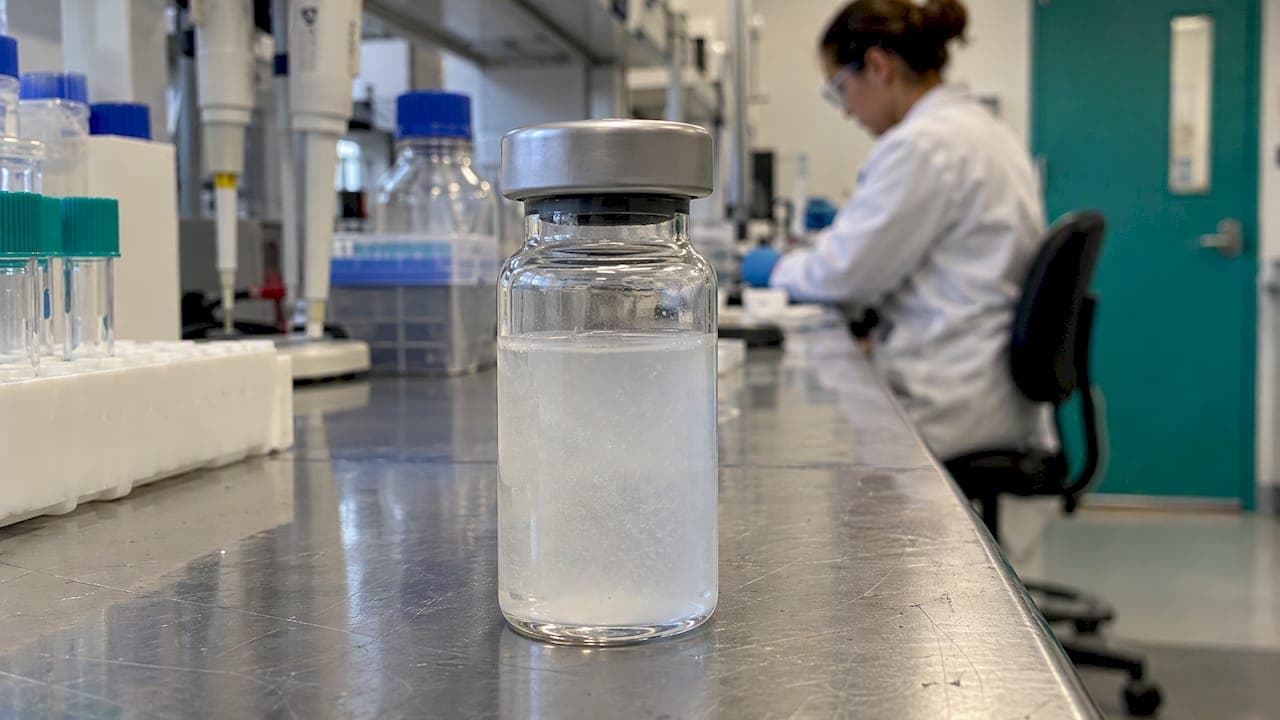
Peptide precipitation has two meanings in the lab. Unwanted: a peptide drops out of solution, the vial turns cloudy, and a dose or assay is at risk. Intended: a peptide is crashed out of a cleavage mixture with cold ether during synthesis workup. The fix differs for each. Unwanted precipitation is sometimes reversible (aggregation, incomplete dissolution, a pH or temperature effect) and sometimes not (solvent incompatibility, microbial growth, degradation). This guide covers both cases, with a decision path, a cause table and the handling precautions that apply in Australian laboratories.
TL;DR
- Cloudiness alone does not identify the cause. Incomplete dissolution, pH, salts, concentration, temperature, aggregation, contamination and degradation all look similar.
- Reversible: physical aggregation and slow dissolution. Not recoverable: contamination, degradation and most solvent-driven precipitation. Discard those vials.
- Test first: rest at room temperature, swirl gently, inspect under bright light. Never heat aggressively or sonicate a vial to force clarity.
- Intentional ether precipitation: diethyl ether gives cleaner products than MTBE for aromatic-rich sequences. Peroxide hazards and the SDS apply.
- Parenteral product information, such as the TGA-registered teriparatide label, states that a cloudy solution or one with visible particles must not be used.
Table of Contents
- Two meanings of "peptide precipitation"
- Why a peptide goes cloudy
- Step-by-step: diagnose a cloudy vial
- Fixing precipitation during aqueous preparation
- When to discard
- Intentional precipitation: ether workup after cleavage
- Safety and compliance for solvents in Australian labs
- Where lyophilization fits
- Our perspective
- Research-grade peptides with batch documentation
- FAQ
- Sources
Two meanings of "peptide precipitation"
Search results for this keyword mix two different workflows, so separate them before troubleshooting.
| Situation | Goal | Typical trigger | Recoverable? |
|---|---|---|---|
| Unwanted precipitation in a reconstituted vial or buffer | Clear, stable solution | Wrong solvent, pH, salt, concentration, temperature, contamination | Sometimes |
| Intended precipitation after cleavage | Solid crude peptide | Adding cold ether to the cleavage mixture | Yes, by design |
The first half of this article deals with the vial. The ether workup follows after that.
Why a peptide goes cloudy
Cloudiness is a symptom. It is not a diagnosis. Published troubleshooting guidance lists incomplete dissolution, precipitation driven by pH, salts, concentration or temperature, aggregation, contamination, container or stopper particles, degradation and solvent incompatibility as possible causes, and notes that appearance alone cannot separate them (Cloudy or Clumped Peptide After Mixing? Safety Guide).
In practice the causes fall into three groups.
Reversible: physical aggregation and slow dissolution
Peptide molecules associate through hydrophobic contact or hydrogen bonding. The haze can clear when the solution equilibrates. Lyophilized cake that was added to cold solvent, or dissolved at high concentration, often shows this behavior. Our guide on preventing peptide aggregation covers residue-level causes and how to test one variable at a time.
Condition-driven: pH, salt, concentration, temperature
A peptide is least soluble near its isoelectric point, where net charge approaches zero. Moving a basic peptide to a mildly acidic solvent, or an acidic peptide to a mildly basic one, often restores solubility. Phosphate-buffered saline can also trigger precipitation when a peptide dissolves well in pure water but not in a salt-containing buffer. Practitioners report this pattern often, for example in a forum thread on preventing precipitation of a peptide that dissolves in water but not PBS. Related reading: peptide pH stability and peptide pH adjustment.
Not recoverable: contamination, degradation, solvent incompatibility
Microbial growth, chemical degradation and a solvent that the peptide was never compatible with cannot be reversed by warming or mixing. Particles from stoppers or containers fall in this group too. Warning signs and prevention are in our peptide vial contamination article.
Step-by-step: diagnose a cloudy vial
Run the checks in this order. Stop as soon as one fails.
- Record the baseline. Note lot number, solvent, volume, concentration, pH if known, storage temperature and time since reconstitution.
- Inspect under bright, neutral light against a dark and a white background. Look for haze, floating fibers, flakes, a film on the glass and color change.
- Rest at room temperature for 20 to 30 minutes. Cold solutions hold aggregates that disperse once equilibrated. Do not apply a heat source.
- Swirl gently. No vortexing, no vigorous shaking. Foaming and shear can drive aggregation in some sequences.
- Re-inspect. If the haze clears completely, aggregation or slow dissolution was likely. If haze persists, particles remain visible or color has shifted, treat the vial as compromised.
- Check the solvent against the sequence. Calculate net charge and hydrophobic residue content. Compare with the peptide solubility guide and the solvent compatibility notes.
- Document the outcome against the lot number before any further use.
The pass/fail logic above is a common bench approach, not a guarantee. A vial that clears may still have partial aggregation that affects a sensitive assay. For quantitative work, confirm concentration after clearing.
Fixing precipitation during aqueous preparation
When a fresh preparation precipitates, the cause is almost always the conditions you chose. These adjustments are tested on a small aliquot, never on the whole lot.
- Dissolve a small test portion first. Roughly 1 mg is enough to check a solvent before committing the full vial.
- Match solvent to charge. Basic peptides generally prefer slightly acidic aqueous solvent. Acidic peptides generally prefer slightly basic aqueous solvent. Neutral or strongly hydrophobic sequences often need a small volume of an organic co-solvent, added to the peptide first and then diluted slowly.
- Add the concentrated stock to the buffer dropwise, with gentle mixing. Pouring buffer onto a concentrated stock produces local supersaturation and a visible crash.
- Lower the working concentration. A solution at 0.5 mg/mL may remain clear where 5 mg/mL does not.
- Delay salts. Dissolve in water first when the sequence allows, then bring ionic strength up in steps.
- Avoid repeated freeze-thaw. Aliquot stock solutions once. See lyophilized peptides handling for aliquoting and storage.
- Check counter-ion effects. Residual trifluoroacetate from purification can alter pH and solubility in unbuffered water. The peptide salt forms article explains how to measure it.
Any co-solvent must be compatible with the downstream assay. In cell work, verify the final organic solvent fraction your cells tolerate before dosing (selecting peptides for cell culture).
Are peptides water soluble?
Some are, many are not. Solubility is sequence-dependent and is set mainly by net charge and the share of hydrophobic residues. Short, charged peptides dissolve readily in water. Long peptides rich in leucine, isoleucine, valine, phenylalanine or tryptophan dissolve poorly and tend to aggregate. Supplier handling guidance reports that most peptides dissolve in water, with a smaller fraction needing an organic solvent (Biocat peptide handling guideline). Treat that as a rule of thumb. The sequence and the Certificate of Analysis decide the real answer.
When to discard
Discard the vial when any of the following applies:
- Haze persists after resting and gentle swirling.
- Visible particles, fibers or flakes remain.
- Color has shifted since reconstitution.
- The solution turned cloudy after a long storage period at the wrong temperature.
- Contamination is plausible: the stopper was punctured repeatedly, or non-sterile technique was used.
Regulated medicines set the same standard. The Australian product information for teriparatide, a peptide injection, instructs users not to use the solution if it is cloudy, colored or contains visible particles (TGA product information for teriparatide). Research material deserves the same discipline. A cloudy vial that is used anyway introduces an unknown variable into the experiment.
This also answers the common question about a fixed 30-day shelf life. No single number fits every sequence. Stability depends on the sequence, solvent, pH, temperature, light and handling. Judge each vial by what it looks like and how it was stored, and record what you saw.
Intentional precipitation: ether workup after cleavage
In solid-phase synthesis, cold ether precipitation is the standard way to recover crude peptide after global deprotection and cleavage. Peptides are insoluble in ether while the scavengers and cleaved protecting-group fragments stay in solution.

Choosing the ether
Diethyl ether and methyl tert-butyl ether (MTBE) are the solvents used most often. The choice affects purity. Work by De la Torre and Andreu found that for sequences rich in aromatic or alkylation-prone residues, diethyl ether consistently gives cleaner products than MTBE, because MTBE can alkylate side chains (On choosing the right ether for peptide precipitation after solid-phase synthesis).
Practical points
- Chill the ether before use, typically to about -20 °C.
- Add the cleavage mixture to a large excess of cold ether. Add slowly and mix gently.
- Hold the mixture cold for a period, commonly 30 to 45 minutes or more, so that fine solid forms.
- Pellet by centrifugation, decant, wash the pellet with fresh cold ether and repeat as needed.
- Dry under a stream of inert gas or vacuum, then dissolve in aqueous solvent for purification or freeze-drying.
Limits of the method
Ether precipitation is a crude cleanup. Chromatography specialists note that it keeps protecting groups, short truncation products and other impurities in the solid, and that alternatives exist that save processing time and avoid hazardous reagents (Biotage, post-synthesis workup). Precipitation does not replace purification. Purity is established afterward by HPLC and mass spectrometry.
If the peptide will not precipitate
Short, very polar or very hydrophobic peptides may stay dissolved or form an oil. Reduce the cleavage volume first, for example by a gentle nitrogen stream. Use more ether, keep it colder, and extend the cold hold. If an oil forms, decant the ether, add fresh cold ether and triturate. Persistent failure is a reason to move to a different isolation route.

Safety and compliance for solvents in Australian labs
Ethers are flammable and can form explosive peroxides over time. Safe Work Australia's labelling code of practice notes that an expiry date is required where degradation could change a chemical's hazard classification, and ethers are a standard example (Labelling of workplace hazardous chemicals). Date every container on opening and do not distill or concentrate aged ether without peroxide testing.
The duty to obtain the current safety data sheet applies before a hazardous chemical is used at a workplace. An SDS covers safe handling, storage and disposal (Managing risks of hazardous chemicals in the workplace). The SDS content requirements are set out in the code of practice on preparing safety data sheets. Confirm requirements for your state or territory and your institution's waste procedures with your safety officer. Our own checklist is in peptide solvent safety.
Where lyophilization fits
Lyophilization (freeze-drying) removes water from a frozen peptide solution under vacuum. The product is a dry cake that is stable far longer than a solution. It is relevant to precipitation in two ways.
- After workup: a peptide purified by HPLC is usually freeze-dried from an aqueous or aqueous-organic solution. Precipitated crude can be dissolved and freeze-dried this way.
- For stability: storing material as lyophilized powder avoids many solution-state routes to aggregation. Lyoprotectants such as sucrose and trehalose are used in some formulations to protect structure during drying (patent describing lyoprotectant function).
Lyophilized powder still needs careful handling: warm sealed vials to room temperature before opening to limit moisture uptake, keep them dark and cold, and reconstitute only what the experiment needs.
Our perspective
Most precipitation complaints we see reduce to two causes: the solvent was not matched to the sequence, or a stock was handled in a way that promoted aggregation. Few are product defects. That is why we give every batch the same documentation: HPLC and mass spec identity and purity (≥99%), traceable batch records and a Certificate of Analysis on request. A COA lets a researcher compare the observed behavior against the expected sequence and purity before blaming the vial.
We recommend this routine:
- Read the COA and calculate net charge before choosing a solvent.
- Test a small aliquot first.
- Change one variable at a time and record it.
- Discard any vial with persistent haze, particles or color change.
- Contact us with the lot number if a result does not match the documentation.
— Tintastic
Research-grade peptides with batch documentation
Peptastic Labs supplies research-grade peptides across Metabolic, Cognitive & Neuro, Tissue & Repair, Longevity, Cosmetic Science, Blends, Hormone & Reproductive and Ancillaries & Reagents lines. Each batch is independently HPLC and mass spec tested to ≥99% purity, with a Certificate of Analysis available on request. Bulk and wholesale options are available. For research use only, supplied to qualified researchers and institutions.
Browse the full peptide catalogue or start from Peptastic Labs. Ordering is available online, including pre-filled Telegram and WhatsApp checkout.
FAQ
Why has my peptide gone cloudy?
The common causes are incomplete dissolution, pH, salt, concentration or temperature effects, aggregation, contamination and degradation. Appearance alone does not tell them apart. Rest the vial at room temperature, swirl gently and re-inspect. If the haze clears it was probably aggregation. If it stays, discard.
Can I warm or sonicate a precipitated peptide to clear it?
Gentle, passive warming to room temperature is a reasonable diagnostic. Aggressive heating can degrade the peptide, and a vial that clears only under heat and clouds again on cooling should not be trusted. Brief sonication is sometimes used for stubborn dissolution of a fresh preparation, but not as a rescue for a vial that already looks compromised.
How do you lyophilize peptides?
The peptide is dissolved, frozen, then dried under vacuum in stages: primary drying removes ice and secondary drying removes bound water. The result is a dry cake. Cycle design depends on the sequence and formulation, so follow the validated protocol of your facility.
Do peptides really go bad after 30 days?
No fixed 30-day rule applies to every peptide. Stability depends on sequence, form, solvent, pH, temperature and handling. Lyophilized powder kept cold and dry lasts far longer than a reconstituted solution. Inspect each solution before use and discard it if it shows haze, particles or a color shift.
Which ether is better for precipitating peptides, diethyl ether or MTBE?
For peptides rich in aromatic or alkylation-prone residues, diethyl ether gives cleaner products because MTBE can alkylate side chains. Both are flammable and form peroxides over time, so follow the SDS and date each container.
Sources
- Cloudy or Clumped Peptide After Mixing? Safety Guide
- Preventing precipitation of a peptide that dissolves in water but not PBS
- TGA product information for teriparatide
- On choosing the right ether for peptide precipitation after solid-phase synthesis
- Biotage, post-synthesis workup
- Labelling of workplace hazardous chemicals
- Managing risks of hazardous chemicals in the workplace
- Preparation of safety data sheets for hazardous chemicals
- Peptide handling guideline
- Patent describing lyoprotectant function