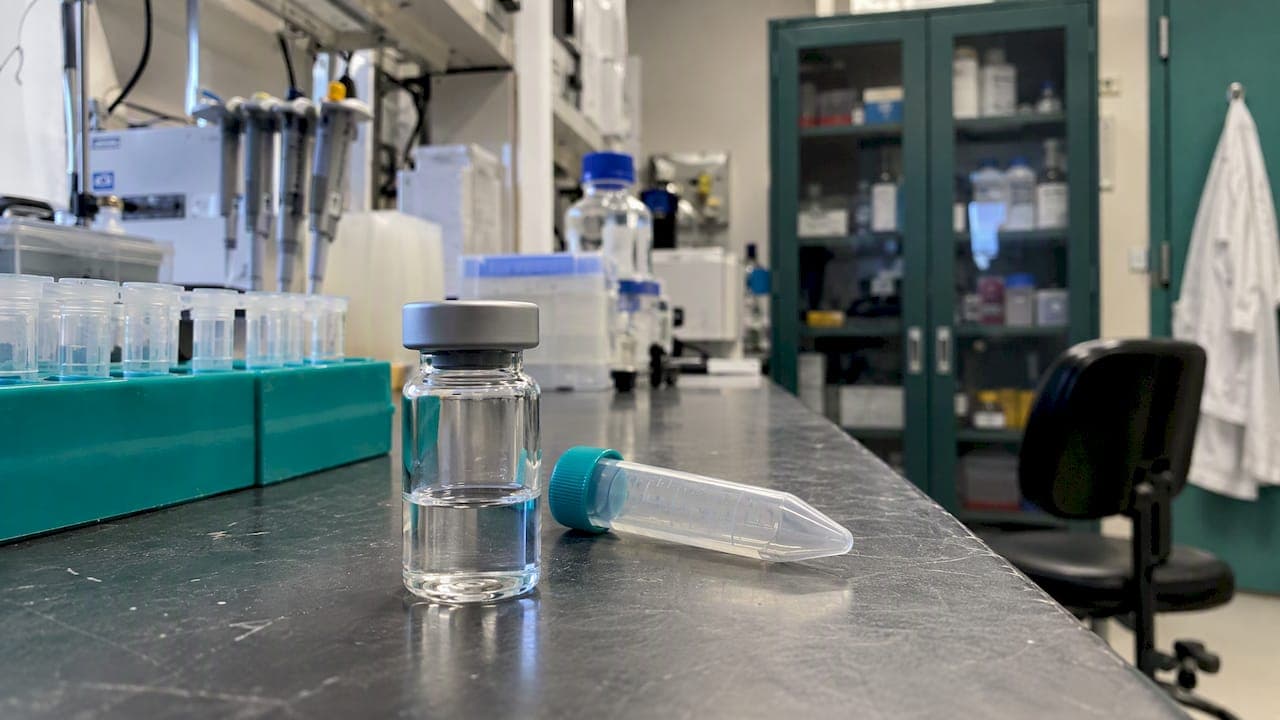
Light sensitivity in a research peptide means that ultraviolet or visible light, usually together with oxygen, can chemically modify specific amino acid residues. The result can be a change in structure, purity and activity. Not every peptide is affected equally: the risk depends on the sequence, the form (lyophilized or in solution), the container and the total light dose. This guide covers which residues matter, what the published evidence shows, what amber glass does and does not do, and a practical handling routine for Australian laboratories.
TL;DR
- Light damage is residue-specific. Tryptophan, tyrosine, histidine, methionine and cysteine are the residues to check in any sequence.
- Degradation depends on cumulative dose and oxygen, not only on brightness. Short bench exposure is a lower risk than repeated or prolonged exposure.
- Amber vials reduce exposure. They do not stop oxidation, temperature damage, moisture or freeze-thaw damage.
- Light sensitivity is product-specific. Check the sequence, the CoA and the SDS before assuming a peptide is safe or unsafe in light.
- Store lyophilized material cold, dry and dark. Reconstitute only what the protocol needs, and aliquot.
Table of Contents
- What light sensitivity means for a peptide
- Which residues make a peptide light sensitive
- How much light is too much
- Amber vials and other light protection
- Light sensitivity varies by peptide and by form
- Storing and handling to limit light exposure
- Australian laboratory requirements
- Perspective: how we treat light risk
- Sourcing documented material
- FAQ
- Sources
What light sensitivity means for a peptide
Peptides absorb light through certain side chains. Once a residue absorbs energy, it can react directly or pass energy to dissolved oxygen, forming reactive species that attack the same residue or its neighbors. A 2023 peer-reviewed review of light and temperature sensitivity recommendations states that light-induced degradation of therapeutic proteins can change structure and function, appearance, potency and immunogenicity. It notes that effects can arise from ultraviolet and visible light during production, packing, storage, preparation and administration.
That last point matters for research use. Exposure is not limited to a sunny windowsill. Fluorescent bench lighting, a biosafety cabinet lamp, a clear tube left on a rack and a vial photographed under a lamp all add to the total dose.
A stability review in Bioprocess International explains that photooxidation can alter primary, secondary and tertiary structure, and therefore long-term stability and bioactivity. It adds that the effect depends on the light energy delivered and on the oxygen in the environment. Two practical consequences follow:
- Removing oxygen (headspace control, sealed vials) reduces one of the two drivers.
- Reducing cumulative exposure reduces the other.
What changes on the analytical side
Photo-damage rarely shows as a visible change at first. In an HPLC trace it appears as new peaks, often eluting earlier or later than the main peak, and as a lower main-peak area. In mass spectrometry it appears as characteristic mass shifts, such as an oxygen addition (+16 Da) on methionine or tryptophan. This is why batch documentation matters: a CoA records purity and identity at release, and a later run on a stored or handled sample tells you whether anything has changed since. See our guide to avoiding false degradation in peptide stability testing for how to separate real degradation from handling artifacts.
Which residues make a peptide light sensitive
The Bioprocess International review lists methionine, cysteine, histidine, tryptophan and tyrosine as susceptible to oxidation. It states that light can modify tryptophan, histidine and tyrosine in the presence of oxygen, that the position in the sequence and neighboring residues affect oxidation, and that peptide backbone damage can also occur.
| Residue | Typical light-related change | Practical note |
|---|---|---|
| Tryptophan (Trp, W) | Oxidation products such as N-formylkynurenine; cross-linking with neighbors | Highest priority in a light-risk review |
| Tyrosine (Tyr, Y) | Hydroxylation and other tyrosine-derived products | Damaged alongside Trp under UVA in model peptides |
| Histidine (His, H) | Oxidation in the presence of oxygen | Sensitive to environment and neighbors |
| Methionine (Met, M) | Methionine sulfoxide | Also oxidizes in the dark with air exposure |
| Cysteine (Cys, C) | Disulfide disruption, scrambling, trisulfide | Relevant to cyclic and disulfide-bridged peptides |
A sequence with none of these residues has a lower light risk, though it still needs correct temperature and moisture control.
Evidence from model studies
The published work gives a consistent picture, though under different conditions:
- A 2017 photosensitization study found that both tryptophan and tyrosine in peptide models were damaged under UVA exposure, and that small sequence changes could alter how fast each was consumed.
- A 2011 Environmental Science & Technology study exposed amino acids to 365 nm light with riboflavin-related photosensitizers. It found rapid photodegradation involving tyrosine, tryptophan, methionine and histidine, with singlet oxygen contributing to different degrees depending on the amino acid.
- An ACS Omega study on somatostatin-14 and arginine vasopressin reported UV-generated N-formylkynurenine, Trp-Phe cross-linking, a tyrosine product with ammonia loss, and disruption of an unstable disulfide bond into trisulfide and scrambled dimeric products.
- A 2022 review on advanced oxidation processes reports that air-saturated methionine-enkephalin solutions irradiated with near-UV light at 25.2 Wh m−2 produced methionine sulfoxide, hydroxylated tyrosine products and several further tyrosine-derived products, which were also detected after visible-light irradiation.
These are mostly solution studies, several with deliberate photosensitizers or high-intensity sources. They show mechanisms and which residues react. They do not give a universal safe bench time for a lyophilized research peptide.
How much light is too much
There is no single threshold, but two reference points help frame dose.
Regulatory test doses. The ICH Q1B guideline, reproduced in the EMA's official version, specifies confirmatory photostability exposure of at least 1.2 million lux hours and at least 200 Wh/m² of integrated near-UV energy. It calls for suitable daylight-like or fluorescent/near-UV sources and either temperature control or a dark control. Exposed samples are assessed for appearance, clarity and colour, assay and photochemical degradants, using validated methods. The guideline is written for medicinal substances and products. It is a testing framework, not a shelf-life claim for every research peptide.
Cumulative exposure, not only intensity. A 2018 PDA Journal study on monoclonal antibodies found that quality effects depended on cumulative light exposure rather than intensity up to 5,000 lux. Products differed in sensitivity, and one showed no quality impact after 0.13 million lux hours. The study concerns antibodies, not short peptides. The transferable lesson is that dose accumulates, and that sensitivity differs between products.
In practice, a vial handled for a few minutes under room lighting receives a small fraction of the ICH confirmatory dose. A solution left in a clear tube on a lit bench for days does not. Treat minutes and days differently.

Amber vials and other light protection
Amber glass absorbs a large share of UV and short-wavelength visible light, which is the most damaging range. It is a sensible default for light-sensitive material. It has limits:
- It does not remove oxygen. Photooxidation needs light and oxygen. Oxidation of methionine and cysteine also proceeds without light.
- It does not control temperature. Heat accelerates deamidation, hydrolysis and aggregation. See our note on temperature excursions and why a log will not clear a batch.
- It does not control moisture. Lyophilized peptides are often hygroscopic, and absorbed water drives degradation.
- It does not transmit nothing. Absorption is partial. Long exposure to strong light still delivers some dose.
- Container interaction still counts. ICH Q1B requires consideration of container interactions, and notes that forced photodegradation studies use chemically inert, transparent containers, while confirmatory studies provide information for handling, packaging and labelling. Packaging claims should rest on testing, not assumption.
Secondary protection adds margin: an opaque box, aluminum foil around a tube, or a closed freezer drawer. For solutions in clear tubes during a long run, foil wrapping is a simple control.
Light sensitivity varies by peptide and by form
The 2023 review states that light sensitivity is product-specific. Formulation, protein type, dosage form, container, diluent, excipients and storage conditions all influence whether light protection is needed. Its authors argue that light protection should be based on product-specific photostability evidence, not on the assumption that all protein or peptide materials behave alike.
For a research lab this translates into a per-peptide check.
Lyophilized versus reconstituted
Lyophilized powder has little mobile water and limited oxygen in the cake, so photochemistry is slower. Once dissolved, molecules move freely, oxygen is dissolved in the solvent, and the exposed surface of a clear container is large. Reconstituted material is the higher-risk state for light, oxygen, pH drift and microbial growth together. Our guides on lyophilized peptide handling, storage, reconstitution and aliquoting and on peptide pH stability cover the solution-phase variables that interact with light.
A quick sequence screen
- Write out the sequence and mark W, Y, H, M and C.
- Count them. Peptides with Trp or several of the listed residues go to the strictest handling tier.
- Note disulfide bridges. Light-induced disruption of an unstable disulfide was reported in the somatostatin-14 and vasopressin work above.
- Check the supplier documentation and SDS for storage and light statements.
- Record the tier in the lab notebook next to the lot number.
Storing and handling to limit light exposure
This routine reflects common laboratory practice for lyophilized peptides and the evidence above. Where your peptide's documentation gives a different instruction, follow the documentation.
Before reconstitution
- Keep the vial in its original container, inside a closed box, in cold storage as specified for the lot.
- Let a cold vial reach room temperature before opening, so condensation does not enter. Moisture and light compound each other.
- Open under normal room lighting briefly; avoid direct sun, UV lamps and the cabinet's germicidal UV cycle.
- Reseal promptly. Where the protocol allows, purge the headspace with dry inert gas.
After reconstitution
- Reconstitute only the volume the planned work needs. Our reconstitution and dosing math guide for Australian labs covers volumes and CoA-based calculations.
- Divide into single-use aliquots in amber or foil-wrapped low-bind tubes.
- Freeze aliquots as the protocol specifies, and avoid repeat cycles. The one freeze, one thaw SOP sets out the routine.
- Label with date, lot, concentration and a light-tier note.
During shipping and transfer
Shipments add light, temperature and time variables together. Opaque outer packaging and documented temperature control help. For cold-chain steps, see the 2°C to 8°C cold chain SOPs. For wider storage planning, see our lab-ready guide to peptide degradation in storage.
Bench checklist
| Step | Control |
|---|---|
| Storage | Dark, cold, sealed, original container |
| Opening | Equilibrate to room temperature, brief exposure |
| Solution | Amber or foil-wrapped tube, minimal volume |
| Aliquots | Single use, labeled, one freeze and thaw |
| Long runs | Cover the rack; avoid direct sun and UV |
| Records | Lot, dates, exposure notes, light tier |
Australian laboratory requirements
Two points apply to handling in Australia.
First, the safety data sheet governs storage and handling. Safe Work Australia's model code of practice on preparing safety data sheets says storage guidance in an SDS should address sunlight, temperature and humidity, and should explain packaging compatibility and measures that maintain chemical integrity. Follow the product SDS and your workplace risk controls.
Second, many research peptides have incompletely characterized hazards. For research chemicals whose hazards are not fully known, the same code says an acceptable SDS must state that full identification or hazard information is unavailable and that a precautionary approach must be taken in handling or storage. Treat unknowns conservatively, including for light.
Research-grade peptides are supplied for laboratory research only. They are not for human or veterinary use, and nothing in this article is dosing or use advice.
Perspective: how we treat light risk
We handle light as one variable among several, not a standalone concern. For a lyophilized peptide stored cold, dry and dark, light is rarely the limiting factor. It becomes the limiting factor after reconstitution, for sequences with tryptophan or tyrosine, and during long benchwork.
Our position rests on documentation. Each batch is tested independently by HPLC and mass spectrometry, and a Certificate of Analysis is available on request. Those records fix identity and purity at release. They let a lab compare a stored or handled sample against a known baseline, which is the only reliable way to tell whether light, heat or handling caused a change.
Three rules we would apply in any lab:
- Screen the sequence before the first vial is opened.
- Keep the dose low: minimal volume, minimal time, opaque cover.
- Verify instead of assuming: re-run HPLC on stored material if a result looks inconsistent.
— Tintastic
Sourcing documented material
Light-risk screening only works when the starting material is characterized. Peptastic Labs supplies research-grade peptides across metabolic, cognitive and neuro, tissue and repair, longevity, cosmetic science, hormone and reproductive, blends and ancillaries categories, each verified to ≥99% purity by HPLC with batch documentation. Browse the full catalogue and request the CoA for the lot you plan to use. Bulk and wholesale options are available. For sterility questions, see what COAs can and cannot prove about sterility.
FAQ
Are all peptides sensitive to light?
No. Sensitivity depends on sequence and form. Peptides containing tryptophan, tyrosine, histidine, methionine or cysteine carry more risk, and a peptide without them is less exposed. Reconstituted solutions are more vulnerable than lyophilized powder.
Is an amber vial enough to protect a peptide?
It reduces light exposure, which is useful, but it does not control oxygen, heat, moisture or freeze-thaw damage. Use it together with cold storage, sealed headspace and single-use aliquots. Foil or an opaque box adds margin for long runs.
How long can a peptide sit on the bench in normal room light?
There is no universal figure. Published work shows that damage depends on cumulative dose and differs between products, so minutes in a closed workflow carry far less dose than days in a clear tube. Keep exposure short and check the supplier documentation for the specific peptide.
How can I tell whether light has degraded a peptide?
Visual change is unreliable. Compare HPLC and mass spectrometry results against the batch CoA: new peaks, a lower main-peak area or mass shifts such as +16 Da indicate oxidation. Keep a protected control aliquot for comparison.
Sources
- Trends in Light and Temperature Sensitivity Recommendations (2023 review)
- Biopharmaceutical Product Stability Considerations, Part 1
- Photosensitization of peptides and proteins by pterin derivatives
- Photosensitized Amino Acid Degradation in the Presence of Riboflavin
- Characterization of Ultraviolet Photoreactions in Somatostatin-14 and Arginine Vasopressin
- Advanced Oxidation Processes in Pharmaceutical Science
- ICH Q1B Photostability Testing, EMA
- ICH Q1B Guideline
- Determination of the Acceptable Ambient Light Exposure, PDA Journal
- Preparation of safety data sheets for hazardous chemicals, Safe Work Australia