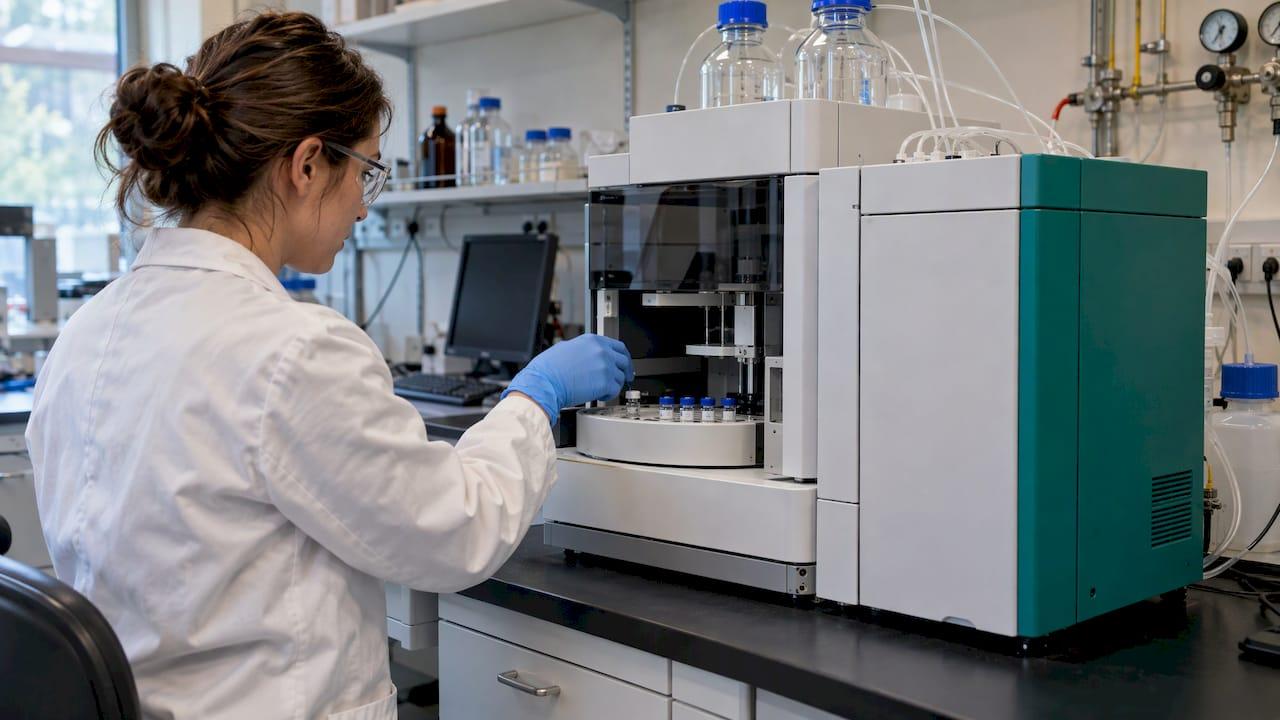
Amino acid analysis (AAA) breaks a peptide into its individual amino acids, then measures how much of each is present. The result tells you the peptide's composition and its quantity. It does not tell you purity or sequence. For a full quality picture you read AAA alongside HPLC purity and mass spectrometry identity data, all traceable to one batch. That is how we document research peptides at Peptastic Labs: ≥99% purity by HPLC, mass spec identity testing, batch documentation, and Certificates of Analysis on request.
TL;DR
- AAA hydrolyses a peptide into free amino acids, then separates, detects and quantifies each one.
- It reports composition and absolute peptide quantity. HPLC reports purity. Mass spectrometry confirms molecular weight.
- Quantitation better than 5% can usually be obtained once hydrolysis limitations are accounted for.
- Standard acid hydrolysis destroys tryptophan, and cysteine unless it is derivatized. Asparagine and glutamine are reported as Asx and Glx.
- Read AAA results against the known sequence, and next to the HPLC and MS data on the same batch.
Table of Contents
- What amino acid analysis measures
- How AAA works, step by step
- How accurate is AAA?
- What AAA cannot see
- AAA, HPLC and mass spec: three different questions
- Reading an AAA report
- Where AAA fits in a quality workflow
- Peptastic Labs: documentation that covers the questions above
- Our perspective
- FAQ
- Sources
What amino acid analysis measures
AAA determines the amino acid content of a peptide-containing sample. The peptide bonds are hydrolysed, and the liberated amino acids are then separated, detected and quantified chromatographically. Because you know the sequence of a synthetic peptide, you also know what ratio of amino acids to expect. The measured ratios either match that expectation or they do not.
Two questions are answered at once:
- Composition. Are the right amino acids present in the right proportions?
- Quantity. How much peptide is in the sample, based on the summed amounts of its amino acids?
A published review of polypeptide analysis describes AAA as an accurate method for determining polypeptide composition and quantity, including for synthetic peptides. That second point matters in practice. A lyophilized powder is never 100% peptide by weight. It also holds counter-ions such as acetate or trifluoroacetate, and residual water. AAA can provide an absolute or net peptide content estimate when amino acid quantities are compared with standards and interpreted against the known sequence.
How AAA works, step by step
Every AAA workflow follows the same four stages. Each has a place where results go wrong.

1. Sample preparation
The sample has to be clean. The UC Davis Molecular Structure Facility lists lipids, urea, detergents, glycerol and high concentrations of buffers or salts as common contaminants that can interfere with ion-exchange AAA. A peptide dissolved in a heavy buffer can give a distorted result before analysis even starts.
2. Hydrolysis
Hydrolysis is the central step. The accepted approach uses 6 M HCl at 110 °C for 20 to 24 hours, preferably in the gas phase. The protocol literature stresses that method choice has to be adapted for vulnerable residues such as tryptophan, cysteine and methionine. For cysteine and methionine, performic acid oxidation before hydrolysis converts them into acid-stable forms. Alternate procedures exist for tryptophan.
3. Separation and detection
The most reliable classical method is ion-exchange chromatography with post-column ninhydrin derivatization. Each amino acid is identified by its reproducible elution time. Its amount is read from the intensity of the ninhydrin colour, measured spectrophotometrically. Newer LC-MS methods skip some derivatization problems. A 2023 method used certified 13C- or 15N-labelled internal standards and calculated peptide quantity from the summed concentrations of the amino acids in the known sequence.
4. Calculation
The measured amounts are compared with the expected residue counts from the sequence. The review describes three ways of calculating results. The choice of calculation depends on which residues survived hydrolysis and which are reliable enough to anchor the calculation.
A worked illustration of the logic: a peptide with a known sequence contains, say, two glycine residues and one phenylalanine. After hydrolysis, the glycine-to-phenylalanine molar ratio should come out near 2:1. If it does not, either the sample is not what it was labelled, or hydrolysis or sample handling skewed the numbers. The ratio check is simple, and that is why AAA has stayed in use for decades.
How accurate is AAA?
The review of polypeptide analysis reports that quantitation better than 5% can usually be obtained when hydrolysis limitations are taken into account. The condition matters. The figure assumes the analyst has chosen the right hydrolysis for the residues in the sequence.
For the modern LC-MS approach, the 2023 study reported linearity with r² ≥ 0.997 over 1 to 100 pmol on-column, a peptide-response r² of 0.9995 and intra- and inter-day precision of ≤10% CV under its stated conditions. Those are method-validation numbers from one laboratory. They show what a well-controlled workflow can reach, not what every report will show.
Factors that move the result:
| Factor | Effect on the result |
|---|---|
| Hydrolysis time and temperature | Under-hydrolysis leaves peptide bonds intact, over-hydrolysis degrades labile residues |
| Sample contaminants | Salts, detergents, lipids and urea can interfere with ion-exchange separation |
| Background amino acids | Environmental contamination, particularly serine and glycine, inflates low-level samples |
| Sequence composition | Peptides rich in tryptophan, cysteine or methionine need modified procedures |
| Calibration standards | Result is only as good as the standards and internal standards used |
The practical lesson is to analyse enough material. Low-picomole samples are more exposed to background contamination than samples run well inside the validated range.
What AAA cannot see
Knowing the blind spots is what lets you read a result correctly.
- Tryptophan is destroyed under standard hydrolysis conditions, depending on the conditions.
- Cysteine is destroyed as well, unless it is derivatized first. Standard 6 N HCl hydrolysis destroys cysteine, methionine and tryptophan, so alternate procedures are used to measure them.
- Asparagine and glutamine are converted to aspartate and glutamate by acid hydrolysis. Ordinary AAA reports them as combined Asx and Glx values and cannot distinguish the original amide from its acid.
- Sequence order. AAA gives composition, not order. Two peptides with the same residues in a different arrangement give the same AAA profile.
- Impurity profile. A deletion or truncation product may shift the ratios slightly, but AAA does not list impurities peak by peak.
When a report lists no tryptophan for a peptide that should contain it, that is the method, not a missing residue. Check how the laboratory handled that residue before drawing any conclusion.
AAA, HPLC and mass spec: three different questions
These three techniques are often confused because all appear on a peptide's documentation. They answer different questions.
| Technique | Question it answers | Typical output |
|---|---|---|
| HPLC | How pure is the main peptide relative to everything else detected? | Main peak area as a percentage of total peak area |
| Mass spectrometry | Is the molecular weight what the sequence predicts? | Observed mass against theoretical mass |
| AAA | Which amino acids are present, and how much peptide is there? | Residue ratios and net peptide content |
HPLC purity is calculated from the area of the main peak relative to the total detected peak area. A high percentage tells you the sample is dominated by one species. It does not say whether that species is the right one. Mass spectrometry covers identity, and our guide to demanding the right COA fields to confirm peptide identity explains what to look for. For the trade-offs between the two chromatographic approaches, see HPLC vs LC-MS for peptide QC. If you want to understand how a single peak can hide co-eluting species, read about peak purity for researchers.
Mass values themselves come from residue masses. Our amino acid molecular mass reference lists them, so you can check a theoretical mass yourself. For the instrument side, the five-stage LC-MS/MS workflow walks through how peptides are measured by mass spectrometry.
Reading an AAA report
When you receive an amino acid analysis result, work through it in this order.
- Confirm the sequence used for the expected values. Every ratio is calculated against it.
- Check which residues are reported as Asx and Glx. Those values combine two amino acids each, so they cannot be matched to a single residue.
- Look for the unreported residues. Missing tryptophan, cysteine or methionine usually reflects the hydrolysis method, not the sample.
- Compare ratios, not single numbers. Residue ratios against the expected count are more telling than any one amino acid value.
- Read the net peptide content. This is the fraction of the powder that is peptide, which feeds directly into how you weigh and reconstitute for a stock solution.
- Place it beside the HPLC and MS data from the same batch. Matching batch numbers on every document keep the evidence together.
Net peptide content is the figure that most affects bench work. If your stock calculations assume the gross weight is all peptide, concentrations will be overstated. Contamination and handling after opening also affect results, so see our notes on vial contamination, oxidation control and residual solvents on a COA.
Where AAA fits in a quality workflow
In a layered quality approach each technique covers a gap left by the others:
- HPLC establishes how much of the sample is the main species.
- Mass spectrometry establishes that the main species has the expected molecular weight.
- AAA establishes the composition and how much of the weighed powder is peptide.
When all three agree for one batch, the identity, purity and content story is consistent. When they disagree, the disagreement points to where to look: a correct mass with low content suggests salts or water, while a purity shortfall with correct composition suggests closely related peptide-derived impurities.
This is why batch traceability matters more than any single number. A purity percentage with no batch number, method or chromatogram cannot be tied back to the vial in your hands.
Peptastic Labs: documentation that covers the questions above

Our catalog of over 22 research-grade peptides spans metabolic, cognitive, tissue repair, longevity, immunology and cosmetic research lines. Each compound is independently tested and verified to ≥99% purity by HPLC, and each batch is also checked by mass spectrometry. Batch documentation is traceable, and Certificates of Analysis are available on request. Bulk and wholesale options are available for institutions.
All products are supplied for laboratory research. Browse the full research peptide catalogue and request the COA for the batch you intend to use.
If you are working out how a particular batch's documentation lines up with the tests described here, our team can be contacted through the checkout channels on peptasticlabs.com.
Our perspective
Peptide quality is a stack of evidence, and each layer answers a different question. HPLC tells you how dominant the main species is. Mass spectrometry tells you whether that species has the right molecular weight. Amino acid analysis speaks to composition and net content.
We build our documentation around that logic. Every batch carries independent HPLC and mass spec testing, a traceable batch record and a Certificate of Analysis on request, with ≥99% purity verified by HPLC. A researcher should be able to hold a vial, read a batch number and trace each claim behind it.
Our advice to any lab: weigh and reconstitute against what the documents say, keep batch numbers attached to every result, and read each analytical method for what it actually measures.
Tintastic
FAQ
What does AAA stand for in peptide testing?
AAA stands for amino acid analysis. The peptide is hydrolysed into free amino acids, which are then separated, identified and quantified. The output is composition and peptide quantity.
Is amino acid analysis the same as HPLC purity testing?
No. HPLC purity reports the main peak area as a share of the total detected peak area. AAA reports which amino acids are present and in what amounts, and it can estimate how much of a powder is peptide. Both are useful, and they answer different questions.
Why does my AAA report show no tryptophan or cysteine?
The hydrolysis conditions are the usual reason. Standard acid hydrolysis destroys tryptophan, and cysteine unless it is derivatized. Laboratories use alternate procedures to measure these residues when they matter.
Why are Asx and Glx reported instead of Asn, Asp, Gln and Glu?
Acid hydrolysis converts asparagine to aspartate and glutamine to glutamate, so the original amide and acid cannot be told apart. The report therefore gives combined Asx and Glx values.
How accurate is amino acid analysis?
With hydrolysis limitations considered, quantitation better than 5% can usually be obtained. Accuracy depends on clean samples, suitable hydrolysis for the sequence and sound calibration.
Sources
- Amino Acid Analysis, Rutherfurd and Gilani, Current Protocols (2009)
- Analysis of Polypeptides by Amino Acid Analysis, PubMed
- Amino acid analysis for peptide quantitation using LC-MS, PMC (2023)
- Amino acid analysis for peptide quantitation, Analytical and Bioanalytical Chemistry (2023)
- 26.5 Amino Acid Analysis of Peptides, OpenStax Organic Chemistry
- Amino Acid Analysis, UC Davis Molecular Structure Facility
- Amino Acid Analysis, Protein Chemistry Lab, Texas A&M