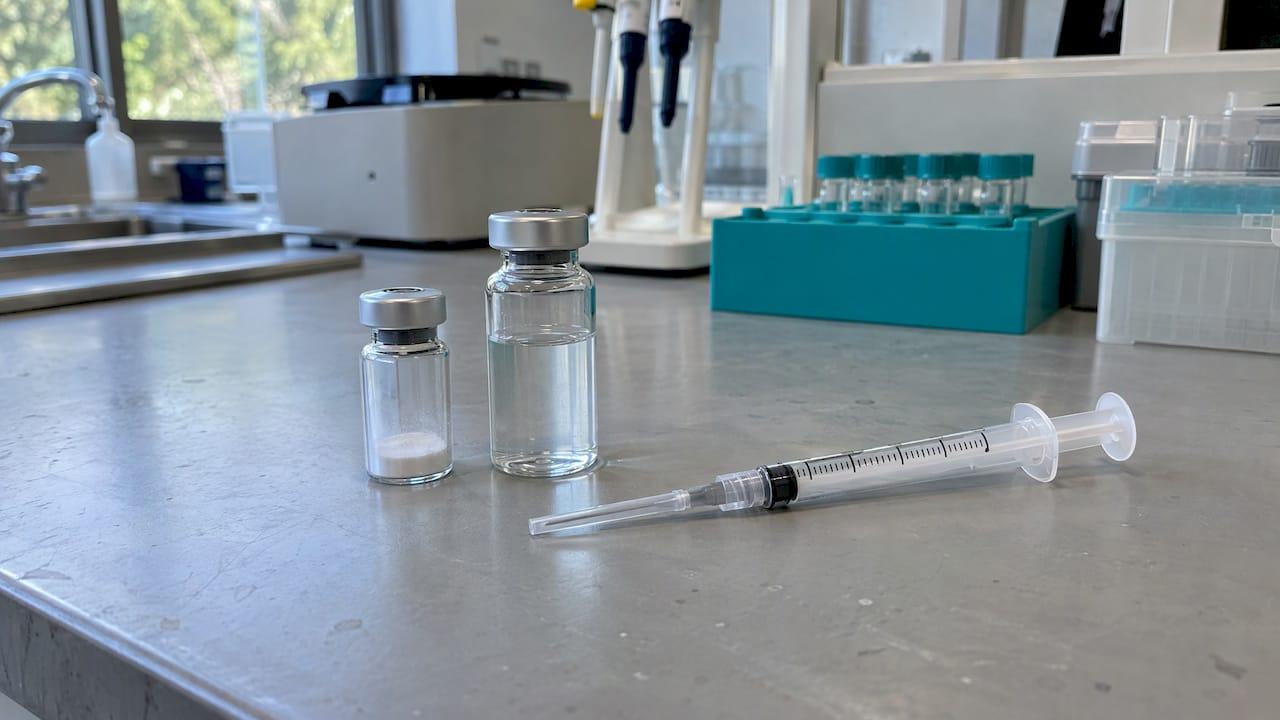
Reconstitution volume is set by one relationship: concentration equals mass divided by volume (c = m / V). Pick the concentration you want, divide the vial's peptide mass by it, and the answer is the final solution volume. A 10 mg vial brought to 2 mg/mL gives 5 mL. The rest of this guide covers the unit conversions, syringe markings and checks that keep that arithmetic correct at the bench.
This article is written for laboratory work with research-grade material. Peptastic Labs supplies lyophilized peptides at ≥99% purity, HPLC-verified, with Certificates of Analysis on request, so the label mass you calculate from is backed by batch documentation.
TL;DR
- Concentration (mg/mL) = peptide mass (mg) ÷ diluent volume (mL). Rearranged: volume = mass ÷ target concentration.
- Milligrams measure the compound and millilitres measure the liquid. Adding more diluent lowers concentration; it does not add compound.
- On a U-100 syringe, 1 unit = 0.01 mL, so 100 units = 1 mL.
- Work in one unit system (mg and mL, or µg and µL) from start to finish, and write the final concentration on the vial label.
- Check the calculation backwards before use: concentration × volume drawn must return the amount you intended.
Table of Contents
- The core formula
- Choose a target concentration that is measurable
- Unit conversions you will need
- Reading a U-100 syringe
- A full calculation, step by step
- Common calculation errors
- Diluent choice and how it affects the maths
- Aliquot planning
- Why the label mass matters
- Our perspective
- Sourcing material for your calculations
- FAQ
- Sources
The core formula
Every reconstitution calculation is a rearrangement of three variables:
| Want to find | Formula | Units |
|---|---|---|
| Concentration | c = m ÷ V | mg/mL |
| Diluent volume | V = m ÷ c | mL |
| Mass in a volume | m = c × V | mg |
Where m is the labelled peptide mass in the vial and V is the volume of solution. Concentration is a ratio, so the same vial can be prepared at many concentrations. The mass never changes; only the volume you dissolve it in does.
Worked example 1: find the concentration
A 10 mg vial is reconstituted with 2 mL of diluent.
- c = 10 mg ÷ 2 mL = 5 mg/mL
- 5 mg/mL is the same as 5,000 µg/mL, or 5 µg/µL.
Worked example 2: find the volume for a target
You want a 2 mg/mL stock from a 10 mg vial.
- V = 10 mg ÷ 2 mg/mL = 5 mL
The 5 mL is the finished solution volume. For the small masses typical of research vials, the dry powder takes up negligible space, so adding 5 mL of diluent is treated as giving 5 mL of solution. If your protocol demands tighter tolerance, state that assumption in your records.
Worked example 3: a 5 mg vial at a convenient volume
A 5 mg vial with 1 mL of diluent gives 5 mg/mL. The same vial with 2.5 mL gives 2 mg/mL. A 2 mL volume gives 2.5 mg/mL. Choose the volume that gives a concentration you can measure accurately with the pipette or syringe you have.

Choose a target concentration that is measurable
The usual mistake is to pick a diluent volume first and accept whatever concentration results. Work from the other end instead.
- Decide the amount per aliquot or per assay well you need to deliver.
- Decide the smallest volume your equipment can transfer reliably. A pipette is generally least accurate at the bottom of its range.
- Divide: concentration = amount ÷ transferable volume.
- Then calculate the diluent volume from the vial mass.
If the result is a very small draw (a few microlitres), make the stock less concentrated. If it is a very large draw, make it more concentrated. Both extremes increase measurement error.
Unit conversions you will need
Most errors come from mixing mg with µg or mL with µL. Convert once, at the start.
| From | To | Multiply by |
|---|---|---|
| mg | µg | 1,000 |
| µg | mg | 0.001 |
| mL | µL | 1,000 |
| mg/mL | µg/µL | 1 (they are numerically equal) |
| mg/mL | µg/mL | 1,000 |
| g/mol and mg/mL | µM | see molarity below |
The equality of mg/mL and µg/µL is the most useful shortcut: a 5 mg/mL solution contains 5 µg in every µL.
Converting to molarity
In vitro work is usually specified in molar terms. Molarity needs the peptide's molecular weight (MW), which is on the Certificate of Analysis.
- Molar concentration (mM) = concentration (mg/mL) ÷ MW (g/mol) × 1,000... check units: mg/mL equals g/L, so mol/L = (g/L) ÷ MW.
- Example with a hypothetical MW of 1,000 g/mol: 1 mg/mL = 1 g/L ÷ 1,000 g/mol = 0.001 mol/L = 1 mM.
- A 10 µM working solution is then a 1:100 dilution of that 1 mM stock.
For more on setting and calculating assay concentrations, see our guide on in vitro peptide concentrations.
Reading a U-100 syringe
U-100 syringes are marked in units, where 100 units equal 1 mL. So:
- 1 unit = 0.01 mL = 10 µL
- 10 units = 0.1 mL = 100 µL
- 50 units = 0.5 mL
To convert a volume to syringe units, multiply mL by 100. To convert units to the mass drawn:
amount (µg) = units ÷ 100 × concentration (µg/mL)
Worked example 4: units to amount
A 10 mg vial is reconstituted with 2 mL: 5 mg/mL = 5,000 µg/mL.
- 10 units = 0.1 mL
- 0.1 mL × 5,000 µg/mL = 500 µg
Worked example 5: amount to units
You need 250 µg from the same 5,000 µg/mL solution.
- Volume = 250 ÷ 5,000 = 0.05 mL
- Units = 0.05 × 100 = 5 units
Small unit counts sit close together on the barrel and are hard to read precisely. Diluting the stock further so that the required draw falls at 10 to 50 units reduces reading error. Our needle gauge and syringe guide covers the syringe hardware side.
A full calculation, step by step
Target: a stock from a 5 mg vial that delivers 100 µg per 10 units on a U-100 syringe, for laboratory measurement purposes.
- Define the draw. 10 units = 0.1 mL, which must contain 100 µg.
- Find the concentration. 100 µg ÷ 0.1 mL = 1,000 µg/mL = 1 mg/mL.
- Find the volume. V = 5 mg ÷ 1 mg/mL = 5 mL.
- Check backwards. 5 mL × 1 mg/mL = 5 mg, matching the vial. 0.1 mL × 1 mg/mL = 0.1 mg = 100 µg. Correct.
- Label. Write peptide name, lot number, concentration, diluent, date and your initials on the vial.
Step 4 is the one that catches transposed decimals. It takes ten seconds and should never be skipped.
Common calculation errors
| Error | What happens | Fix |
|---|---|---|
| Treating diluent volume as mg | Concentration off by orders of magnitude | Keep mg for mass and mL for volume |
| Mixing µg and mg | Tenfold or thousandfold error | Convert everything before dividing |
| Using the wrong syringe scale | Draw is 2x to 10x off | Confirm the barrel is U-100 and check what 1 mL reads |
| Forgetting the vial is a total mass | Per-aliquot amount miscalculated | Divide by total volume, not by number of draws |
| Rounding early | Cumulative error | Round only the final figure |
| Not recording the result | The next user recalculates differently | Label every vial with the final concentration |
Diluent choice and how it affects the maths
The formula does not depend on the diluent, but the practical outcome does. Bacteriostatic water contains a preservative and is used when a vial will be accessed multiple times; the reasoning is covered in why bacteriostatic water is used with peptides. Whatever you use, record it alongside the concentration, because the same figure in a different solvent can behave differently over time.
When adding diluent, run it down the inside wall of the vial instead of jetting it onto the cake, and swirl gently instead of shaking. Our lyophilized peptide handling guide sets out the storage, reconstitution and aliquoting routine in full.

Aliquot planning
Once the stock is made, divide it. Repeated freezing and thawing of the whole vial degrades material, which is why a single-use aliquot plan belongs in the calculation itself.
Example: 5 mL of 1 mg/mL stock.
- Aliquot size: 0.25 mL each (250 µg)
- Number of aliquots: 5 ÷ 0.25 = 20
- Keep one working aliquot refrigerated and freeze the rest
The one freeze, one thaw SOP explains the handling, and peptide shelf life compares lyophilized and reconstituted stability. For storage conditions, see peptide degradation and storage.
Why the label mass matters
Every calculation above assumes the vial contains the mass printed on it. If the actual peptide content is lower, or the identity is not what the label states, concentration and everything downstream is wrong, however careful the arithmetic. This is the reason documentation sits next to the maths. Peptastic Labs batches are independently HPLC and mass-spec tested, with traceable batch documentation and a Certificate of Analysis available on request, so the identity and purity figures you note in your records come from the batch you are using.
In Australia, therapeutic goods are regulated by the Therapeutic Goods Administration. Research-grade peptides are supplied for laboratory research only, and the calculations in this article describe laboratory preparation, not use in people or animals.
Our perspective
Most reconstitution mistakes we see discussed are not hard maths. They are unit slips and unrecorded assumptions: a mg read as a µg, a diluent volume that was never written down, a syringe scale taken for granted.
Our position is that the calculation and the documentation belong together. The formula only gives a true concentration when the vial contents match the label, which is why every batch we supply is HPLC-verified to ≥99% purity, independently tested, and traceable, with a Certificate of Analysis on request.
For researchers, we recommend fixing one unit system, working backwards from a measurable draw volume, checking the result in reverse, and labelling every vial. Our Australian reconstitution and dosing maths guide expands on the CoA-based workflow.
Tintastic
Sourcing material for your calculations
Research teams that want the calculation to start from verified material can order from the Peptastic Labs catalogue: Metabolic, Cognitive & Neuro, Tissue & Repair, Longevity, Cosmetic Science, Blends, Hormone & Reproductive, and Ancillaries & Reagents. Each peptide is HPLC-verified to ≥99% purity with batch documentation, and bulk and wholesale options are available. Orders can be placed online or through the Telegram and WhatsApp pre-filled checkout.
Browse the full catalogue. For how research teams structure ordering, see the peptide procurement workflow.
FAQ
How much diluent should I add to a peptide vial?
There is no single correct volume. Choose the concentration you need, then divide the vial mass by it: V = m ÷ c. A 10 mg vial at 5 mg/mL takes 2 mL, and at 2 mg/mL it takes 5 mL. Pick a volume that gives a draw you can measure accurately.
How many syringe units is 0.1 mL?
On a U-100 syringe, 0.1 mL is 10 units, because 1 unit equals 0.01 mL. To convert any volume in millilitres to units, multiply by 100. Confirm that your syringe is U-100 before relying on this.
Does adding more diluent change how much peptide is in the vial?
No. The mass in the vial stays fixed. More diluent lowers the concentration, so each millilitre carries less peptide. Total mass is always concentration multiplied by total volume.
How do I convert mg/mL to µg per unit on a syringe?
Multiply mg/mL by 1,000 to get µg/mL, then divide by 100 to get µg per millilitre-hundredth, which is one unit. A 5 mg/mL solution is 5,000 µg/mL, so each unit holds 50 µg.
How do I convert mg/mL to molarity?
mg/mL is the same as g/L. Divide by the molecular weight in g/mol to get mol/L. For a peptide of 1,000 g/mol, 1 mg/mL is 1 mM. The molecular weight is listed on the Certificate of Analysis.