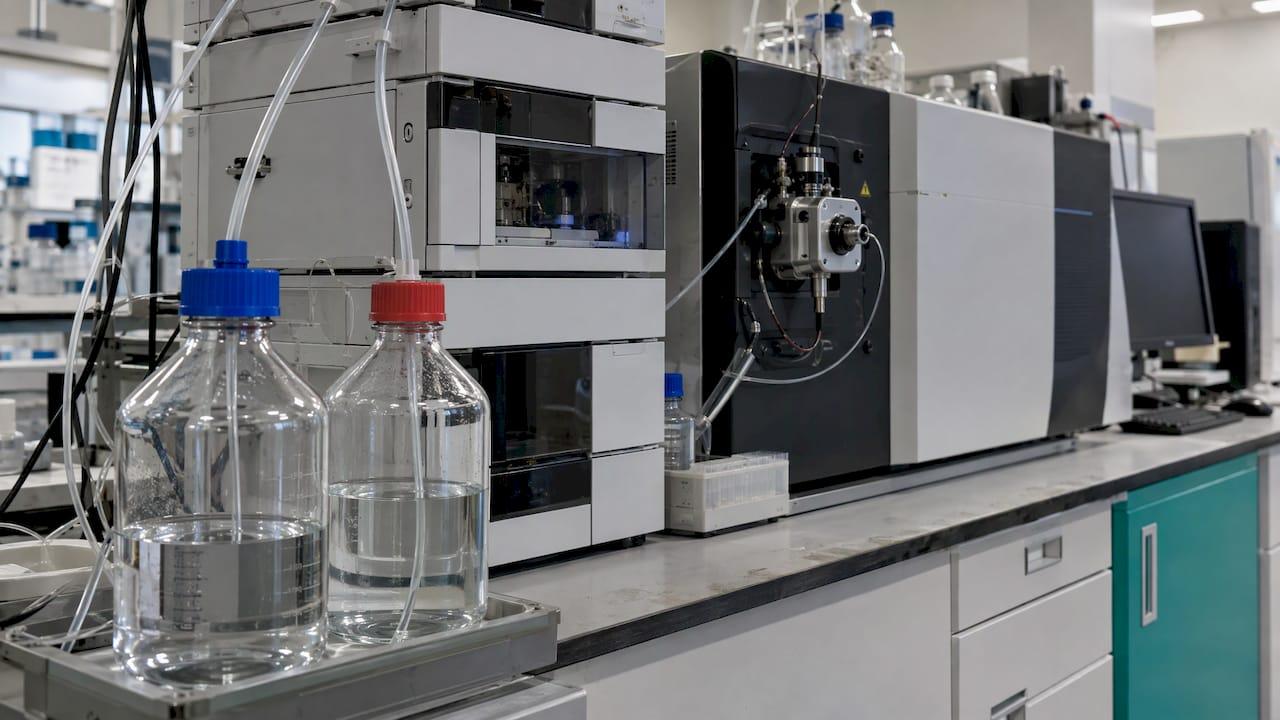
Formic acid (0.1%) is the default mobile phase additive for peptide LC-MS. Acetic acid (typically 0.5%) is the alternative, and recent studies report higher MS signal with it. For dissolving peptides, dilute acetic acid is the usual acidic starting solvent for basic sequences that do not dissolve in water. The two acids do different jobs, so the right choice depends on the workflow: chromatography and detection, or reconstitution and handling.
This guide covers both uses. It states what the published data show, where each acid introduces artefacts, and what Australian laboratories need to consider for safe handling. Material is for research use only.
TL;DR
- LC-MS: 0.1% formic acid is the standard. An interlaboratory study found 0.5% acetic acid gave about 2.2–2.5× higher MS signal and up to 60% more peptide identifications.
- Retention: acetic acid shifts peptides slightly earlier, about −0.7% acetonitrile on average. The shift grows with peptide net charge.
- Artefacts: formic acid can formylate peptides, acetic acid can acetylate N-termini. Low temperature and short exposure reduce both.
- Dissolution: dilute acetic acid is a common step for basic peptides that resist water. Confirm compatibility with the assay before scaling up.
- Handling: acetic acid is corrosive. Follow the Safe Work Australia hazardous chemicals code and the supplier SDS.
Table of Contents
- Formic acid vs acetic acid at a glance
- What each acid does in LC-MS
- Chemical artefacts: formylation and acetylation
- Dissolving peptides: when acetic acid is used
- Choosing by workflow
- Handling both acids in an Australian lab
- Perspective
- Research-grade peptides with batch documentation
- FAQ
- Sources
Formic acid vs acetic acid at a glance
| Parameter | Formic acid | Acetic acid |
|---|---|---|
| Formula | HCOOH | CH3COOH |
| Typical LC-MS concentration | 0.1% | 0.5% in published comparisons |
| MS signal (peptides, ESI) | Baseline | Reported ~2.2–2.5× higher |
| Peptide identifications | Baseline | Up to 60% higher reported |
| Retention on reversed phase | Baseline | Slightly lower (about −0.7% ACN average) |
| Peak capacity | Higher acidity favors it | Typically lower acidity, better detectivity |
| Chemical artefact | N-terminal formylation | N-terminal acetylation |
| Dissolution role | Acidifying diluent, extraction | Acidifying diluent, solvent for basic peptides |
What each acid does in LC-MS
In reversed-phase peptide separations, an acid in the mobile phase protonates carboxyl groups, controls pH and acts as an ion-pairing modifier. Formic acid is the additive most labs use for MS work because it is volatile and gives acceptable peak shape without the heavy ion suppression associated with TFA.
Signal and identification gains with acetic acid
An interlaboratory comparison of 0.1% formic acid and 0.5% acetic acid reported roughly 2.2–2.5× higher MS signal and up to 60% higher peptide identification output with acetic acid. The same work found a small retention decrease, about −0.7% acetonitrile on average, and that the decrease scaled with peptide net charge at acidic pH. The MS signal dependence was linked to the charge difference between the precursor ion and the peptide in solution, favoring low-pI species.

For low-input work, the effect was also reported. In sub-nanogram and single-cell proteomics, substituting 0.5% acetic acid for 0.1% formic acid increased proteome coverage across the loads tested. A 20-picogram digest showed about a 1.8-fold increase to over 2,000 protein groups in a 30-minute analysis.
The acidity trade-off
Stronger acids are not simply better. A nano-flow LC/MS study that compared TFA, formic, acetic and cyanoacetic acid at 0.1% (v/v) on monolithic silica capillary columns found that higher-acidity additives increased peak capacity but decreased MS detectivity. Formic acid sits in the middle of that range. Acetic acid, the weaker acid, favors detectivity.
Practical reading:
- Need maximum sensitivity, low-abundance peptides: evaluate 0.5% acetic acid.
- Need sharpest peaks, UV detection, or an established validated method: keep 0.1% formic acid.
- Changing additive changes retention. Re-check gradient, retention windows and any scheduled acquisition lists.
For the wider method context, see the five-stage LC-MS/MS workflow for peptides and the comparison of HPLC vs LC-MS for peptide QC.
Chemical artefacts: formylation and acetylation
Both acids can modify the analyte. Reviewers of proteomics chemical artefacts note that formic and acetic acid used in sample processing and LC-MS/MS can formylate or acetylate peptide N-termini, which raises the chance of isobaric combinations that confuse data interpretation. The same review notes that 5% formic acid is used to extract peptides from gel bands, and that acid in LC buffers can be expected to cause N-terminal formylation. Acetic acid used in sample processing may likewise lead to N-terminal acetylation.
A separate study reported that dissolving tryptic peptides in a solvent containing only 0.1% formic acid was associated with unwanted formylation. The authors stated these modifications can be averted by handling samples at low temperature or by replacing formic acid in the solvent with trifluoroacetic acid.
Controls to apply:
- Keep samples cold in the autosampler and during storage in acidic solvent.
- Minimize time in acid before injection.
- Prepare acidic solutions fresh.
- Include a mass shift check for +28 Da (formyl) and +42 Da (acetyl) at N-termini when a peptide mass looks unexpected.
- Compare against the Certificate of Analysis mass to separate supplier-side identity from handling-induced modification.
TFA is the other common counter-ion and can persist in lyophilized material. See peptide salt forms and residual TFA by 19F NMR and TFA removal methods.
Dissolving peptides: when acetic acid is used
Acidic additives are also used to prepare peptide solutions. A tutorial review on peptide assays reports that acetic acid, formic acid or TFA at 0.1%–5% v/v can acidify diluents as part of controlling adsorption through solvent and pH.
The common sequence-based logic used across the field:
- Net basic peptides (several Lys, Arg, His; calculated pI above neutral): often dissolve better when protonated. Dilute acetic acid is the usual first acidic step after water.
- Net acidic peptides: dilute base or buffer is the usual direction, not acid.
- Hydrophobic or neutral peptides: a small volume of organic solvent first, then slow dilution into aqueous buffer.
Why acetic acid rather than formic for this step: it is a weak, less aggressive acid, and it does not carry the formylation concern in the same way during bench dissolution. Supplier solubility guidance commonly suggests trying water first, then a dilute acetic acid solution for basic sequences, with concentrations varying by the document. Treat any quoted concentration as a starting point for a small test aliquot, never as a fixed rule.
Dissolution workflow
- Calculate net charge at pH 7 from the sequence.
- Test a small aliquot, not the whole vial.
- Add water first. Vortex, then brief sonication if needed.
- If a basic peptide stays cloudy, add dilute acetic acid dropwise and recheck.
- Dilute into the final buffer slowly with mixing.
- Record the final pH and acid percentage in the lab notebook.
- If the solution turns cloudy on dilution, see the precipitation diagnosis guide.
Residual acid changes pH, which can affect cell assays, enzymatic assays and stability. The peptide pH adjustment steps and the solvent compatibility guide cover testing before scale-up. Residual solvents and counter-ions are also verified on the COA; see residual solvents testing and limits.
Choosing by workflow
| Workflow | Suggested starting point | Note |
|---|---|---|
| Routine peptide LC-MS identity check | 0.1% formic acid | Established, widely validated |
| Low-abundance or low-input peptide LC-MS | Evaluate 0.5% acetic acid | Reported higher signal and coverage |
| Highly charged basic peptides | Evaluate acetic acid | Retention drop larger with higher charge |
| UV-only HPLC purity | Method-dependent, often TFA or formic | Peak shape drives choice |
| Dissolving a basic peptide that resists water | Dilute acetic acid, small aliquot first | Record final pH |
| Long-term acidic storage of peptide solutions | Minimize time in formic acid, keep cold | Formylation risk |
For purity assessment limits, see peak purity for researchers and requesting raw chromatograms.
Handling both acids in an Australian lab
Both acids are hazardous chemicals under Australian WHS rules. The Safe Work Australia model code on managing risks of hazardous chemicals (June 2023) states that exposure standards are airborne concentrations that must not be exceeded, directs users to the Workplace Exposure Standards or HCIS, and notes that monitoring may be needed. It also advises reviewing control measures when monitoring shows concentrations approaching the standard, for example above half of it. Exposure standards are not a fine dividing line between a healthy and unhealthy work environment.
For acetic acid specifically, ICSC 0363 describes it as corrosive to eyes, skin and respiratory tract. Repeated or prolonged contact can cause dermatitis, and repeated or prolonged aerosol exposure carries a risk of tooth erosion.
Safe use checklist:
- Read the current supplier SDS for each concentration in use.
- Prepare stock solutions in a fume cupboard or with local exhaust ventilation.
- Wear chemical-resistant gloves, eye protection and a lab coat.
- Label diluted solutions with acid, percentage and date.
- Keep spill materials accessible. Dispose of waste through the institution's chemical waste stream.
- Direct questions on exposure limits to your institution's WHS officer.
Perspective
We see the acid question as a documentation question as much as a chemistry one. A peptide can be pure at release and still show unexpected masses after handling, because acid, temperature and time in solution all change what reaches the detector.
Our catalog of over 22 compounds is independently tested by HPLC and mass spec, with each batch verified to ≥99% purity and traceable batch documentation. Certificates of Analysis are available on request. That record gives researchers a fixed reference for identity and purity, so a +28 Da or +42 Da shift seen later can be assessed against the batch data rather than guessed at.
Our recommendation for researchers: keep the additive, concentration and solvent in the method record next to the batch number. Run the first dissolution on a small aliquot. Compare LC-MS output with the COA mass before concluding anything about the material.
Tintastic
Research-grade peptides with batch documentation
Peptastic Labs supplies independently tested, research-grade peptides across metabolic, cognitive and neuro, tissue and repair, longevity, cosmetic science, blends, hormone and reproductive, and ancillaries and reagents lines. Each batch is HPLC-verified to ≥99% purity, with Certificates of Analysis on request. Bulk and wholesale options are available. Products are supplied for laboratory research only.
Browse the full research peptide catalogue or visit the Peptastic Labs home page for ordering details.
FAQ
Is acetic acid better than formic acid for peptide LC-MS?
For sensitivity, published data favor it. An interlaboratory study using 0.5% acetic acid versus 0.1% formic acid reported about 2.2–2.5× higher MS signal and up to 60% more peptide identifications. Formic acid remains the more established default, and switching requires re-checking retention times.
Can I dissolve peptides in acetic acid?
Yes, for many basic peptides that do not dissolve in water. Start with a small aliquot, add dilute acetic acid gradually, then dilute into the final buffer and record the pH. Confirm the residual acid is compatible with the downstream assay.
Why does formic acid cause formylation?
Formic acid can react with free amines, especially peptide N-termini, during prolonged exposure. A proteomics study linked dissolving peptides in 0.1% formic acid alone to artificial formylation. Cold handling and short exposure times reduce the effect.
Does acetic acid change peptide retention time?
Slightly. Compared with formic acid, the reported average shift was about −0.7% acetonitrile, larger for peptides with higher net charge at acidic pH. Adjust gradients and retention windows when changing additive.
What safety rules apply to these acids in Australia?
Both fall under hazardous chemical obligations in the Safe Work Australia model code. Acetic acid is corrosive to eyes, skin and respiratory tract per ICSC 0363. Use ventilation, gloves and eye protection, and follow the supplier SDS.
Sources
- Acetic Acid Ion Pairing Additive for Reversed-Phase HPLC (J. Proteome Res., 2022)
- Acetic acid is a superior ion pairing modifier for sample-limited proteomics (2024)
- Effect of Acidic Additives on Peak Capacity and Detectivity (2016)
- Dissolving Peptides in 0.1% Formic Acid Brings Risk of Artificial Formylation (2020)
- Small Mass but Strong Information: Diagnostic Ions (2021)
- Tutorial review for peptide assays (2023)
- Managing risks of hazardous chemicals in the workplace (Safe Work Australia, June 2023)
- ICSC 0363: Acetic acid (2010)